Looking beyond the crises: A new agenda for peace

by Jim Hodgson

For years, I have gathered and often shared the stories of how people organize for a better future for their communities and the planet. A few days ago, I started gathering articles as they appeared about the ecological crisis.

And I am alarmed – though the rational part of my brain reminds me that I have long-known of the intersection of ecological disaster with civil conflict and war. 
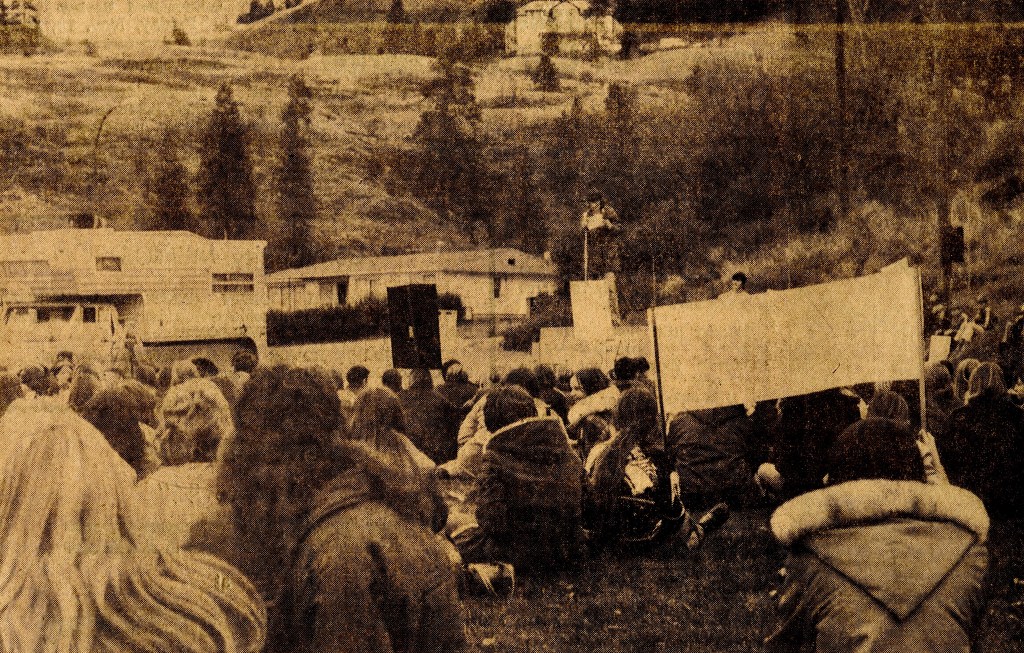
In 1971, I was 13 when I attended my first demonstration. It was about peace and the environment: opposing the third in a series of U.S. nuclear tests at Amchitka in the Aleutian Islands between Alaska and Siberia. Again today, war and ongoing failure to respect ecology bring us closer to collapse. A previous test in 1969 gave rise to the Don’t Make A Wave Committee in Vancouver. The group became the global movement Greenpeace. (Photo: an old clipping from the Summerland Review, November 1971).

Addressing the UN General Assembly a week ago, Secretary General António Guterres pointed to the two canals most vital to world trade and management of supply chains.

Trade via the Panama Canal is down 36 per cent in the past month because of low water levels – a consequence of the climate crisis. 

Trade via the Suez Canal is down by 42 per cent, since the start of Houthi attacks on shipping in the Red Sea more than three months ago. Those attacks in turn are a foreseeable consequence of the excessive – many argue “genocidal” – Israeli response to the Hamas-led attack on Israeli civilians from the Gaza strip last Oct. 7.

The Pressenza news service reports this week that for the first time on record, the average global temperature exceeded 1.5 degree Celsius over a 12-month period, according to data from the Copernicus Climate Change Service (C3S). Last month was also the warmest January globally since C3S records began in 1950, with an average air surface temperature 0.7 degrees Celsius higher than the January average from 1991 to 2020.

Meanwhile, the Atlantic Ocean system of ocean currents may already be on course to collapse, according to a new report published Feb. 9 in the journal Science Advances. Such collapse could lead to further sea level rise and cause temperatures to plunge dramatically in Europe and rise in the southern hemisphere.

A new UN report shows that about 44 per cent of migratory species worldwide are declining in population. More than a fifth of the nearly 1,200 species monitored by the UN are threatened with extinction.

In Mexico, prolonged drought led to sharp drops in production of corn and avocados last year. Lack of rainfall has affected water reservoirs used for agriculture. Across the country, water storage is at 42.7 per cent of normal, and down 34.8 per cent from 2022. This is leading producers to plant less in the winter 2023-24 season. Images from La Jornada: (left) “corn production dropped 40 per cent because of the drought;” (centre) “Monarch butterflies occupy 59.3 per cent less surface area than the previous year because of climate impacts;” (right) “Industrial activity in Iztapalapa (the east side of Mexico City) could be paralyzed for lack of water.”

In January, Mexico’s national weather service reported that 2023 was the driest in 82 years, with just 21.1 per cent of normal rainfall. Last year also saw the largest amount of land afflicted by wildfires.

The Aqueduct Water Risk Atlas has published an interactive map where you look at drought risks in any part of the planet. Half of Mexico and large parts of the western United States are in red, along with most of northern Alberta. 

Raúl Zibechi, the Uruguayan observer of social movements in Latin America, published a column recently that examined these and other risks.

“We continue to be stuck in the minuteness (‘chiquitismo’) of consumerist and narcissist daily life,” he wrote – “the latest telephone or clothing; the football game where we are merely spectators; the electoral campaign that only entertains, but does not resolve anything profound. This is the strategic triumph of capitalism: taking us headlong toward collapse while we look at the screen, ignoring the destruction and massacre of life.”

Views from Corpus Christi, Texas, June 2007. (Photos: Jim Hodgson)

In the speech by António Guterres that I noted above, he denounced the wars and ecological destruction, and offered some signs of ways forward. He spoke of A New Agenda for Peace.

“Peace is a rallying cry,” he said. “It is a call to action.” And he went on to describe the actions that must be taken: ceasefires, negotiations, addressing causes of migration, protection of species, debt and development finance, real action on climate, and reform of UN systems including the Security Council.

“We must also make peace with the planet. Humanity has waged a war we can only lose: our war with nature,” Guterres said. “For my part, I can guarantee that I will never give up pushing for peace.”

Global allies stand with El Salvador’s water defenders

by Jim Hodgson

The global allies that united to accompany communities in El Salvador in their defence of water  resources against a Canadian mining company are working together again to defend five community leaders and to ensure that a national ban on open-pit mining stays in place.

Thursday, Jan. 11 marks one year since Antonio Pacheco and four colleagues were arrested in and near Santa Marta in northern Cabañas. 

On Jan. 5, 185 academics and lawyers, and 13 organizations from 21 countries sent an open letter to the Salvadoran Attorney General calling for the case against the five to be dropped. 

The five water defenders were FMLN combatants during the 1980-1992 civil war in El Salvador and are protected, the lawyers argue, by El Salvador’s internationally-recognized Peace Agreement and the National Reconciliation Law, both signed in 1992.

The lawyers’ letter says that Salvadoran prosecutors lack evidence, but the men – released from jail in September – still face charges of murder, unlawful deprivation of liberty, and unlawful association, alleged crimes that took place 33 years ago within the context of the civil war.

Rallies to support the Santa Marta Five are happening on Wednesday, Jan. 10 in person at the above-named locations at 4 PM local time. 

Water protectors in El Salvador say the arrests are politically motivated and a strategy to demobilize strong community opposition to mining as the government of President Nayib Bukele seeks to end the 2017 national prohibition of metals mining.

“The selective violation of the National Reconciliation Law to muzzle key leaders of the anti-mining movement while stifling any meaningful attempt to bring the largest perpetrators of human rights violations during the civil war – the Salvadoran military – to justice is a telling sign of the political motivations behind this case,” says the lawyers’ letter.

The perpetrators of the largest massacres of the civil war and of several high-profile assassinations have never been prosecuted in El Salvador. A series of massacres in northern Cabañas in late 1980 and in 1981 that led the people of Santa Marta and nearby communities to flee across the Lempa River into a six-year exile in Honduras have scarcely been investigated.

Late last year, an international delegation visited Santa Marta and other parts of El Salvador to look more deeply at the charges against the Santa Marta Five and the broader context of human rights violations in El Salvador. Their report “State of Deception: Fact Finding Report on the Detained Santa Marta Water Defenders, Mining, and the State of Human Rights under the Bukele Administration, will be released Thursday, Jan. 11.  

The report will show how Bukele has – in the words of Manuel Perez-Rocha of the Institute for Policy Studies – “reduced the independence of the judiciary, violated basic human rights, suspended civil liberties, and upended the rule of law.”

The United Church of Canada (my previous employer) has two funded partners in El Salvador. In 2019, when Emmanuel Baptist Church recognized its long relationship with the United Church, two colleagues from the Santa Marta Association for Economic and Social Development (ADES) travelled from Cabañas to San Salvador to join our celebration. Shown here are: Antonio Pacheco, the ADES executive director (one of the five men arrested a year ago); Kathy Brett, a member of the United Church’s executive; former Moderator Jordan Cantwell; ADES President Vidalina Morales; and Jim Hodgson, Latin America program coordinator at that time.

Human rights groups including Amnesty International have documented severe abuses of human rights under the guise of overcoming street-gang violence. Says Amnesty: “As of October 2023, local victims movements and human rights organizations had recorded more than 73,800 detentions, 327 cases of forced disappearances, approximately 102,000 people imprisoned – making El Salvador the country with the world’s highest incarceration rate – a rate of prison overcrowding of approximately 236%, and more than 190 deaths in state custody.”

Among the most recently-targeted is Rubén Zamora, the 81-year-old former politician and diplomat who was, for many, the public face of the coalition of groups aligned against the government during the civil war. Zamora was a Christian Democrat who left his party in 1980 over its alliance with the armed forces. He was a member of congress in the early 90s, and ran for the FMLN as its presidential candidate in 2004. 

After a life-long career in politics, Rubén Zamora served as El Salvador’s ambassador to the United States in 2013-14, and then served until 2019 as ambassador to the United Nations.

Absurdly, he is accused of helping to cover up one of the high-profile massacres – El Mozote in 1981, when about 1,000 people were murdered, the largest single massacre of civilians in modern Latin American history – by being a member of congress when the abysmal 1993 amnesty law was approved. But Zamora opposed that law and refused to add his signature to it once it was approved by other legislators. (That law was overturned by the Supreme Court in 2016.)

ADES and other Cabañas organizations that support the Santa Marta Five have also called for support to Zamora. There is also an on-line petition that you can sign.

Transformation in Mexico: a work in progress

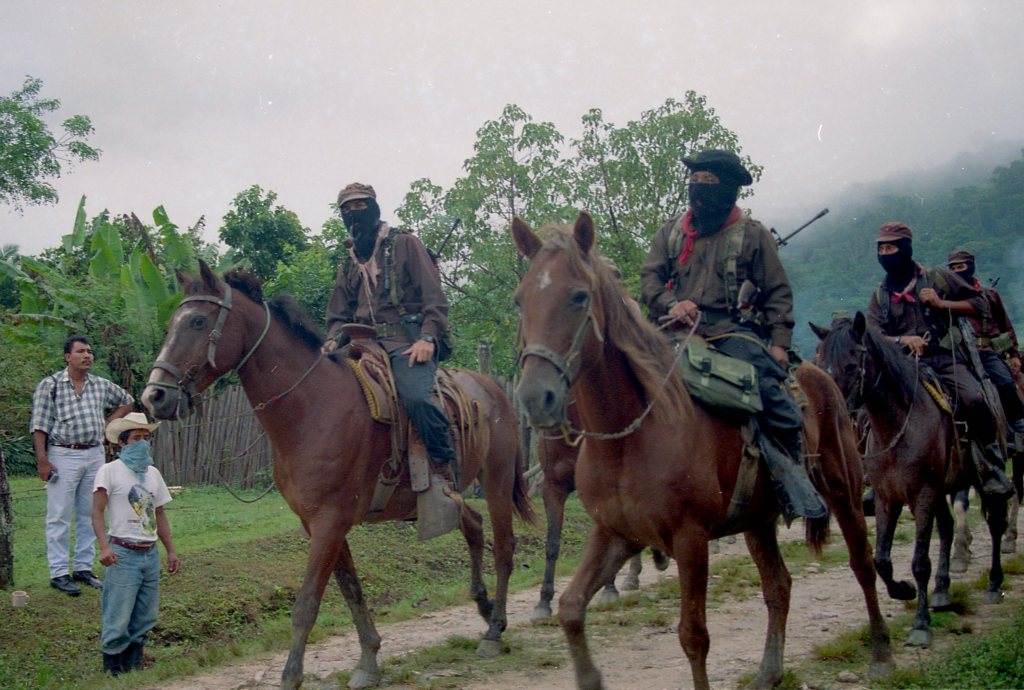
Zapatista leaders: Marcos and Moises in La Realidad, Chiapas, November 1996. Photo: Jim Hodgson

by Jim Hodgson

On Jan. 1, 1994, the same day that the North American Free Trade Agreement (NAFTA) came into effect, the Zapatista Army of National Liberation (EZLN) seized control of several cities in the highlands of Chiapas, Mexico’s southern-most state.

Within a few days, it was clear that the group was Indigenous-led and that it had a charismatic spokesperson in Subcomandante Marcos. The movement also had expectations of social transformation that extended beyond the immediate goal of improving the lot of the Maya people of the Chiapas highlands.

From mountains of southeast Mexico, the Zapatistas put forward a vision of a world where there is respect for diverse ways of being human and of organizing political life, where there might be diverse expressions of truth in the face of supposedly universal truths like the one offered by business elites about the all-powerful “invisible hand” of the free market. They invited us to imagine a world with room for all – “un mundo donde quepan muchos mundos.”

Headlines on Jan. 1, 1994: “Uprising in Chiapas,” “EZLN takes 4 cities in Chiapas”

The Zapatistas pressed for new ways of thinking about power – that leaders should obey their communities – and rejected the hegemony of political parties. The vision had a big impact on those who created the World Social Forum series of encounters that in turn have helped to transform politics in Latin America over the past quarter-century.

Zapatista communities established autonomy from other levels of government, and set about ruling themselves. In the words of a chronicler of social movements in Latin America, Raúl Zibechi, these processes “modify” how people relate to each other as they manage health, education, production, justice, celebrations, sports and art: more mutual, less expert-client, relationships.

Competing posters: Bishop Samuel Ruiz was a man “wanted” for “treason;” EZLN says, “The world that we want is one with room for many worlds.”

“Disorganized crime” and “remilitarization”

Thirty years on, the communities say they have to re-organize themselves in the face of violence between rival drug cartels – “disorganized crime,” the EZLN called them in a recent statement – that now afflicts Indigenous territories near the border with Guatemala and indeed across most of Chiapas. 

Forced displacement, said the Fray Bartolomé de Las Casas Human Rights Centre (known as Frayba), is among the most serious human rights violations in Chiapas today. In a new report launched in July, the San Cristóbal-based group said 16,755 people had been forced from their homes between 2010 and 2022. Frayba attributed the violence to actions by paramilitary groups that have afflicted the state for decades and to the newer criminal gangs, adding that the violence affects the Zapatista communities. At the same time, Frayba describes a “remilitarization” –more soldiers, more bases – in the area. 

Mexico’s Fourth Transformation

In 2018, Mexicans chose their new president, Andrés Manuel López Obrador (AMLO) on the same day as the people of Chiapas elected their new governor, Rutilio Escandón. Their party, the National Regeneration Movement (Morena), promotes a program of change they call the “Fourth Transformation” (4T), the previous three being the war of independence, the mid-19th-century liberal reforms of Benito Juárez, and the Mexican Revolution (1910 to 1917 – or through 1940, if you include the massive land reform led by Lázaro Cárdenas in the mid and late 1930s).  The 4T includes a security component: “abrazos, no balazos” (hugs, not shootings), the idea being to ensure that people have viable economic possibilities so that they do not turn to lives of crime.

More than five years into their respective administrations (and six months before the next elections), reviews are mixed. The old conservative parties loathe AMLO – “socialist!” “Chavista!” A more responsible critique comes from Indigenous people and sectors of the left that reject “neo-developmentalist” approaches that emphasize resource extraction and mega-projects for the sake of job creation – but again mostly benefit the traditional elites. Those criticisms were also levelled at all of the so-called “pink tide” governments that produced some changes over the past 25 years, but did not transform the systems of dependence on the export of natural resources. (This problem afflicts Canada too and in the face of climate change, requires urgent action.)

Despite promises, Mexico’s 4T government has not tried to implement the San Andrés Sakamch’en Agreement that was achieved in negotiations among Indigenous peoples and the government in 1996. Those talks, sparked by the EZLN-led rebellion and moderated by Bishop Samuel Ruiz, marked the first (and only) time that the government has negotiated face-to-face with Indigenous peoples. It was not a comprehensive peace deal, but rather the first step in a planned process to address Indigenous rights in Chiapas and beyond.

On June 2, 2024, voters will elect a new president and a new governor for Chiapas. These will be the sixth since the EZLN uprising. Over the years, the Zapatistas have used a variety of strategies to have an impact on Mexico’s political culture. They won’t be silent in the coming months.