Empathy: a basic element of human decency

by Jim Hodgson

Back in the late 1990s, I travelled frequently by bus over the mountains between my home in Cuernavaca and my job in Mexico City. Even when the traffic was bad, the trip usually took less than two hours. The bus company almost always showed a film.

When not working or looking at the views, including the Popocatepetl volcano, I watched the movies. I can’t guess how many movies I saw without ever seeing how they ended. My friends and I joked about organizing a Pullman de Morelos film festival, renting or borrowing some of the movies, and just watching the last half hour of all of them to see how they ended.

Among those movies was a favourite of mine, Smilla’s Sense of Snow (Bille August, 1997). The shocking death of a small boy in Copenhagen opened a tale of conflict between corporate greed and the Inuit people of Greenland. But I never saw how it ended. 

Years went by and then, in a used bookstore in Strathroy, Ontario, I found the novel by Peter Høeg on which the film was based. It’s an excellent book with a satisfying ending. 

Among parts that have stayed with me was this:

“…[W]e read Karl Marx’s Das Kapital. It was a book I grew quite fond of. For its trembling, feminine empathy and its potent indignation. I know of no other book with such a strong belief in how much you can accomplish if you simply have the will to change.” *

Hmm. Empathy as a feminine virtue? Let’s see. Google offers this definition: “the ability to understand and share the feelings of another.” 

To me, it’s a basic element of human decency. A measure of empathy is vital in action to transform the plight of those made miserable by any who abuse their power. To empathize doesn’t mean you have to agree with someone: just recognise their different circumstances. Maybe some of us would rather say solidarity.

“In a time when empathy is increasingly treated as a vice, we must not turn our backs on the world’s most impoverished,” wrote Andy Harrington after a recent visit to South Sudan. Harrington is the executive director of the Canadian Foodgrains Bank (CFGB), a Winnipeg-based NGO that enables food aid to reach people in need and communities to move toward food sovereignty. He said people are already dying because of Trump’s cuts to USAID, adding that Canadian support is more essential than ever. (Eight people in South Sudan, including five children, died as they tried to walk for three hours to seek treatment for cholera after U.S. cuts forced local health services to close, Save the Children said April 9.)

Elon Musk said recently that empathy is killing Western civilization. But it seems the far-right has been attacking empathy for a long time now. And it does so with some masculine archetypes.

MAGA influencers have begun to talk of the tariffs as a way to make the United States ‘manly’ again, by bringing old-time manufacturing and mining back,” asserts historian Heather Cox Richardson in her Substack post on April 8. In these first three months of the disastrous Trump regime in the United States, she has found her way into my daily reading as she sets current events in historical context. She adds: 

In a larger sense, Trump’s undermining of the global economy reflects forty years of Republican emphasis on the myth that a true American man is an individual who operates outside the community, needs nothing from the government, and asserts his will by dominating others.

Associated with the American cowboy, that myth became central to the culture of Reagan’s America as a way for Republican politicians to convince voters to support the destruction of federal government programs that benefited them. Over time, those embracing that individualist vision came to dismiss all government policies that promoted social cooperation, whether at home or abroad, replacing that cooperation with the idea that strong men should dominate society, ordering it as they thought best.

The Trump administration has taken that idea to an extreme, gutting the U.S. government and centering power in the president, while also pulling the U.S. out of the web of international organizations that have stabilized the globe since World War II. …

Now Trump is demonstrating his power over the global economy, rejecting the conviction of past American leaders that true power and prosperity rest in cooperation.

In less than 100 days, the Trump regime has dismantled that “liberal consensus” that at least regulated corporate excess, provided very basic social welfare, and promoted infrastructure. (This is not to ignore some of the United States’ greatest failures. Among them: slavery and Indigenous genocide, of course. But also not providing universal health care and maintaining racial segregated schools by underfunding the public education systems.)

* Peter Høeg, Smilla’s Sense of Snow, Toronto: McClelland-Bantam, 1997, pp.144-45.

Tomorrow: Karl Marx in the Rose Garden

With a dizzying array of executive orders, Trump attacks the vulnerable

The White House, February 1982, just after the inauguration of Ronald Reagan. (Jim Hodgson photo)

by Jim Hodgson

“American inauguration day was a grim business, like someone slamming a baseball bat into the concept of human decency all day long until it was bleeding and paper-thin,” wrote Heather Mallick today in the Toronto Star.
In a blizzard of speeches, insults and executive orders, Donald Trump erased anything positive about the legacy of the interregnum president, Joe Biden. “Que sigue la continuidad” (follow the continuity) is the inept slogan of a local politician in the village in Chiapas where family responsibilities have placed me for a few months, but it could well have been the title of Trump’s work plan for the day.
I started keeping a list. Eventually, my journalist brain took over. I had to make choices and prioritize. 
The one specific action that I expected with dread came in the evening: revocation of Biden’s announcement six days earlier that some of the cruel U.S. sanctions levelled against Cuba would be eased. Cuban President Miguel Diaz-Canel responded on social media late on Monday, calling Trump’s decision to revoke Biden’s measures an “act of mockery and abuse.”
Here’s my list, drawn partly from Associated Press and the Toronto Star, with additional sources as noted below. At the end, a treat: an eloquent plea for mercy spoken in Trump’s presence by Washington’s Episcopal bishop, the Right Rev. Mariann Edgar Budde.


Trump suspends U.S. foreign aid for 90 days pending reviews
Because this blog is broadly about issues related to development, let me start here: Trump temporarily suspended all U.S. foreign assistance programs for 90 days pending reviews to determine whether they are aligned with his policy goals. (From other statements, it’s pretty clear he is going after support for women’s sexual and reproductive health.) It was not immediately clear how much assistance can be affected by the order. Funding for many programs has already been appropriated by Congress and must be spent. And there are contracts that must be honoured.

Mexico is not alone in feeling nervous over Trump’s designation of cartels and gangs as “terrorist organizations.” Right: La Jornada reports that the deportations have already begun in Ciudad Juárez and Matamoros.


Trump declares a border emergency
As he had promised, Trump declared a national emergency on the U.S.-Mexico border, suspending refugee resettlement and ending automatic citizenship for anyone born in the U.S. La Jornada reported that he suspended the U.S. government’s CBP One app that asylum-seekers waiting in Mexico use to make appointments for their claim to be heard by officials on the U.S. side of the border.
Trump acknowledged an imminent legal challenge to overturning birthright citizenship, which has been enshrined in the U.S. Constitution since 1868. He said automatic citizenship was “just ridiculous” and that he believes he was on “good (legal) ground” to change it.
Rainbow Railroad newsletter, Jan. 21: Trump signed an executive order that suspended the U.S. Refugee Admission Program, halting the processing of LGBTQI+ refugees already approved for resettlement, and leaving vulnerable and displaced queer and trans individuals stranded in dangerous and precarious conditions.


Use of wartime power act to deport gang members
Trump raised the possibility of using the Alien Enemies Act of 1798 (last used during World War II to detain Japanese people) to deport gang members who are deemed members of a foreign terrorist organization. His executive order paves the way for criminal organizations such as MS-13 to be named “foreign terrorist organizations.” His government will also return “millions of foreign criminals” to their places of origin. 

Late Tuesday, Trump ordered that all U.S. government staff working on diversity, equity and inclusion (DEI) schemes be put on immediate paid administrative leave, and called for an end to the “dangerous, demeaning and immoral” programs.


Ending protection from discrimination based on gender identity or sexual orientation
Trump rescinded a 2021 order (Title IX) that the Education Department used to protect against discrimination based on gender identity or sexual orientation.
A couple of paragraphs from the Rolling Stone’s excellent coverage:
Earlier in the day, Trump declared in his inaugural address: “As of today It will henceforth be the official policy of the United States government that there are only two genders, male and female.” 
Trump intends to sign an executive order that prohibits federal recognition of transgender Americans. The anticipated order, leaked to the right-leaning Free Press, will reportedly bar government issued identification like passports from listing anything other than a person’s birth gender, remove transgender individuals from protection of laws barring sex-discrimination, end funding for transition surgeries for federal prisoners, and purport to protect the First Amendment and other rights of those who flout “preferred pronouns” or refuse to recognize the reality of transgender individuals. 

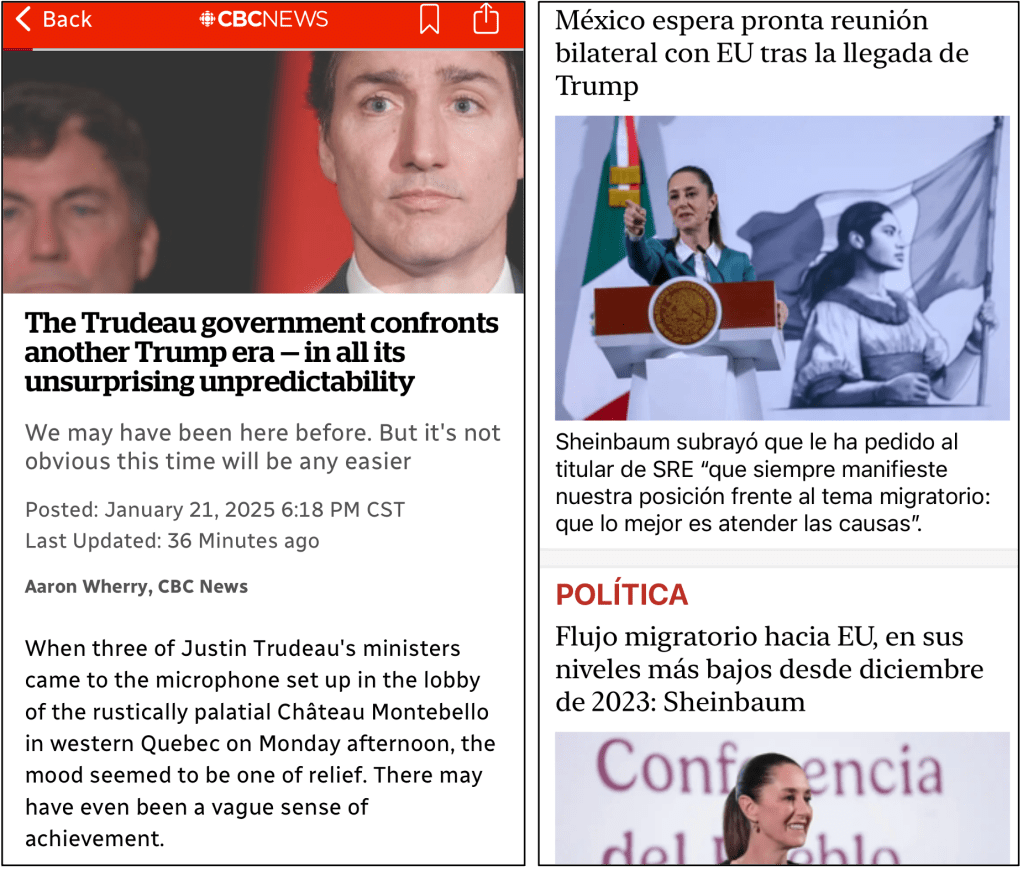
Canadian Prime Minister Justin Trudeau and Mexican President Claudia Sheinbaum and their respective ministers are preparing responses to whatever comes from Trump after Feb. 1 with regard to tariffs. Both leaders are trying to ease tension about their borders with the United States. Trump may go after China with tariffs that day too.


In addition to a federal hiring freeze, other measures include:

  • Pardons and commutations that Trump said would cover about 1,500 people criminally charged in the attack on the Capitol on Jan. 6, 2021
  • Halting 78 Biden-era executive actions
  • A regulatory freeze preventing bureaucrats from issuing regulations until the Trump administration has full control of the government
  • A freeze on all federal hiring except for military and a few other essential areas
  • A requirement that federal workers return to full-time in-person work
  • A directive to every department and agency to address the cost of living crisis
  • Withdrawal from the Paris climate treaty as Los Angeles burns [Canada’s environment minister Steven Guilbeault called the move “deplorable”]
  • Withdrawal from the World Health Organization (WHO)
  • A government order restoring freedom of speech and preventing censorship of free speech
  • Ending the “weaponization of government against the political adversaries of the previous administration”

Episcopal bishop asks Trump ‘to have mercy’ on LGBTQ+ communities and immigrants
video
Washington’s Episcopal bishop, the Right Rev. Mariann Edgar Budde:
“Let me make one final plea, Mr. President. Millions have put their trust in you, and as you told the nation yesterday, you have felt the providential hand of a loving God. In the name of our God, I ask you to have mercy upon the people in our country who are scared now. There are gay, lesbian, and transgender children in Democratic, Republican, and independent families, some who fear for their lives. The people who pick our crops and clean our office buildings, who labor in poultry farms and meatpacking plants, who wash the dishes after we eat in restaurants and work the night shifts in hospitals, they may not be citizens or have the proper documentation, but the vast majority of immigrants are not criminals. They pay taxes and are good neighbors. They are faithful members of our churches and mosques, synagogues, gurdwara, and temples.
I ask you to have mercy, Mr. President, on those in our communities whose children fear their parents will be taken away, and that you help those who are fleeing war zones and persecution in their own lands to find compassion and welcome here. Our God teaches us that we are to be merciful to the stranger, for we were all once strangers in this land. May God grant us the strength and courage to honor the dignity of every human being, to speak the truth to one another in love, and walk humbly with each other and our God, for the good of all people, the good of all people in this nation and the world. Amen.”

A day later, Trump called the bishop a “Radical Left hard line Trump hater,” “ungracious,” “nasty” and “not compelling or smart.”

U.S. wins trade dispute, forces Mexico to end GM corn restrictions

by Jim Hodgson

A trade dispute panel has ruled against Mexico’s restrictions on the use of genetically modified (GM or genetically engineered) corn, siding with the United States in forcing Mexico to allow the use of GM corn for food. Canada backed the U.S. position. 

The decision, announced Friday afternoon, Dec. 21, is another demonstration of how free trade agreements are used to undermine policy options made in the public interest.

Mexico City’s La Jornada daily newspaper contains an excellent series of articles today about the consequences for Mexican agriculture of 30 years of free trade with the United States and Canada; climate change is another factor in the fall of production.

In Mexico, a coalition of 300 farming, Indigenous and environmental groups said the Mexican government should not modify its policy and called on civil society organizations to maintain their defense of native varieties of corn. 

The Sin Maíz no hay País (“Without Corn There is no Country”) group told La Jornada that the decision is designed “mostly to protect the interests of transnational corporations, instead of giving priority to the rights of the Mexican people or to sustainability of the environment.”

The trade panel, they added, was made up of three experts in international trade who were not “scientists or experts in public or environmental health” and had no “legitimacy or capacity to evaluate measures taken by a country that were intended to protect its population, preserve its biocultural richness and safeguard the genetic reservoir” of corn.

La Jornada editorial said the administration of President Joe Biden “fought a legal battle against food sovereignty, health, biodiversity, and the right to an adequate diet for Mexicans—not to favour its citizens, but rather four giant global corporations and a handful of rich farmers.”

The Mexican government said it would comply with the decision though it maintains that the restrictions are in line with the principles of public health and the rights of Indigenous peoples, established in national legislation and in the international treaties to which it is a party. On Feb. 13, 2023, Mexico published a Presidential Decree that included stopping the use of GM white corn intended for use in traditional foods such as tortillas and stated Mexico’s intention to eventually replace all GM (yellow) corn in processed food.

The United States challenged Mexico’s restrictions under the Canada-United States-Mexico trade agreement (referred to variously as USMCA or CUSMA) as being a disguised trade restriction. The restrictions were first announced by then-President Andrés Manuel López Obrador at the end of 2020, and revised in 2023.

“This trade panel decision runs counter to a national consensus in Mexico on the threat of GM corn to Mexico’s food sovereignty,” said Cathy Holtslander of the National Farmers Union (NFU) in Canada. “The people of Mexico have the right to protect their unique relationship with corn.”

Holtslander’s comments are included in a Dec. 23 joint news release from the NFU, the Canadian Biotechnology Action Network (CBAN), the Canadian Centre for Policy Alternatives and the Trade Justice Group of the Northumberland Chapter of the Council of Canadians.

“Canada joined the US challenge to force open an unwilling market to genetically modified corn,” said Lucy Sharratt of CBAN.

“This outcome demonstrates how free trade agreements can be used to overthrow democratic decisions for corporate interests,” said the joint news release.

The 117-page decision did not assess the scientific evidence on GM corn provided by Mexico but concluded that Mexico did not conduct a risk assessment that conforms to the terms of the trade agreement. “The Panel recommends that Mexico bring its Measures into conformity with its USMCA obligations under Chapters 2 and 9 of the USMCA. The Panel accepts that Mexico is seeking to address genuine concerns in good faith, and suggests that such concerns be channeled into an appropriate risk assessment process, measures based on scientific principles, and in dialogue among all USMCA Parties to facilitate a constructive path forward.”

“Mexico’s GM corn policy was clearly meant to achieve several goals at once, such as supporting biodiversity, cultural diversity, food sovereignty, Indigenous Peoples’ rights, public health and economic development,” said Stuart Trew, senior researcher with the CCPA. “It is disingenuous for the trade panel to claim the policy is a ‘disguised restriction on trade’ simply because it may affect imports of U.S. or Canadian corn. But doing so conveniently allowed the panel to sidestep Mexico’s strong defence of the GM corn restrictions based on environmental and Indigenous Peoples’ rights exceptions in CUSMA.” 

Canada does not export any corn to Mexico. In explaining its decision to back the U.S. complaint, the government of Canada stated that, to secure a future for genetically modified organisms (GMOs) in Canada and to prevent trade disruptions due to illegal GMO contamination, product developers need access to all markets.

Mexico is regarded as the birthplace of modern corn. It will continue to prohibit planting of GM corn because it may contaminate native strains of the grain. 

Mexico is the top foreign buyer of U.S.-grown yellow corn, nearly all of which is genetically modified. Half of the corn consumed in Mexico today is imported from the United States. The imports are mostly of “yellow corn,” used for animal feed and industrial food production. “White corn” produced in Mexico is used for human consumption.

Mexico has more than 60 native varieties of corn (known as landraces), coming in a variety of colours and with distinct flavours.

In April 2024, CCPA provided an excellent background analysis of the GM corn dispute.

CBAN has joined with US and Mexican groups to issue a new call to action: Groups and individuals in Canada, the US and Mexico are asked to sign a trinational statement in solidarity.