Venezuela in the wake of quakes, kidnapping and theft of its assets

by Jim Hodgson

I begin with a confession. In the wake of the catastrophic double-tap earthquakes that struck Venezuela on June 24, I have been slow in sharing my thoughts and what I have learned.

My delay is partly due to memories of other disasters, especially my involvement in efforts to rebuild in Haiti after its 2010 earthquake. 

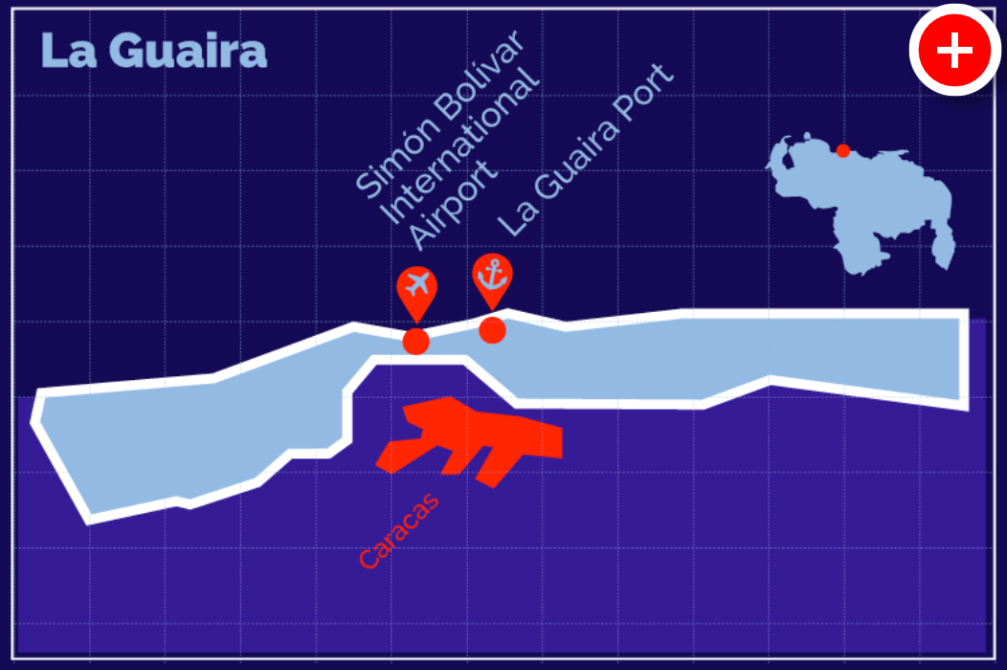
I am also remembering visits in better moments to the area most affected by current calamity: the north coast communities in La Guaira state. It’s the Caribbean Sea, so there are hotels, beaches, pools, yacht clubs and high-rise condominiums, as well as homes for the people who work in the airport, the seaports, and in fishing and service industries.
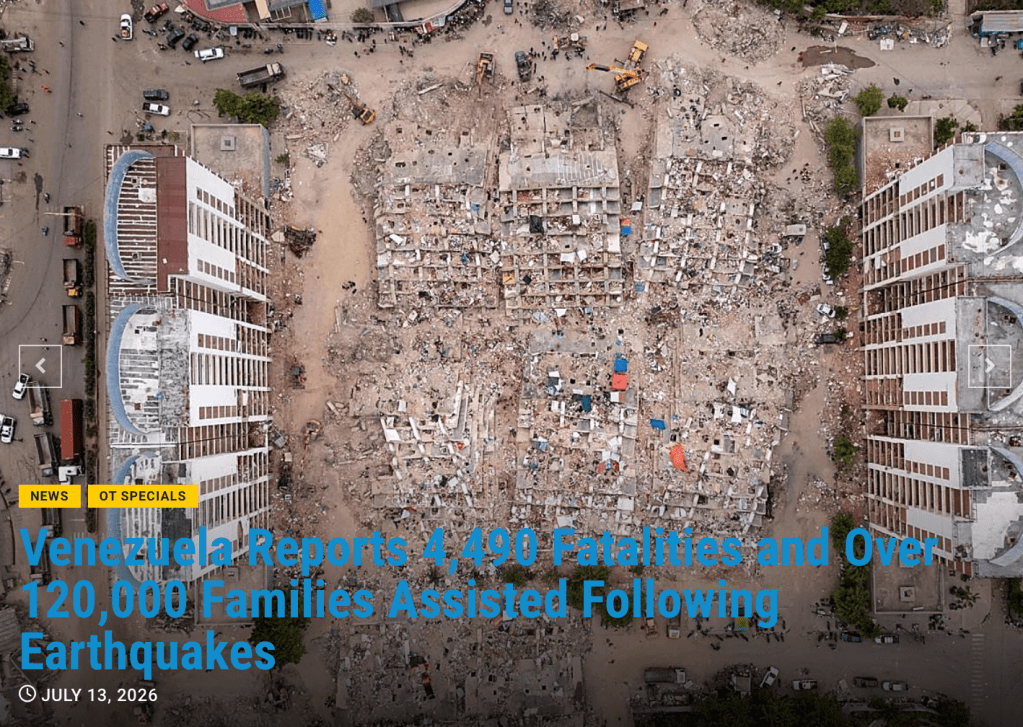
The disaster has slipped from Global North headlines. As of Wednesday, July 15, the official death toll had risen to 4,829 (up from the number shown in the above graphic). The number of reported injuries remained stable at 16,740. (Image: Orinoco Tribune, July 13)

If you travel to Venezuela by air, odds are you arrive in La Guaira at the Simón Bolívar International Airport (often called Maiquetia for a nearby community). Caracas, the capital, is a 25-km drive south and high up into the mountains.

On two of my trips to Venezuela, I observed elections in Caracas and La Guaira. In 2004, an opposition attempt to remove then-President Hugo Chávez proceeded through a revocatory referendum. An election in 2018 (boycotted by part of the opposition) returned President Nicolás Maduro to office. (I wrote about the latter experience in a series of articles for rabble.ca.) 

The day before the 2018 vote, we spent an afternoon visiting communities in La Guaira, including a new social housing project, “Urbanización Hugo Chávez,” located in Catia La Mar just beyond the west end of the airport.

In the wake of the earthquakes, it feels like every building in Guaira has become a point of contention in Venezuela’s polarization. While the government says only five per cent of the damaged buildings are newly built housing, this natural disaster is politicized: something known to happen elsewhere, as in the current wildfire season in Canada. 

But whether you are looking at a pancaked high-rise or a home dislodged from its foundation in a social housing project, people needed to be rescued and survivors still need support.

Economic and social context

To understand what happened in the immediate aftermath of the earthquake, “it’s necessary to place the place the tragedy in its economic and social context,” wrote La Jornada’s Ángel González from Caracas. 

“Venezuela has spent years with a public health system that has not been able to reach optimal conditions after 11 years under U.S. sanctions. That led to a reduction of more than 90 per cent in the budget for public health and education (with 80 per cent of the overall budget allocated to social welfare programs).” Moreover, sanctions prevented the government from buying parts for heavy equipment or new machinery needed for an emergency such as this.

Even so, within a few days, added González, the situation in La Guaira had begun to be addressed with field hospitals set up by the Venezuelan army and international brigades. Two weeks later, temporary shelters with services for more than 22,000 people were in place. About 18,000 people are left without a home.
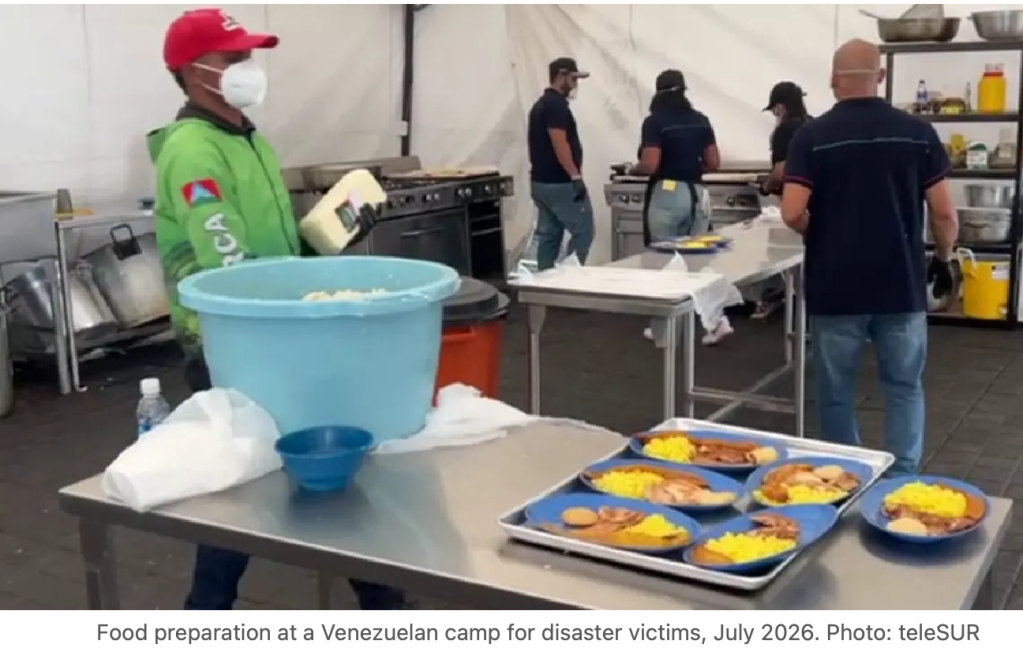
Acting President Delcy Rodríguez announced July 8 that her government was already working with experts to identify appropriate areas to “build new earthquake-resistant homes and cities.” She added that local and international companies had also been called up “for the rapid and aggressive construction of housing.” That will take time. And money.

And here again, politics enter in. While rescue missions and immediate relief efforts shift to longer-term support and re-building, U.S., Canadian and European sanctions must be eased and Venezuelan assets held abroad must be unblocked.

I have witnessed the humanitarian consequences of sanctions that are misused in cruel attempts to induce regime change in Venezuela, Cuba and other countries, and so have searched almost in vain for news articles that mention sanctions. One exception is an AP News item July 9 that covered the president’s housing announcement. Rodríguez said she had “decided to send a letter, among others, to the King of England” to request the release of 31 metric tons of Venezuelan gold reserves frozen at the Bank of England due to economic sanctions. The gold, valued at USD $1.2 billion in 2019, is now worth about $4.6 billion.

I’ll share more about the use and misuse of sanctions in Venezuela and elsewhere in another post in days ahead.

Meanwhile, you might like to read this op-ed by Mark Weisbrot published in the Los Angeles Times and on the site of the Center for Economic Policy and Research. Sanctions, he writes, “target and punish the civilian population in pursuit of a political goal. Once relatively rare, they have become a ‘tool of first resort, according to the US Treasury — probably because the resulting fatalities are mostly unseen.”

And, to my surprise, there is a relatively good piece in The New York Times about U.S. Secretary of State Marco Rubio acting as Venezuela’s de facto viceroy. I think this link will take you past the paywall to the article.
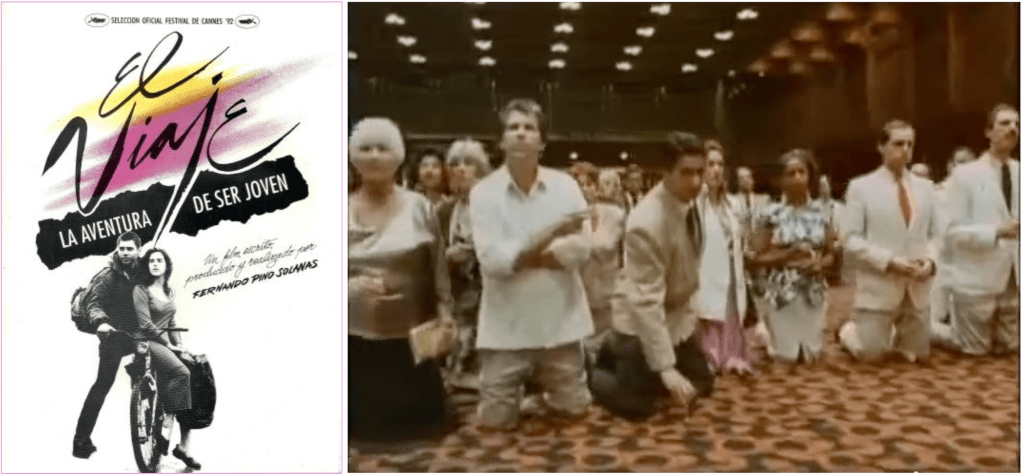
The Shield of the Americas: a summit of nations on their knees

by Jim Hodgson

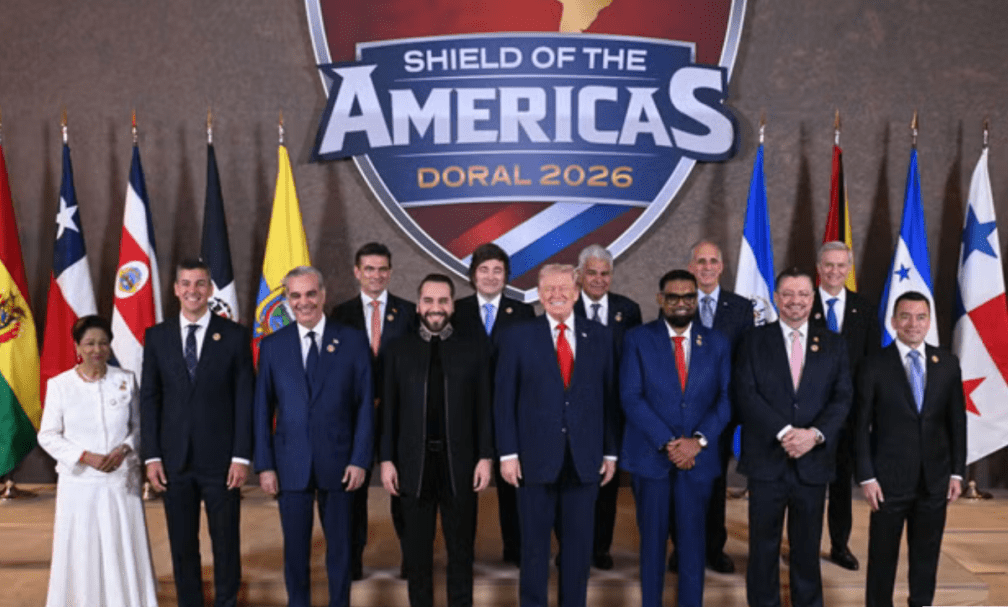
Leaders of a dozen Latin American and Caribbean nations spent a few hours last week with President Donald Trump at one of his golf courses near Miami. This was the launch of the “Shield of the Americas,” a bloc of right-wing governments that have pledged to join Trump’s war against so-called “narco-terrorism.”

The spectacle recalled for me a 1992 film, El Viaje (The Journey), by Argentinian director Fernando “Pino” Solanas. It won prizes at film festivals in Cannes and Havana, and I saw it in Toronto.

El Viaje satirizes the way Latin American governments in the 1980s and 90s knelt before the rich countries for the sake of debt forgiveness, implementing austerity programs that harmed their own people. One scene (above right) shows a meeting of the Organización de Países Arrodillados (the Organization of Countries on their Knees). You can see a clip on Facebook.

In Miami, the leaders plainly knew that their face time with Trump was squeezed out from his preoccupation with his ill-conceived and unpopular war on Iran. They even applauded his insults: “I’m not learning your damn language,” said Trump. “I don’t have time.”

Beyond the farce, however, there is harsh reality to be faced. 

Trump called for an “anti-cartel coalition” that would use military might to “eradicate” drug cartels. A day earlier, his “war secretary,” Pete Hegseth, warned representatives from 16 countries in the region that if they didn’t adopt more aggressive strategies against drug cartels, the Trump regime would do it for them. Hegseth urged the countries to remain “Christian nations, under God, proud of our shared heritage with strong borders,” and not to be led astray by “radical narco-communism, anarcho-tyranny… and uncontrolled mass migration.”

Since his return to power 14 months ago:

Trump’s threat at the summit to “take care of” Cuba drew an immediate response from Havana. President Miguel Díaz-Canel wrote on X:

“The little reactionary and neocolonial summit in Florida, convened by the United States and attended by right-wing governments from the region, commit themselves to accept lethal use of U.S. military force to resolve internal problems of order and tranquility in their countries.”

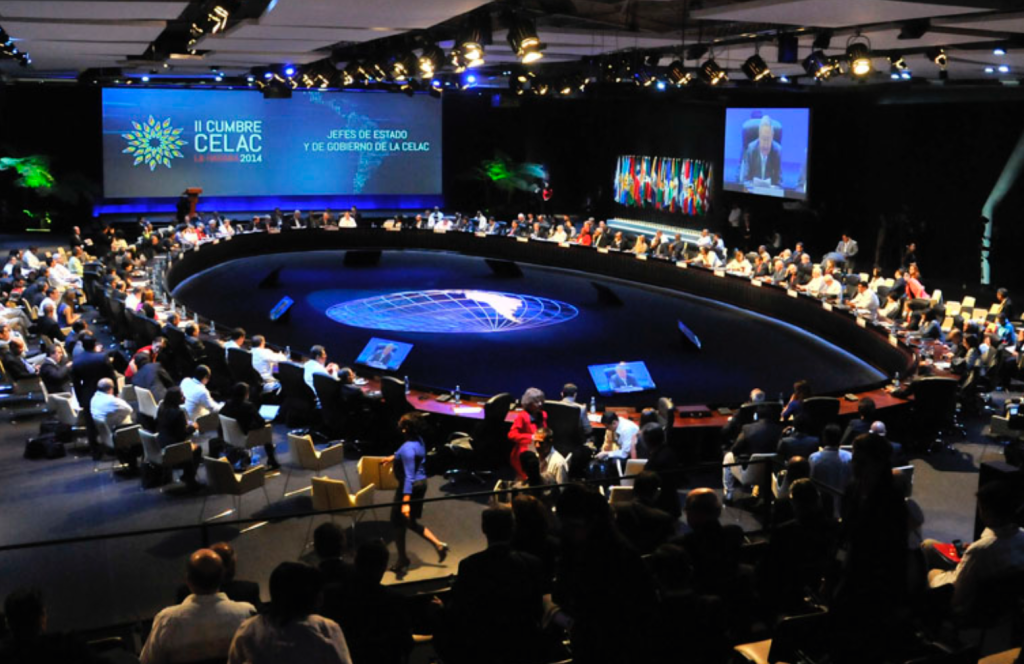
Díaz-Canel said the summit was an attack on the 2014 proclamation of Latin America and the Caribbean as a Zone of Peace, a declaration signed in Havana (photo above by René Pérez Massola.) The summit, he added, also attacked “aspirations for regional integration” and was “a sign of their willingness to subordinate themselves to the interests of the powerful nation to the north.”

Cuba’s foreign minister, Bruno Rodríguez, said the Miami summit was “a clear and dangerous setback in the long and difficult process of independence for the peoples of Latin America and the Caribbean.”

In his speech, Trump said that Mexico was the “epicentre” of drug-trafficking. The cartels, he said, “are getting worse and taking over the country. The cartels are running Mexico. We can’t have that. Too close to us, too close to you.”

Hours later, President Claudia Sheinbaum, pleaded for “cabeza fría” (cool heads) as Mexico determines its next moves – all (like Canada) under the pressure of new free trade talks with the United States.

A few days before the summit, Costa Rica’s president-elect, Laura Fernández, called Mexico “a reference point for where we do not want to go” regarding violence, organized crime and drug-trafficking. She was the minister of national planning and economic policy under the out-going president, Rodrigo Chaves. Chaves attended the Sheild summit, not Fernández, but her comment got attention in Mexico.

In an editorial, the daily newspaper La Jornada said that if Fernández wants to avoid the suffering experienced in Mexico over the past two decades, she should bear in mind that the crisis of insecurity was launched by a politician of the same ultra-right current that she represents. After his election in 2006, President Felipe Calderón began Mexico’s war on drugs by:

“opening the country to U.S. spy agencies, subordinating national interests to those of Washington, ignoring the social and economic roots of the crime phenomenon, and declaring a war against his own citizens. The violence of the state became a criterion for measuring success. The lessons of the Calderón years are important to for the other governments (and the governed) that still see or pretend to see the White House ‘war on drugs’ as an offensive against criminal structures and not the mechanism of imperial domination that it is.”

Trump says U.S. is ‘starting to talk with Cuba’ even as he tries to block oil imports

by Jim Hodgson

In the face of U.S. President Donald Trump’s threats to impose new tariffs on any nation that exports oil to Cuba, we all need to stand firm. Here are two ways to send messages to Canadian leaders.

First, the Take Action proposed by Canadian churches, trade unions and NGOs. Yes: it pre-dates the current crisis, but its message is vital. Canada cannot be silent.

Second, the Canadian Network on Cuba has an on-line petition to Canadian parliamentarians. It too pre-dates the immediate crisis, but is still an important means to communicate.

Of course you can write your own letters to leaders in whichever country you live.

Take heart from increasingly strong messages from Mexican President Claudia Sheinbaum.

Today, she denied Trump’s claim a night earlier that they had talked about Cuba, much less that he had asked her to stop sending Mexican oil to Cuba and that she would comply.

La Jornada

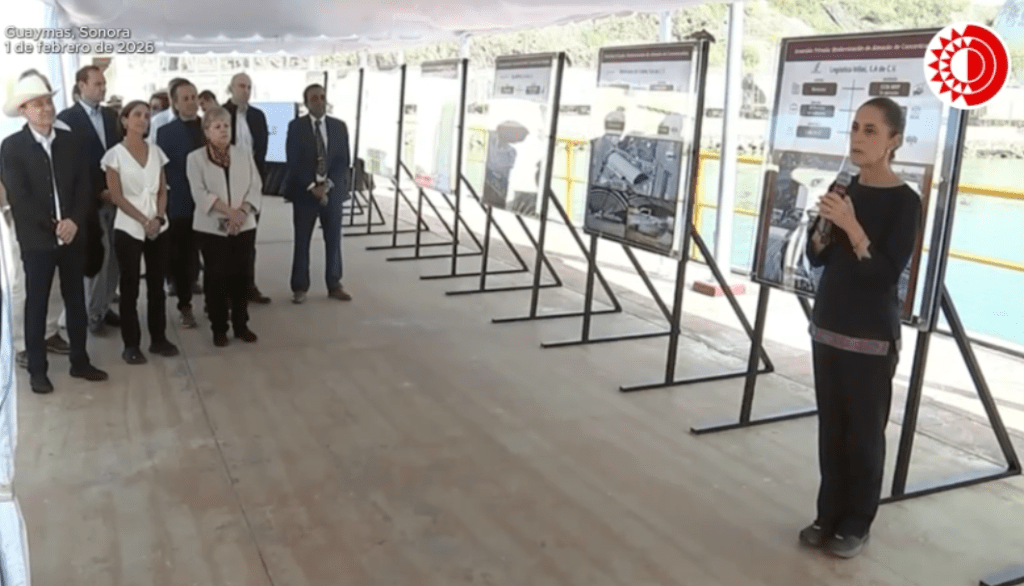
The only such conversation, she said while travelling in Sonora state, had been between her foreign affairs secretary, Juan Ramón de la Fuente, and U.S. Secretary of State Marco Rubio. Sheinbaum has said several times this week that her country will continue to send humanitarian aid including oil to Cuba. Various sources report that Cuba has only enough oil to satisfy needs for another 15 to 20 days.

For his part, de la Fuente told Mexican legislators today that Mexico considers it “unacceptable that there not be humanitarian aid where it is needed, when some country in the world requires it.”

Saturday night, while travelling from Washington DC to his home in Florida, Trump said the United States was beginning to talk with Cuban leaders. (There is no confirmation as of Sunday evening from Cuba that such talks have begun.)

In comments to reports on Air Force One, he added: “It doesn’t have to be a humanitarian crisis. I think they probably would come to us and want to make a deal,” Trump said Saturday. “So Cuba would be free again.”

He predicted they would make some sort of deal with Cuba and said, “I think, you know, we’ll be kind.” (U.S. interventions since 1812 have not been known for their kindness.)

The comments follow more than six decades of U.S. sanctions aimed at inducing regime change in revolutionary Cuba, the kidnapping four weeks ago of Venezuelan President Nicolás Maduro, and Trump’s threat to impose tariffs on any country that continued to sell oil to Cuba. 

On Wednesday night, Jan. 29, he declared a “national emergency” to protect “U.S. national security and foreign policy from the Cuban regime’s malign actions and policies.”

Granma photo: Ricardo López Hevia

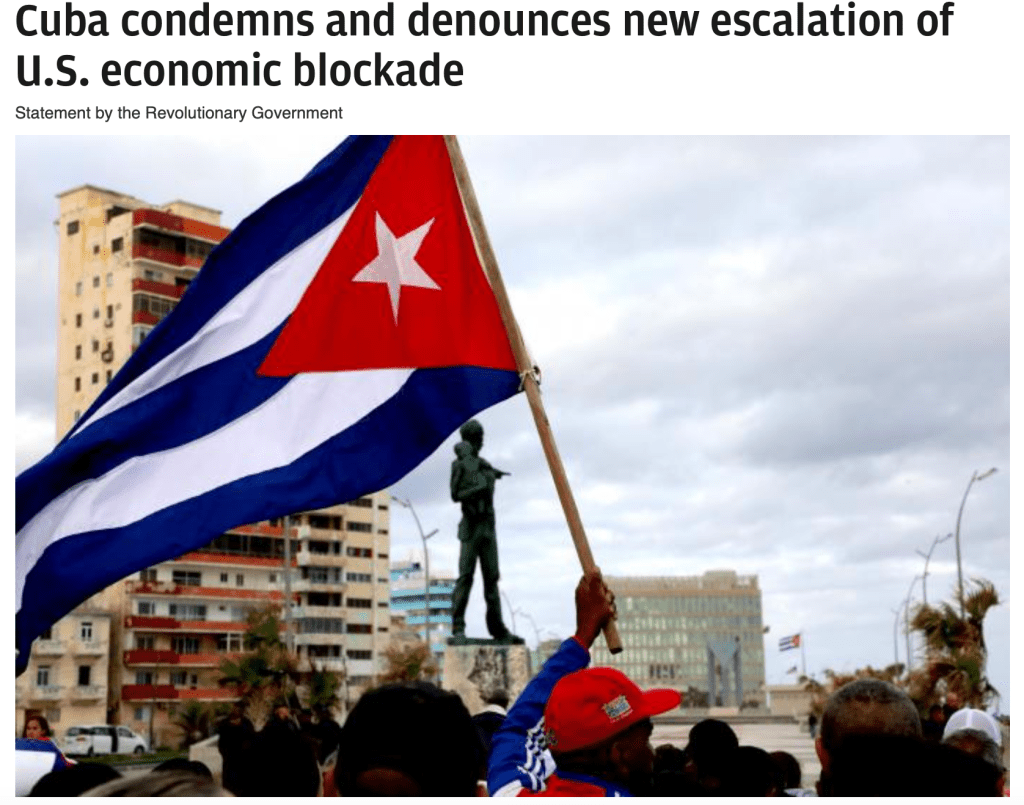
Cuban leaders have condemned and denounced this new escalation of the “U.S. economic blockade.”

“Surrender will never be an option, and hard times like these must be faced with courage and bravery,” said President Miguel Díaz-Canel Saturday.

The Trump regime’s tactic of confiscating Venezuelan oil tankers has worsened a fuel and electricity crisis in Cuba. The Cuban people face rolling blackouts and struggle to cope without reliable fuel and electricity supplies.