Trump revives “big stick” approach to Latin America

by Jim Hodgson

With all of my passion for justice and in the face of so many gross injustices, I can get paralyzed. And with Trump in power next door, there is always something new to distract us from what went before or from demanding freedom for captives or the release of the #EpsteinFiles.

Just today, he threatened Canada again. #ElbowsUp, still.

Yesterday, it was a plan to end Israel’s war in Gaza that even the New York Times admits “checks every box on Israel’s wish list.” It does nothing to strengthen Palestine or assist recovery after the genocide, and will impose a new, colonial-style authority on the people. 

Let’s step back for a moment.

Last week, I was going to write about Trump’s efforts to rescue his far-right cronies in Argentina and Brazil. Here’s a short version.

Argentina’s president, Javier Milei, faces a collapsing peso and political setbacks. Milei’s chainsaw approach to slashing government was a model for Trump and Elon Musk. U.S. Treasury Secretary Scott Bessent said Sept. 22 that Washington is ready to do “whatever is necessary” – from central bank swaps to direct peso purchases or buying Argentine debt through the Treasury’s Stabilization Fund. The moves are intended to ease political opposition to Milei that has grown as the economy collapses. Milei – already dependent on a $20 billion IMF package – sought U.S. support ahead of congressional elections in October. Investors have been pulling money out from Argentina since Milei’s party lost an election in Buenos Aires province on Sept. 7, provoking worry that he will soon lack legislative support to advance his agenda. 

Front-page of a Buenos Aires newspaper shows Trump managing the rescue plan for Argentina’s Milei. Right: response from Occupy Democrats.

Earlier, Trump imposed a 50% tariff on goods from Brazil, claiming that Brazil engages in unfair trade practices and that the government is engaged in a “witch hunt” against Trump’s ally, former president Jair BolsonaroBolsonaro was convicted earlier this month of attempting a coup after voters dumped him from office. He was sentenced to more than 27 years in prison, sparking Trump’s ire. The present Brazilian government called the U.S. move “a new attempt of undue interference in Brazilian internal affairs.”

When he spoke of the U.S. rescue of Argentina’s Milei, Bessent told reporters that the Trump administration hoped to solidify what it sees as a rightward shift in Latin American countries, including potentially Colombia. (Colombia is now government by a left-centre coalition led by President Gustavo Petro, who cannot succeed himself. His party is currently selecting a new candidate.) 

New and old threats

Bessent’s move came hours before Trump took centre stage at the United Nations General Assembly to press his MAGA-style policies on the rest of the world. 

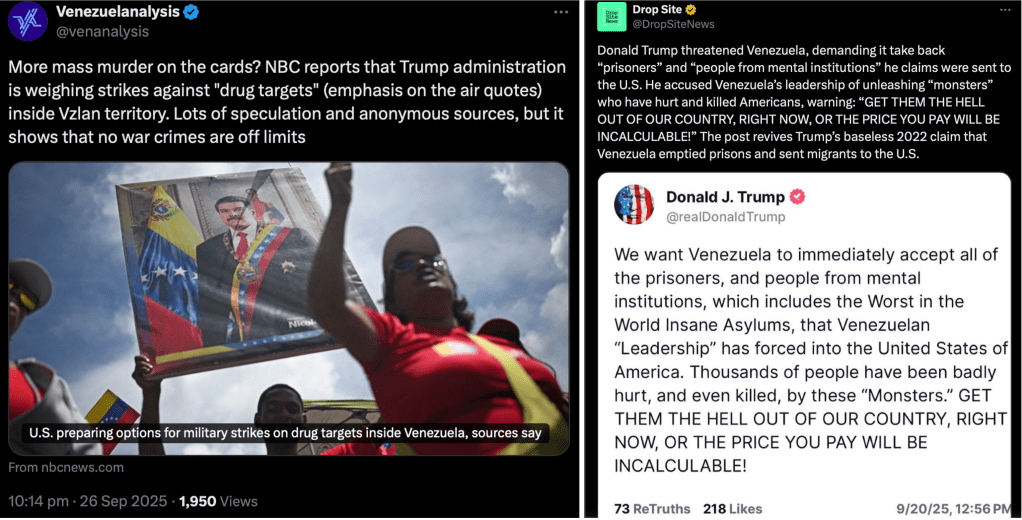
In the speech, Trump threatened to “blow out of existence” Venezuela’s president, Nicolás Maduro. Maduro responded with a plan to declare a state of external unrest to enable rapid mobilization in defence of Venezuela. He had earlier sent a letter to Trump, proposing direct talks. When asked about the letter, White House press secretary Karoline Leavitt, said it was “full of lies” and said the administration still views Maduro as an “illegitimate leader.”

Trump’s threat came after he moved warships into the south Caribbean and after recent attacks on Venezuelan fishing boats (alleged without evidence to be carrying drugs). Trump and his minions seem determined to revive the worst applications of U.S. foreign policy in Latin America, from the 19th-century Monroe Doctrine to Teddy Roosevelt’s “big-stick” diplomacy in the early 20th century.

A recent US government document revealed the Trump administration plans to redirect $1.8 billion in foreign aid toward a new “America First” strategy, Reuters news agency reported Sept. 24. It would give priority to neutralizing “Marxist, anti-American regimes” in Latin America. The report said $400 million would support activities to end illegal immigration to the US, counter China, and “confront the Marxist, anti-American regimes of Venezuela, Cuba and Nicaragua.” The document, known as a Congressional Notification, follows news that the upcoming National Defense Strategy will also pivot the U.S. away from a focus on adversaries like China and Russia to instead prioritize efforts in the Americas.

But not everyone serving Trump is onside with these approaches. On Sept. 29, the Washington Post reported that eight current and former officials have said there is a deep rift between the political appointees at the Pentagon and the military leaders there. Reflecting on the Post report, historian Heather Cox Richardson said that War Secretary Pete Hegseth “is withdrawing forces from Europe, reducing the concentration of power and consolidating commands abroad while focusing on using the military in the U.S. and neighboring countries.

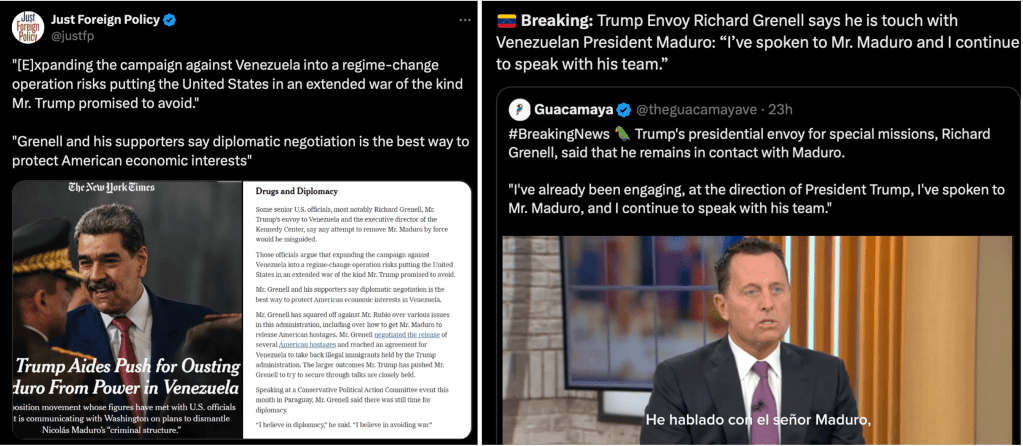
Among Trump administration opponents to use of force to provoke regime change in Venezuela is Richard Grenell, Trump’s special envoy to the country, said Drop Site News on Sept. 29. Grenell has successfully re-opened channels for export of Venezuelan oil to the United States. Grenell and his supporters say diplomatic negotiation is the best way to protect U.S. economic interests. Among those who oppose Grenell is U.S. Secretary of State Marco Rubio. 

Gunboats follow sanctions in U.S. strategy for regime change in Venezuela

by Jim Hodgson

U.S. claims to have bombed a supposed “drug vessel” in the southern Caribbean were met with considerable scepticism and calls for action to stop an invasion.

Action suggestion from the Alliance for Global Justice (AFGJ): Please send an email to UN Secretary General António Guterres asking him to intervene to stop a possible U.S. invasion of Venezuela.

“Earlier this morning [Tuesday], on my Orders, U.S. Military Forces conducted a kinetic strike against positively identified Tren de Aragua Narcoterrorists in the SOUTHCOM area of responsibility,” President Donald Trump said in a Truth Social post. “The strike occurred while the terrorists were at sea in International waters transporting illegal narcotics, heading to the United States. The strike resulted in 11 terrorists killed in action.”

He added that TdA is a “foreign terrorist organization” that operates under the control of Nicolás Maduro, Venezuela’s president.

Mexico’s La Jornada shared Images of the U.S. boat attack

Neither Trump nor the video showed any proof that the boat was carrying drugs, nor that it came from Venezuela, nor that it had anything to do with TdA, much less that its destination was the United States. There is no indication of who the crew was. Why would 11 people be on a small boat that is supposedly carrying a large amount of drugs? Could they have been migrants? Human traffickers? It’s more common that such craft are stopped and searched. If anything is found, arrests follow. Not summary executions.

On social media, Venezuelan news outlet Venezuelanalysis speculated on how U.S. SOUTHCOM knew the small boat was carrying drugs without carrying out an inspection. On Monday, President Maduro said his country was at “maximum preparedness” and denounced the expanded U.S. military presence in the Caribbean as, “an extravagant, unjustifiable, immoral and absolutely criminal and bloody threat.”

In Colombia, President Gustavo Petro said he doubted the veracity of the U.S. claim. “We have spent decades capturing civilians who transport drugs without killing them.”

In Mexico, where Trump’s secretary of state Marco Rubio arrived Monday night, news of the attack was felt to be a warning to President Claudia Sheinbaum about methods the United States might use in its effort to dismantle Mexican cartels.

In previous weeks, the United States had deployed as many as eight warships, a nuclear-powered submarine and 4,500 troops as part of Trump’s anti-drug cartel operation, projecting military force into the Caribbean Sea. Among useful news analyses: The Cradle (left, a publication usually focused on events in West Asia). Newsweek (right), unusual among mainstream U.S. media is sharing multiple articles about a new “Trump Doctrine.” It’s similar in effect to the Monroe Doctrine, ostensibly about curbing European influence in the Americas, but used to justify U.S. interference in Latin America and the Caribbean since 1823.

In March, Trump used the Tren de Aragua myth as a justification to justify the extraordinary rendition of young Venezuelan men to El Salvador. A New York Times article in April showed that Tren de Aragua is not invading the United States. Nor is it a “terrorist organization,” and to call such “criminal groups terrorist is always a stretch since they usually do not aim at changing government policy.” The article goes on to show that Tren de Aragua is not centrally organized, much less that it colludes with the Maduro government. 

Maduro said in March that TdA “no longer exists; we defeated it.” The Venezuelans held in El Salvador were finally returned home in July.

Left: Chevron is once again moving Venezuelan oil to the United States. Right: President Nicolás Maduro speaks with foreign reporters.

This new chapter in Venezuela’s drama plays out in the context of historic U.S. refusal to accept the development in this hemisphere of a political and economic model other than the capitalist one. Since 1998, Venezuela has embarked upon a “Bolivarian Revolution” (named for Simon Bolivar, the hero of the 19thcentury independence struggle) and intended to break capitalist hegemony over every aspect of the lives of the people.

Since 2005, U.S. administrations have made the annual determination that Venezuela has “failed demonstrably to adhere to its obligations under international narcotics agreements.” A year later, the United States began applying sanctions (“unilateral coercive measures,” the UN calls them). These and other measures have been strengthened since 2015, eventually driving a severe economic crisis and exodus of millions of people who sought better opportunities elsewhere.

In this second Trump administration, some see incoherence. On the one hand, ongoing verbal threats and this military build-up. On the other, easing of sanctions to allow Chevron to import Venezuelan oil to the United States. Conjecture persists about the relative influence of corporations like Chevron that want back in, the south Florida Venezuelans and Cubans who are Rubio’s constituency, and the isolationist sector of the Trump-MAGA base that wants out of all foreign wars.

Justice denied: U.S. sends Venezuelan asylum-seekers to Salvadoran prison

Even in the face of the Trump regime’s horrific arrests, extraordinary renditions, and forced disappearances of immigrants and asylum-seekers, there are shreds of hope.

Activists and journalists are gradually identifying and sharing the stories of victims, including the 238 Venezuelans and 23 Salvadorans shipped to a prison in El Salvador on March 15. And judges and some politicians are more vocal in support of “due process”—the U.S. constitutional guarantee of at least being heard before being deprived of liberty—for all migrants.

One group has built a website: thedisappeared.org. They make prominent use of the blue triangle, the symbol used by Nazis in their concentration camps to designate migrants. About the 238 Venezuelans, they say: “There is no evidence to support the allegations that they are hardened criminals.” The group also posts on Facebook.

Above on the left is Andry Hernández Romero, age 31. I learned of his case the way many others did. A photojournalist, Philip Holsinger, met the airplanes that brought the Venezuelans to El Salvador and then accompanied them to the prison. A man who caught Holsinger’s attention shouted “I’m innocent” and “I’m gay,” and was crying as his head was shaved. From Holsinger’s photo, friends and family members identified him as Andry. Details of his situation were covered first in LGBTQIA+ media (The Advocate and the Washington Blade) and later by NBCCBS and elsewhere. His lawyer has mobilized political support in California, including that of Gov. Gavin Newsom and U.S. Rep. Robert Garcia.

The disappeared.org site draws attention to many other cases, including that of two-year-old Maikelys Antonella Espinoza Bernal (below) whose father, Maiker Espinoza Escalona, was sent to the prison in El Salvador. She and her mother Yorely Bernal Inciarte, were supposed to be sent together on a deportation flight back to Venezuela—part of her homeland’s “Vuelta a la Patria” program for citizens willing to go home. But the United States refused to return the child to her mother before she left.

When Yorely arrived back home alone, Venezuelan media and the government took up the family’s cause (image on the left, above). So too did CodePink (right), a women’s peace network in the United States with which I have collaborated to draw attention to the negative impact on Venezuelans of U.S. economic sanctions

The Disappeared shared a piece from a group called United Strength for Action about the U.S. role in creating the disaster that Venezuelans face. I can’t concur with all the group said–many people in the United States just can’t see the historical context of U.S. imperialism–but I am relieved that they at least acknowledged the role of U.S. sanctions in creating a humanitarian crisis that drives the exodus of refugees. “This wasn’t foreign policy; it was collective punishment that pushed millions of Venezuelans past their breaking point.”

Since 1998, successive U.S. administrations have done all they could to be rid of Nicolás Maduro and his predecessor, Hugo Chávez: a coup attempt in 2002, a “revocatory” referendum in 2004, the effort to impose a “president” (Juan Guaidó) whom nobody had voted for, and through waves of sanctions. Given the failure of those efforts to induce regime change and seeing the flow of migrants out of Venezuela, President Joe Biden for a time tried a different approach, one of dialogue and engagement. The early weeks of Trump’s administration gave some hope this could continue, but the hard-liners seem to hold sway once again.

At a May Day march, President Maduro vowed to “rescue” Maikelys along with the Venezuelans now held by El Salvador. He also spoke directly to the hundreds of thousands of Venezuelans who have tried to reach the United States in recent years: 

“Stop going there. The true dream is that of our land to build with our hands. Stop being victims of xenophobia, of abuse… The only land that will welcome you and serve you like the prodigal son is called the Bolivarian Republic of Venezuela. We must take care of it, fertilize it, and build it. This homeland belongs to all!”

Maduro emphasized Venezuela’s right to build its own social model. “We have the right to true democracy, to our cultural identity. We are not gringos. We are proudly Bolivarian, Latin American, Caribbean. We are Venezuelans!”

Venezuela says it is willing to receive people deported from other countries. Between February and April 25 this year, 3,241 Venezuelans had returned on 16 government-funded flights. Yorely (the mother of Maikelys) came home on just such a flight.

Two more issues. Trump officials say that the people sent to jail in El Salvador were linked to the Tren de Aragua criminal gang, and that they used tattoos to identify the gang members.

It’s good to see “mainstream” media like The New York Times (left) and Wall Street Journal (right) join the rest of us rabble-rousers in calling attention to the Trump regime’s actions.

Trump’s executive order decreeing the deportations said the gang is “conducting irregular warfare and undertaking hostile actions against the United States.”

But that is not true. In an article for The New York Times, a team of experts on violence in Venezuela said Tren de Aragua is not invading the United States. Nor is it a “terrorist organization,” and to call such “criminal groups terrorist is always a stretch since they usually do not aim at changing government policy.” The article goes on to show that Tren de Aragua is not centrally organized, though members were involved in migrant smuggling and the sexual exploitation of Venezuelan migrants in Colombia, Chile and Peru. 

The NYT piece adds that even U.S. intelligence officials do not believe the Maduro government is colluding with the gang, the key assertion in Trump’s justification for invoking the 1798 Alien Enemies Act to render Venezuelan migrants to El Salvador.

Immigration officials used tattoos to “determine” if someone was linked to Tren de Aragua, but the authors of the NYT piece say Venezuelan gangs (unlike Salvador groups like the MS-13) do not use tattoos that way. “Many young Venezuelans, like young people everywhere, borrow from the global culture of iconic symbols and get tattoos. That doesn’t mean they’re in a gang,” they wrote.

Moreover, the Tren de Aragua gang network in Venezuela is largely dismantled.

“The Tren de Aragua is cosmic dust in Venezuela; it no longer exists, we defeated it,” President Maduro said March 19. He was quoted by the English-language Orinoco Tribune in a longer article about the gang’s history in Venezuela.

Interior Minister Diosdado Cabello questioned whether all deportees were Tren de Aragua members, and demanded the US extradite captured suspects. “The US is acting in a confusing manner. They promised to send us Tren de Aragua members, but they have not. Someone there is lying.”

* Update, May 14 * Two-year-old Maikelys has been re-united with her mother in Venezuela. Her father remains in the Trump-Bukele prison in El Salvador. See the statement from CodePink.