Is Trump looking for war in the south Caribbean?

by Jim Hodgson

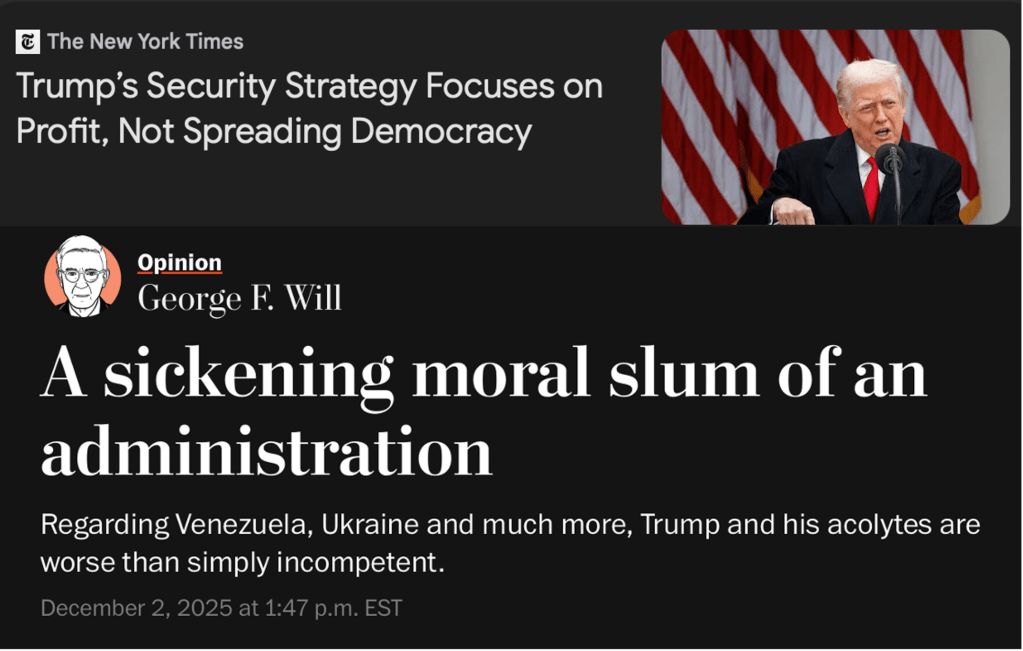
In this decade of Donald Trump at centre-stage, it has been hard to choose a moment or an issue about which to react. The former reality TV star is an expert in deflection and distraction.

Yet some things (Israel’s genocide in Gaza is one) matter more than others. So too Trump’s threats against Venezuela.

Trump’s statement below defending extrajudicial executions shows again how little he values human life. He was responding to a question from a journalist on Oct. 23 about why he didn’t ask Congress for a declaration of war against drug cartels he claims are at war with the United States: 

“Well, I don’t think we’re gonna necessarily ask for a declaration of war, I think we’re just gonna kill people that are bringing drugs into our country. OK? We’re going to kill them. You know? They’re going to be, like dead. OK?”

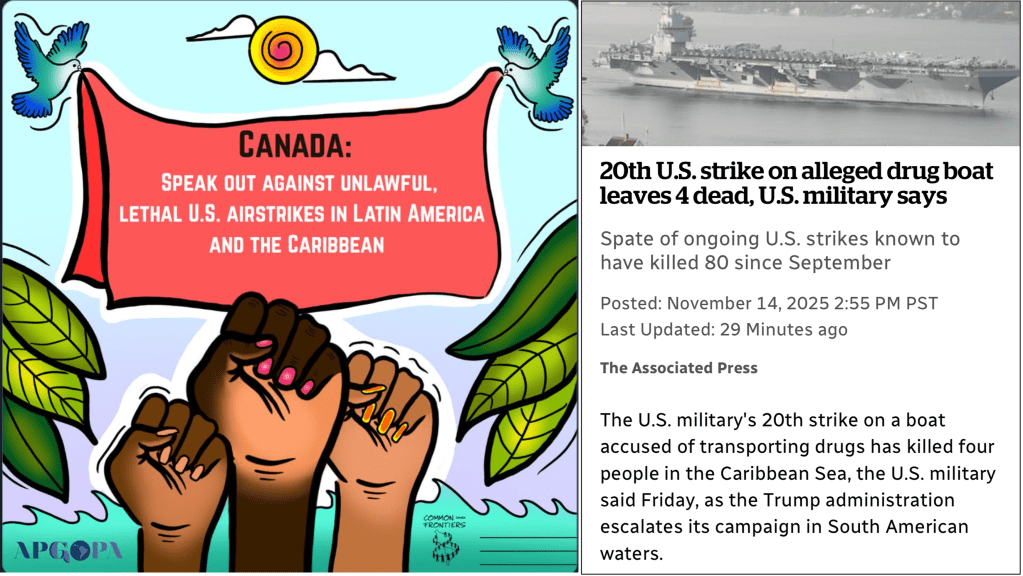
Over the past two months, Trump’s assassins have killed at least 43 people and sunk ten small boats in the Caribbean and along the Pacific coast of Colombia. As Greg Grandin has documented, when the U.S. withdraws from the rest of the world, it doubles down in this hemisphere.

This time, the United States isn’t even bothering with its usual lies as it moves from a decade of sanctions (“unilateral coercive measures”) to threats of war as it presses for regime change in Venezuela. Sanctions have had devastating effects in Venezuela, according to a study conducted by the Center for Economic and Policy Research and published in August in The Lancet Global Health.

Trump’s ire is mostly directed against Venezuela, which since 1998 has refused imperial orders about oil, medical care, governance, and individualistic notions of human rights. But he has plenty left over for Colombia and Mexico.

“He’s a thug” and an “illegal drug leader,” Trump said of Colombian President Gustavo Petro. And he said Mexico is governed by drug cartels, even while expressing respect for President Claudia Sheinbaum.

The text below is translated and lightly adapted from an Oct. 25 editorial in the Mexico City daily La Jornada.

Washington seeks war

The Trump administration is sending increasingly alarming signals about its determination to attack Venezuela to impose regime change and install a puppet administration. Trump uses a “combination of threats of armed action and economic extortion” to support right-wing politicians in Argentina, Brazil, Ecuador, El Salvador and now Bolivia “to facilitate the rise or consolidation of the far right throughout the hemisphere.”

On Oct. 24, his “War Department” announced the deployment of an aircraft carrier, the USS Gerald R. Ford, and its strike group to the U.S. Southern Command—that is, the southern Caribbean and northern South America. This entails the presence of the aircraft carrier itself, the 75 aircraft it carries, and the full range of necessary operations: three destroyers, a replenishment ship, a dry cargo ship, and a Coast Guard cutter. The Gerald R. Ford alone carries 4,600 military personnel, in addition to the crews of auxiliary vessels. 

The argument that all these vessels are being deployed with the goal of “dismantling Designated Terrorist Organizations (DTOs) and countering narco-terrorism in defence of the homeland” doesn’t stand up to scrutiny. First of all, they could be deployed off the US coast, thereby reducing the cost of maintaining long supply chains and avoiding diplomatic friction. 

The thousands of soldiers already sent to the Caribbean could have provided a much greater service to their homeland by monitoring land and air points of entry, where narcotics actually enter the United States. Instead of spending billions of dollars operating its fleets abroad, Washington could gain vast resources by combating money laundering within its own financial system, where authorities estimate that organized crime launders $300 billion annually. If traffickers were unable to collect and move the profits from their activities, they would be immediately paralyzed. But it is clear that the White House is not interested in the health of its citizens or the legality of the money circulating through its banks.

The bellicose tone of this escalation is so evident that even Brazilian President Luiz Inácio da Silva (Lula—who is not friendly to Venezuelan President Nicolás Maduro) criticized the U.S. bombing of boats in the Caribbean, noting that “if it becomes fashionable, everyone will believe they can invade someone else’s territory and do whatever they want,” thus turning the region into a lawless land. 

Lula’s special advisor and former Foreign Minister Celso Amorim warned that external intervention, whether armed or through intelligence services, is not the way to decide who will govern Venezuela, a problem that concerns only Venezuelans. He also warned of the danger of setting South America ablaze and leading to the radicalization of politics throughout the continent. At the same time, Washington is making clear its longing to empower the Colombian oligarchy in Bogotá, always ready to follow its directives and make the Andean-Caribbean territory available to its troops and spy agencies. 

In this regard, Trump escalated his attacks against President Gustavo Petro and imposed sanctions for “allowing drug cartels to flourish and refusing to stop this activity.” No evidence was presented, which is what happens in his constant diatribes against Mexico, Venezuela, and other nations whose governments protect their independence and sovereignty.

In South America, there is no war that justifies besieging the subcontinent with a series of attacks. But it becomes increasingly clear that the White House is determined to start a conflagration, no matter how absurd its pretexts. 

The international community, and particularly Latin American and Caribbean societies, must join forces in rejecting Trump’s attempt to plunge the region into barbarism in order to divert attention from his own ineptitude and hand over vast amounts of money to the military-industrial complex, the only sector whose prosperity apparently interests the U.S. president.

Here’s a way to keep up with Trump’s threats and responses from Caribbean and Latin American political and social movement leaders. The Center for Economic Policy and Research (CEPR) has been a good source of information on U.S. intervention in the region for decades. 

One Nobel winner to another: Why did you ask U.S. to invade Venezuela?

by Jim Hodgson

Perhaps I should be grateful to the Norwegian Nobel Committee for again putting Venezuela into the headlines with its absurd award of the Nobel Peace Prize to María Corina Machado, a woman who has never rejected violence as she sought the overthrow of successive Venezuelan governments since 1998. 

The prize came as the United States stepped up its attacks on fishing boats it alleged (without evidence) were carrying drugs from the Venezuelan coast to the United States. It came as the Trump administration ended a “quiet diplomacy” effort with President Nicolás Maduro that was led by Richard Grenell – a victory for hard-liners like Secretary of State Marco Rubio. If the United States opts for war. In the words of James B. Greenberg: “it will not be because diplomacy failed. It will be because war itself is the preferred instrument.”

And today, the New York Times reports that Trump has authorized “covert CIA action” in Venezuela. U.S. officials “have been clear, privately, that the end goal is to drive Mr. Maduro from power.” (That, by the way, is not news: it’s been the goal all along.)

I was astonished by the award, but then also by the responses. 

Most “progressive” U.S. commentators, including historian Heather Cox Richardson, celebrated Machado simply because she was not Donald Trump. Likewise Occupy Democrats, The Other 98%, and U.S. Democratic Socialists: one of them (I forget which) erred in saying she was Colombian. 

Even World Council of Churches and Pax Christi congratulated her. Made me wonder who they talk with in Latin America, where the reaction is strongly against Machado. Then I welcomed the flow of criticism in the threads that followed the WCC and Pax Christi Facebook posts. During the weekend, the WCC amended its message, and Pax Christi shared a new message (above). 

In the United States, author Greg Grandin told Democracy Now that the Nobel prize was the “opposite of peace.” 

But still: how can the Nobel committee see her together with previous Latin American winners like Rigoberta Menchu and Adolfo Pérez Esquivel who allied themselves persistently with the social movements of the poor, the workers, the Indigenous people, women?

I met Pérez Esquivel at least twice: once in Toronto and again in Buenos Aires (above left) at an economic alternatives conference in 2003. Right: the open letter to Machado.

From one Nobel peace prize winner to another

Let’s hear from Adolfo Pérez Esquivel, Nobel peace prize winner in 1980 for his non-violent defense of democracy and human rights in the face of Latin America’s military dictatorships, especially the regime of Jorge Rafael Videla in Argentina. He published an open letter to Machado on Oct. 13 in the Buenos Aires daily, Página 12. The text is partly translated to English here, source of the following excerpts:

“In 1980, the Nobel Committee granted me the Nobel Peace Prize; 45 years have passed and we continue serving the poorest, alongside Latin American peoples. I accepted that high distinction in their name — not for the prize itself, but for the commitment to shared struggles and hopes to build a new dawn. Peace is built day by day, and we must be coherent between what we say and what we do,” he asserted.

“At 94, I am still a learner of life, and your social and political stance worries me. So I am sending you these reflections,” he emphasized.

In the letter, he argued that the Venezuelan government, led by President Nicolás Maduro, “is a democracy with lights and shadows,” and he underscored the role of former president Hugo Chávez, who, he said, set a path of freedom and sovereignty for the people and fought for continental unity.

“It was an awakening of the Patria Grande,“ he emphasized.

At the same time, he asserted that the United States has not only “attacked” Venezuela but also refuses to allow any country in the region to step outside its orbit and colonial dependence, treating Latin America as its “backyard.” He also highlighted the more than 60-year blockade against Cuba, which he called an attack on the freedom and rights of peoples.

In one of the letter’s toughest passages addressed to Machado, he rebuked her for clinging to Washington even as it confronts her country.

“I am surprised by how tightly you cling to the United States: you should know it has no allies and no friends — only interests. The dictatorships imposed in Latin America were instruments of its drive for domination, and they destroyed lives and the social, cultural and political organization of peoples who fight for freedom and self-determination. Our peoples resist and struggle for the right to be free and sovereign, not a colony of the United States,” he wrote.

On that point, he said the government of Nicolás Maduro «lives under threat» from Washington and from the “blockade,” with U.S. naval forces in the Caribbean and «the danger of an invasion of your country».

“You have not said a word, or you support the interference of the great power against Venezuela. The Venezuelan people are ready to confront the threat,” he warned.

He also criticized that, after receiving the prize, the far-right leader dedicated it to U.S. President Donald Trump. “Corina, I ask you: why did you call on the United States to invade Venezuela?”

“Upon the announcement that you were awarded the Nobel Peace Prize, you dedicated it to Trump — an aggressor against your country — who lies and accuses Venezuela of being a narco-state,” Pérez Esquivel said. He compared that accusation to George W. Bush’s false claims that Saddam Hussein had weapons of mass destruction, used as a pretext for an invasion that looted that nation and caused “thousands of victims.”

“It troubles me that you did not dedicate the Nobel to your people but to Venezuela’s aggressor. I believe, Corina, that you must analyze and understand where you stand,” the Argentine insisted, arguing that her posture makes her “another piece of U.S. colonialism.”

“You resort to the worst when you ask the United States to invade Venezuela,” he added.

Pérez Esquivel concluded: “Now you have the chance to work for your people and build peace — not provoke greater violence. One evil is not resolved with a greater evil; we would only have two evils and never a solution to the conflict. Open your mind and your heart to dialogue and to meeting your people; empty the jug of violence and build the peace and unity of your people so that the light of freedom and equality can enter.”

Drone attacks in the Caribbean have Canadian connections

By Jim Hodgson

Separate incidents of use of explosive drones by the U.S. military to attack alleged Venezuelan drug-traffickers and by Haitian police to attack local gang leaders may have Canadian connections.

The Canadian ecumenical coalition Project Ploughshares reported Monday (Oct. 6) that a Canadian-made high-tech camera system was used to attack two boats that the United States said were carrying drugs. CBC News analysed the Ploughshares report, compared it to product manuals and previously released videos and spoke with former military and defence industry experts, concluding that it is highly likely Canadian tech was involved in surveillance during the operations.

Project Ploughshares and CBC reports on the U.S. attacks and their Canadian connection. The full Ploughshares report is here.

“There has to be more human rights oversight,” said Kelsey Gallagher, a senior researcher with Project Ploughshares. “We are seeing Canadian weapons being misused.” Founded in 1976, Project Ploughshares is the peace research institute of the Canadian Council of Churches

Global Affairs Canada told CBC that it is “aware of the U.S. operation and is monitoring the situation.”

The United States has said it used drones three times to attack boats it alleges were carrying drugs, but provided no evidence of drug-trafficking. The Ploughshares report shows that the U.S. military used a Canadian-made L3Harris WESCAM MX-Series sensor system for tracking and surveillance of boats that were struck as they sailed from Venezuela in the first two of three strikes reported last month.

Drone attack in Haiti’s capital kills 8 children

Meanwhile, a police-directed drone strike on a birthday party in Port-au-Prince that killed at least nine people (most of them children) and wounded 17 others has drawn attention to drones provided to Haiti by Canada. 

The explosions happened Sept. 20 in Cité Soleil, a large, impoverished neighbourhood controlled by Viv Ansanm, a powerful coalition of criminal gangs that the U.S. has designated as a foreign terrorist organization.

Al Jazeera news service said the drones used in the operation were supplied by Canadian police. Successive Canadian governments have long maintained programs of assistance and training to Haitian police. 

Months earlier, Global Affairs Canada told CBC that it was “concerned” about reports of extrajudicial executions, a violation of international human rights law. GAC did not clarify if Ottawa knew of cases in which Canadian-provided drones had been used for lethal purposes in Haiti. It said Haiti had agreed that the equipment provided would not be used “to commit or facilitate any violation of international humanitarian law or international human rights law.”

On Oct. 2, UN Human Rights Commissioner Volker Türk said Haiti’s use of lethal force against gangs was disproportionate and likely unlawful.

Volker Türk (left); Google News headlines in June regarding Erik Prince and his new role in fighting the gangs of Haiti.

Speaking in Geneva to the UN Human Rights Council, Türk said police units had summarily executed 174 people for alleged gang affiliation this year while government drone strikes against alleged gang members in Port-au-Prince had killed at least 559 people to date, including 11 children.

“Most of these drone strikes are likely unlawful under international human rights law,” Türk added.

Canada is legally bound to ensure that its export of military goods does not contribute to violations of international law. Compared to ongoing controversy over Canada’s arms exports to Israel – often shipped via the United States – Canada’s indirect involvement in these drone incidents in the Caribbean may be relatively limited, but seem to reveal a pattern of disregard for human rights consequences of commercial deals in our neoliberal world.

In March this year, the Haitian government hired Vectus Global, a company run by Blackwater founder Erik Prince, to operate drones.

Two days after the drone strike on the birthday party, the UN Security Council approved a new Gang Suppression Force for Haiti. I’ll share more about that (and Canada’s contribution) in days ahead.