Bruce McLeod: an inspiring ecumenical educator and communicator

by Jim Hodgson

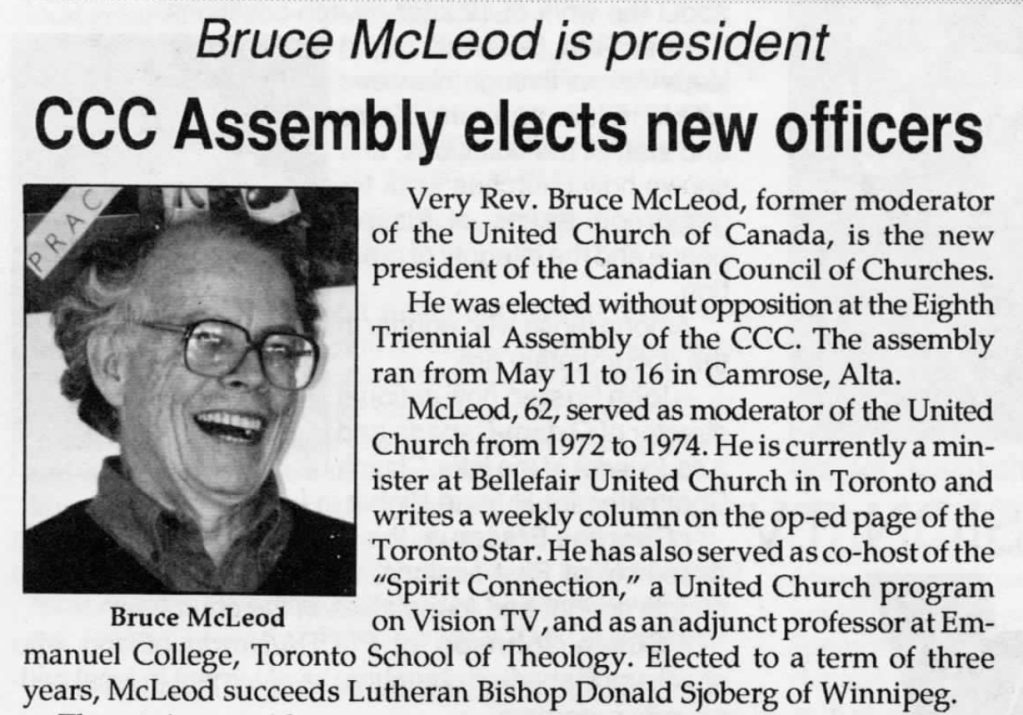
Here today, I want to share some of the words and teaching of the Very Rev. Dr. Bruce McLeod, former moderator of The United Church of Canada (1972-74) and former president of the Canadian Council of Churches (1991-94). He passed away this week at age 96.

It was in that latter role that I knew him best. (The United Church’s memorial is here, and there is more information too on the site of the United Church’s archives.) He was interviewed by Broadview magazine less than a year ago.

I can’t be sure, but I think I first met him in the mid-80s when he co-hosted the United Church’s weekly television program Spirit Connection. (Bruce was also an early ally to 2SLGBTQIA+ people who sought full inclusion and ministry in the United Church and beyond.)

In 1989, I had joined the CCC staff to serve as its secretary for ecumenical education and communication. Bruce was an inspiration for me in my new role (and long since). Some reflections from those years follow.

Entre-nous (the CCC newsletter), July 1991, p.3

Soon after his election as CCC president, he spoke to the CCC’s executive (June 21, 1991):

It’s especially important, in this kairos time of economic retrenchment in which God speaks to us for the Council to address the churches from which we come.

  • To remind them again of the Lund Principle which commits churches to doing separately in God’s world only those things which cannot be done together;
  • To summon our member churches from those ingrown, competing and duplicated enterprises which often preoccupy us;
  • To challenge separated structures (and our own denominational hearts) to think and act together – nationally, regionally and locally – in the name of Jesus who prays that we might be one.

Not for our sakes; but that the world might know that it’s bathed in the love of God, whose Spirit uses us, with others, to make the breaking world a home.

Refugee rights: “We saw their faces”

Back in the late 1980s, the government of Brian Mulroney brought in new rules to restrict the numbers of people who could claim refugee protection in Canada. Bruce was part of the CCC’s board when it launched a court challenge to a new refugee determination system in January 1989.

The churches’ concern then was much as it is today: rules were too tight and would endanger the lives of some refugee claimants by sending them back to persecution, imprisonment or possible death. The specific alarm was over the process for determining whether individuals were eligible to make a claim, and if rejected, whether they would be able to make a meaningful appeal. (We didn’t win the suit then and the fight for protection continues in the face of ever-harsher anti-refugee rhetoric and stricter measures in many parts of the world.)

In a sermon at the council’s assembly in Charlottetown in 1994, he said the churches challenged the new rules “because they knew refugees not as numbers or statistics; they saw their faces, knew their stories and wiped their tears. They heard God calling them to come; they did together what they couldn’t have done separately. It was as though something more than the initiative of the churches was at work here — as though a presence or purpose was waiting in the issues themselves, plucking at the churches to respond.”

Bruce McLeod with his successor as president of the CCC, Dr. Alexandra Johnston (1994).

To cherish and preserve this small world

I heard Bruce tell the story of his encounter in 1992 with astronomer Carl Sagan more than once. They met at a “religion and science” gathering in Washington, and he included the story in a report to the CCC executive that I reproduced in Entre-nous, the CCC newsletter, in July 1992:

“Sagan said that when the Voyager spacecraft spun past Neptune and Pluto edging beyond the solar system to wander forever across the Milky Way, its cameras focused backward for one last glimpse of home.

“’Planet earth from there is not the same as looking at it from the moon where you see the outlines of the continents. Planet earth from there is just a pale blue point of light. That’s where we live,’ he said, his brooding face alight. ‘Where every human being who ever lived, lived – every couple in love – every political leader,’ every church with its earnest positions. Voyager’s photographs he said, ‘conveyed a sense of vulnerability. At least to me it cries out the need to cherish and preserve this small world.’”

Bruce continued: “Here where it is night, we remember the words of Rubem Alves: ‘Hope is the melody of hearing God’s future, faith is dancing it now.’ Together in Jesus name, taking each other’s hands around this table and beyond our different churches, we dance as well we can.”

“God’s single love in the world”

In 1994, at the end of his term as CCC president, Bruce challenged the churches over funding cuts to ecumenical bodies. “Over-lapping mandates” was among the reasons cited for cuts to the council and the inter-church justice coalitions.

Bruce refused to accept those excuses. In a sermon delivered in Charlottetown in 1994 at the CCC’s triennial assembly, he said: “For all the shared ministries at the unpublicized edge, there’s no dearth of ecclesiastical leaders ready to explain why there have to be ten different churches, all struggling to repair their roofs, in one Ontario town with 2,200 people. For all the examples of coalition cooperation, there remain competing church publishing houses (each with separate, crushingly expensive, hymn book projects) and duplicated church head offices, each with floors devoted to world outreach and justice issues, all claiming their share of sacrificial weekly gifts dedicated, to the accompaniment of doxologies across the land, for the work of God’s single love in the world.”

“Security for whom?” asks KAIROS after Canada cuts foreign aid

by Jim Hodgson

Canada’s newest cuts to foreign aid spending follow cuts by other wealthy countries (most notably the elimination earlier this year of the U.S. Agency for International Development). Beyond immediate impacts, these cuts point to a reshaping of sixty years of international cooperation for development.

Over the next four years, Canada will chop $2.7 billion from its aid budget. At the same time, at the behest of the Trump regime next door, it will increase military spending with $81.8 billion over five years.

In June, Canada announced its commitment to increase military spending: CodePink, Development and Peace, and CBC headlines.

Few analysts bring together the issues of development assistance, militarism and climate justice the way that the ecumenical coalition KAIROS Canada has in its statement on the budget:

Canada needs to decide what role it wants to play in the world. These issues are inseparable: climate justice, Indigenous sovereignty, migrant justice, gender equality and peacebuilding rise or fall together — and Canada’s future depends on advancing them as one interconnected project of justice. 

KAIROS added that it is concerned by the prospect of a scaled-up military-industrial complex in Canada. “Even today, arms components made in Canada are used against civilians in Gaza and other conflict zones due to loopholes that allow them to flow indirectly through allies, helping to further entrench global insecurity.” (Canadian-built military surveillance and targeting equipment was used in at least two of the U.S. attacks on small ships in the Caribbean Sea, as reported recently by another Canadian ecumenical coalition, Project Ploughshares.)

KAIROS said the government “could have introduced a wealth tax to tackle the historic wealth gap and fund real climate action. It could have ended subsidies for fossil fuel corporations. Instead, it cut public services, forcing job losses that fall hardest on women, Indigenous Peoples and racialized communities,” as the Canadian Centre for Policy Alternatives warns.

While there are no actual projections yet of where the foreign aid cuts will hit, the budget statement cites Canada’s spending on global health programs as an example, saying this has “grown disproportionately” in comparison to other countries.

“Any reductions to Canada’s global health investments will have devastating consequences for women and children around the world, while threatening the health, security and prosperity of Canadians,” said Charmaine Crockett of the Canadian Partnership for Women and Children’s Health (CanWaCH) in a joint statement with Cooperation Canada. “Canada’s decades of leadership in global health have always been about investing in a safer, more equitable world, because we know that when we turn our back on the world’s most marginalized people, we all suffer.”

The cut to Canadian aid, elimination of USAID, and reduced spending announced by Britain, Germany, Netherlands and others means that in total, G7 countries are trimming their aid budgets by nearly one-third, the steepest reduction since 1960, according to the Globe and Mail

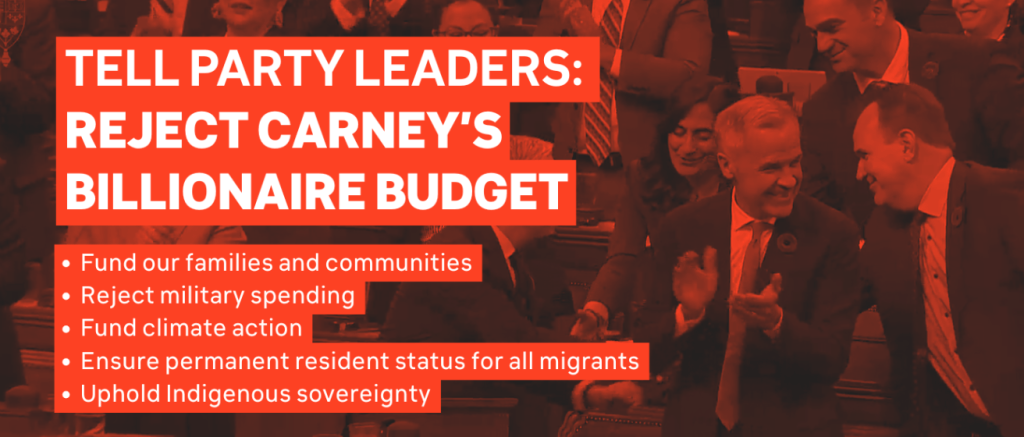
Several Canadian organizations (350.org Canada, World Beyond War, Migrant Rights Network, Council of Canadians, and the Canadian Association of Professional Employees) have come together in a letter-writing campaign to opposition leaders to encourage them to demand change before Parliament votes again on the budget.

Where to now with international development?

I want to share links to some articles that delve more deeply into the significance of what may become a shift away from a model in which rich countries of the Global North “donated” funds to impoverished countries of the Global South. The model has always been criticized as it promotes dependence and blocks systemic change. This is “big picture” stuff, very distant from issues of how to support refugees at border posts or funding for cooperative farming in Central America. (I am, as always, grateful to Brian Murphy for sharing these and other articles. You can follow him on Bluesky @murphyslog.bsky.social.)

First, “The end of the global aid industry,” by Zainab Usman. Usman proposes a focus on industrialization – what has worked for China and South Korea and is unfolding now in Vietnam and Thailand. Usman writes:

Part of the problem with the aid industry is that its benefits have been spread too thinly across a multitude of domains and not focused enough on productivity-enhancing sectors. To this end, advocates of global development should focus on enabling poorer countries to access cheap development financing for targeted investments in sectors that connect people, such as electricity, telecommunications, and mass transit. 

Second, “The geopolitics of international development (after foreign aid),” by Ken Opalo in An Africanist Perspective. Opalo examines a series of essays in Foreign Policy magazine’s Fall 2025 issue that all deal with development issues. Opalo sets his description of the decline of the foreign aid model in the context of a rising multipolarity that is matched by the “ongoing general decline of the authority and influence of Western states.”  

There’s no denying that the financial, intellectual, and institutional hegemony of Western countries significantly shaped development practice over the last 60 years. This era had both good and bad elements. The good elements included efforts to incentivize the modernization of economic management and policymaking in low-income countries (work that’s far from finished, and which has yielded some good results); while the bad elements included the fostering of aid dependence, cyclical faddism, reflexive policy extraversion, lack of elite ambition, and implicit support for a hierarchical world order that permanently placed low-income countries at the bottom of the global totem pole.

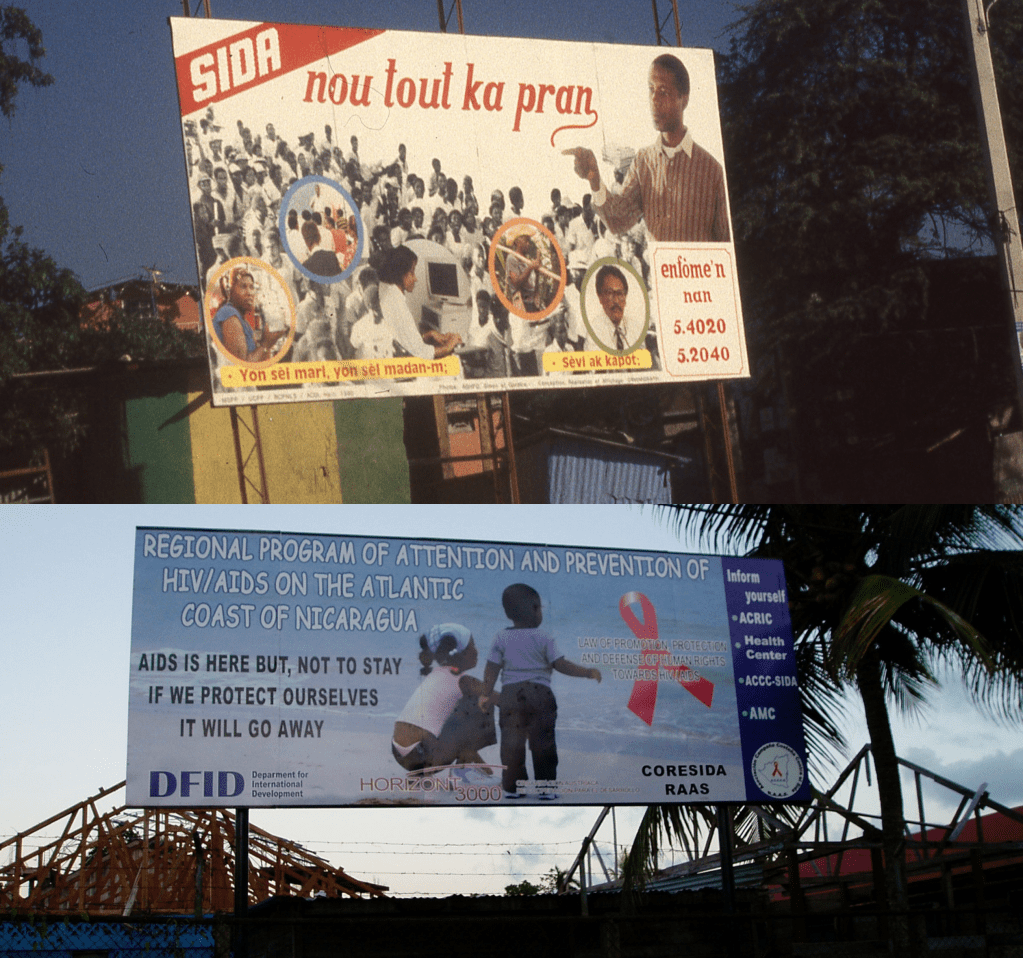
AIDS prevention education in decades past: Haiti in 1984 (top); Atlantic coast of Nicaragua in 2007 (below). Jim Hodgson photos.

Third, “Three ways to help the developing world survive the end of aid,” by Winnie Byanyima, Executive Director of UNAIDS, in The Guardian. Byanyima reminds us that developing countries are still drowning in debt and facing interest rates up to 12 times higher than wealthy countries. “Low- and middle-income countries now pay $4 to the richest in the global north for every $1 they receive in aid. Thirty-four of Africa’s 54 countries spend more on debt than on healthcare.” She adds:

  • Governments must relieve the “chokehold of sovereign debt.”
  • The richest need to pay their fair share: the wealth of billionaires soared by $2 trillion in 2024, but they paid an effective tax rate of just 0.3 per cent.
  • Governments need to treat lifesaving medicines not as commodities, but as global public goods. “This has been one of the great successes of the HIV response” (at least over the past 20 years, though not before—and threatened again with loss of U.S. funding this year).

Draw The Line for people, for peace, for the planet

Global Days of Action for systemic change on issues of debt, migration and ecology are set for Sept. 19-21. In Canada, several networks are focusing attention on Saturday, Sept. 20 – a National Day of Action.

With rallies, strikes, marches and gatherings, communities will mobilize across the country to demand that Prime Minister Mark Carney and the Canadian government pick a side: injustice, violence, and climate destruction – or a just and safe future for all of us.

For more information and to find an event near you, follow this link. Some of the Canadian organizations involved include the Climate Action Network, Migrant Rights Network and Indigenous Climate Action, among others. 

The campaign in Canada has these demands:

  • Put people over corporate profit. Fund our families and communities. “We refuse to accept poverty while the wealthy hoard billions.”
  • Refuse ongoing colonialism. Uphold Indigenous sovereignty. “Canada continues to enforce colonial violence through Missing and Murdered Indigenous Women, Girls, and Two-Spirit people, mass incarceration, child-welfare systems, the underfunding of services, and destructive development across Indigenous lands. … We refuse colonial violence and demand radical transformation away from capitalist systems, justice for MMIWG2S, the return of land to its rightful titleholders, and funding for Indigenous housing, languages, land-based economies, and Indigenous-led climate solutions.”
  • Stop blaming migrants. Demand full immigration status for all now! “Denied permanent status, migrants who grow food, build communities, and care for the sick face exploitation, wage theft and exclusion from services. Corporate elites scapegoat migrants to hide the real culprits: landlords, grocery monopolies, and bank CEOs profiting off our misery.”
  • End the war machine. Stand for justice and peace. “We demand an immediate two-way arms embargo on Israel, cancelling Canada’s plans to balloon its military budget, and a foreign policy based on diplomacy and peace-building.”
  • End the era of fossil fuels. Protect Mother Earth. “We demand Canada end all fossil fuel subsidies, kick fossil fuel companies and their lobbyists out of politics, make polluters pay, invest in a Youth Climate Corps and publicly-owned East-West electricity grid, and do its fair share globally by cancelling unjust debt and funding climate solutions in the Global South with grants, not loans.”

The global campaign focuses on systemic change

“All over the world, people and communities are fighting for survival, for their rights, for justice in the face of economic turmoil, ecological and climate catastrophes, political instability, vicious attacks on fundamental human rights, militarization, and, in places like Palestine and Sudan, genocide.”

This September, let us carry the following demands:

  • Change the System through an equitable and just transition towards a world that is in harmony with nature and centered on people – communities, workers, women, farmers, fishers, pastoralists, youth, children, indigenous peoples, migrants, refugees, people of color, LGBTQI*, and future generations
  • Phase out fossil fuels – fast, fair, feminist, and forever; Shut down polluters; Build renewable energy systems that work for people and planet; Shift from high-carbon agro-industrial farming to agroecology and sustainable, resilient food systems that prioritize healthy staple food production for domestic consumption and the right to food
  • Fund the future, not the crisis! Tax multinational corporations and billionaires; Cancel the debt; Deliver climate finance; Divest from war, fossil fuels, and harmful projects; Scale up quality public services; Support people and community-led solutions; Finance the transition to resilient, sustainable, and equitable economies. 
  • Reclaim the Commons for sustainable support for life; Respect and uphold the territories of Indigenous Peoples and Traditional Communities; Restore the health of ecosystems; Stop extractivism
  • Defend Human Rights and Reclaim Democracy; End war and genocide; Demilitarise and work for peace based on justice
  • End inequalities across countries and within countries: Democratize global economic and financial governance; Make trade, investments, and tax systems just and fair; Redistribute wealth and power; End colonialism, patriarchy, and racism; Build solidarity across peoples and nations