Is Trump looking for war in the south Caribbean?

by Jim Hodgson

In this decade of Donald Trump at centre-stage, it has been hard to choose a moment or an issue about which to react. The former reality TV star is an expert in deflection and distraction.

Yet some things (Israel’s genocide in Gaza is one) matter more than others. So too Trump’s threats against Venezuela.

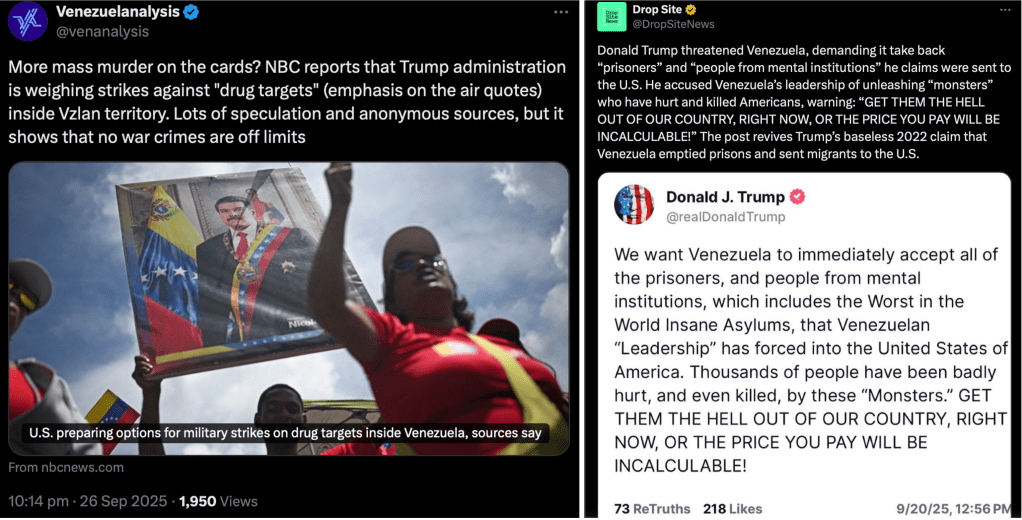
Trump’s statement below defending extrajudicial executions shows again how little he values human life. He was responding to a question from a journalist on Oct. 23 about why he didn’t ask Congress for a declaration of war against drug cartels he claims are at war with the United States: 

“Well, I don’t think we’re gonna necessarily ask for a declaration of war, I think we’re just gonna kill people that are bringing drugs into our country. OK? We’re going to kill them. You know? They’re going to be, like dead. OK?”

Over the past two months, Trump’s assassins have killed at least 43 people and sunk ten small boats in the Caribbean and along the Pacific coast of Colombia. As Greg Grandin has documented, when the U.S. withdraws from the rest of the world, it doubles down in this hemisphere.

This time, the United States isn’t even bothering with its usual lies as it moves from a decade of sanctions (“unilateral coercive measures”) to threats of war as it presses for regime change in Venezuela. Sanctions have had devastating effects in Venezuela, according to a study conducted by the Center for Economic and Policy Research and published in August in The Lancet Global Health.

Trump’s ire is mostly directed against Venezuela, which since 1998 has refused imperial orders about oil, medical care, governance, and individualistic notions of human rights. But he has plenty left over for Colombia and Mexico.

“He’s a thug” and an “illegal drug leader,” Trump said of Colombian President Gustavo Petro. And he said Mexico is governed by drug cartels, even while expressing respect for President Claudia Sheinbaum.

The text below is translated and lightly adapted from an Oct. 25 editorial in the Mexico City daily La Jornada.

Washington seeks war

The Trump administration is sending increasingly alarming signals about its determination to attack Venezuela to impose regime change and install a puppet administration. Trump uses a “combination of threats of armed action and economic extortion” to support right-wing politicians in Argentina, Brazil, Ecuador, El Salvador and now Bolivia “to facilitate the rise or consolidation of the far right throughout the hemisphere.”

On Oct. 24, his “War Department” announced the deployment of an aircraft carrier, the USS Gerald R. Ford, and its strike group to the U.S. Southern Command—that is, the southern Caribbean and northern South America. This entails the presence of the aircraft carrier itself, the 75 aircraft it carries, and the full range of necessary operations: three destroyers, a replenishment ship, a dry cargo ship, and a Coast Guard cutter. The Gerald R. Ford alone carries 4,600 military personnel, in addition to the crews of auxiliary vessels. 

The argument that all these vessels are being deployed with the goal of “dismantling Designated Terrorist Organizations (DTOs) and countering narco-terrorism in defence of the homeland” doesn’t stand up to scrutiny. First of all, they could be deployed off the US coast, thereby reducing the cost of maintaining long supply chains and avoiding diplomatic friction. 

The thousands of soldiers already sent to the Caribbean could have provided a much greater service to their homeland by monitoring land and air points of entry, where narcotics actually enter the United States. Instead of spending billions of dollars operating its fleets abroad, Washington could gain vast resources by combating money laundering within its own financial system, where authorities estimate that organized crime launders $300 billion annually. If traffickers were unable to collect and move the profits from their activities, they would be immediately paralyzed. But it is clear that the White House is not interested in the health of its citizens or the legality of the money circulating through its banks.

The bellicose tone of this escalation is so evident that even Brazilian President Luiz Inácio da Silva (Lula—who is not friendly to Venezuelan President Nicolás Maduro) criticized the U.S. bombing of boats in the Caribbean, noting that “if it becomes fashionable, everyone will believe they can invade someone else’s territory and do whatever they want,” thus turning the region into a lawless land. 

Lula’s special advisor and former Foreign Minister Celso Amorim warned that external intervention, whether armed or through intelligence services, is not the way to decide who will govern Venezuela, a problem that concerns only Venezuelans. He also warned of the danger of setting South America ablaze and leading to the radicalization of politics throughout the continent. At the same time, Washington is making clear its longing to empower the Colombian oligarchy in Bogotá, always ready to follow its directives and make the Andean-Caribbean territory available to its troops and spy agencies. 

In this regard, Trump escalated his attacks against President Gustavo Petro and imposed sanctions for “allowing drug cartels to flourish and refusing to stop this activity.” No evidence was presented, which is what happens in his constant diatribes against Mexico, Venezuela, and other nations whose governments protect their independence and sovereignty.

In South America, there is no war that justifies besieging the subcontinent with a series of attacks. But it becomes increasingly clear that the White House is determined to start a conflagration, no matter how absurd its pretexts. 

The international community, and particularly Latin American and Caribbean societies, must join forces in rejecting Trump’s attempt to plunge the region into barbarism in order to divert attention from his own ineptitude and hand over vast amounts of money to the military-industrial complex, the only sector whose prosperity apparently interests the U.S. president.

Here’s a way to keep up with Trump’s threats and responses from Caribbean and Latin American political and social movement leaders. The Center for Economic Policy and Research (CEPR) has been a good source of information on U.S. intervention in the region for decades. 
Trump revives “big stick” approach to Latin America

by Jim Hodgson

With all of my passion for justice and in the face of so many gross injustices, I can get paralyzed. And with Trump in power next door, there is always something new to distract us from what went before or from demanding freedom for captives or the release of the #EpsteinFiles.

Just today, he threatened Canada again. #ElbowsUp, still.

Yesterday, it was a plan to end Israel’s war in Gaza that even the New York Times admits “checks every box on Israel’s wish list.” It does nothing to strengthen Palestine or assist recovery after the genocide, and will impose a new, colonial-style authority on the people. 

Let’s step back for a moment.

Last week, I was going to write about Trump’s efforts to rescue his far-right cronies in Argentina and Brazil. Here’s a short version.

Argentina’s president, Javier Milei, faces a collapsing peso and political setbacks. Milei’s chainsaw approach to slashing government was a model for Trump and Elon Musk. U.S. Treasury Secretary Scott Bessent said Sept. 22 that Washington is ready to do “whatever is necessary” – from central bank swaps to direct peso purchases or buying Argentine debt through the Treasury’s Stabilization Fund. The moves are intended to ease political opposition to Milei that has grown as the economy collapses. Milei – already dependent on a $20 billion IMF package – sought U.S. support ahead of congressional elections in October. Investors have been pulling money out from Argentina since Milei’s party lost an election in Buenos Aires province on Sept. 7, provoking worry that he will soon lack legislative support to advance his agenda. 

Front-page of a Buenos Aires newspaper shows Trump managing the rescue plan for Argentina’s Milei. Right: response from Occupy Democrats.

Earlier, Trump imposed a 50% tariff on goods from Brazil, claiming that Brazil engages in unfair trade practices and that the government is engaged in a “witch hunt” against Trump’s ally, former president Jair BolsonaroBolsonaro was convicted earlier this month of attempting a coup after voters dumped him from office. He was sentenced to more than 27 years in prison, sparking Trump’s ire. The present Brazilian government called the U.S. move “a new attempt of undue interference in Brazilian internal affairs.”

When he spoke of the U.S. rescue of Argentina’s Milei, Bessent told reporters that the Trump administration hoped to solidify what it sees as a rightward shift in Latin American countries, including potentially Colombia. (Colombia is now government by a left-centre coalition led by President Gustavo Petro, who cannot succeed himself. His party is currently selecting a new candidate.) 

New and old threats

Bessent’s move came hours before Trump took centre stage at the United Nations General Assembly to press his MAGA-style policies on the rest of the world. 

In the speech, Trump threatened to “blow out of existence” Venezuela’s president, Nicolás Maduro. Maduro responded with a plan to declare a state of external unrest to enable rapid mobilization in defence of Venezuela. He had earlier sent a letter to Trump, proposing direct talks. When asked about the letter, White House press secretary Karoline Leavitt, said it was “full of lies” and said the administration still views Maduro as an “illegitimate leader.”

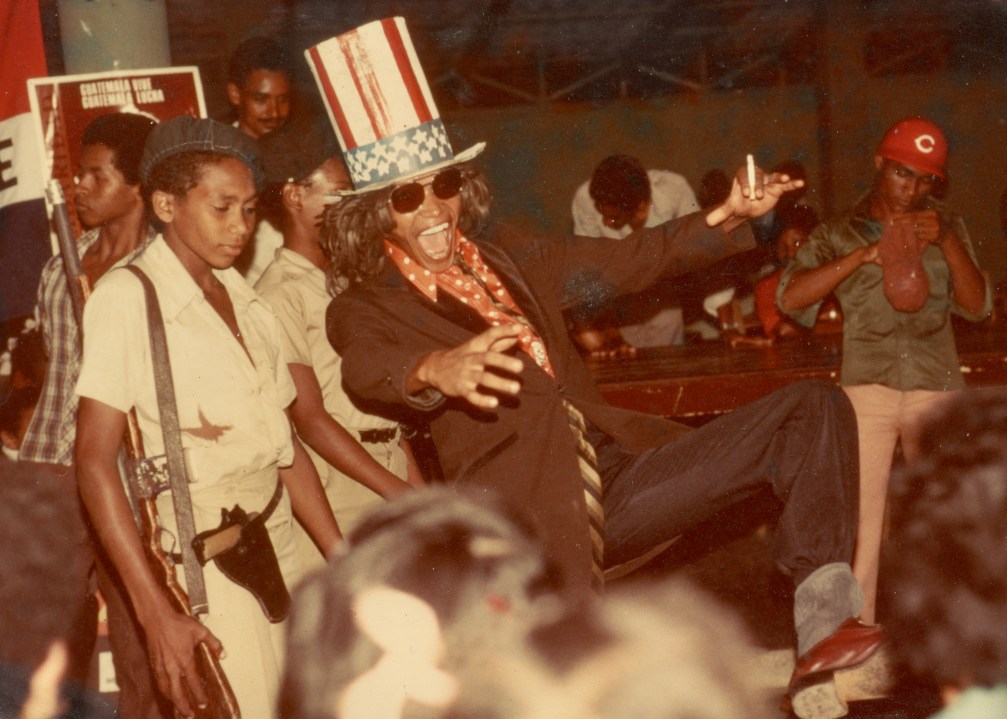
Trump’s threat came after he moved warships into the south Caribbean and after recent attacks on Venezuelan fishing boats (alleged without evidence to be carrying drugs). Trump and his minions seem determined to revive the worst applications of U.S. foreign policy in Latin America, from the 19th-century Monroe Doctrine to Teddy Roosevelt’s “big-stick” diplomacy in the early 20th century.

A recent US government document revealed the Trump administration plans to redirect $1.8 billion in foreign aid toward a new “America First” strategy, Reuters news agency reported Sept. 24. It would give priority to neutralizing “Marxist, anti-American regimes” in Latin America. The report said $400 million would support activities to end illegal immigration to the US, counter China, and “confront the Marxist, anti-American regimes of Venezuela, Cuba and Nicaragua.” The document, known as a Congressional Notification, follows news that the upcoming National Defense Strategy will also pivot the U.S. away from a focus on adversaries like China and Russia to instead prioritize efforts in the Americas.

But not everyone serving Trump is onside with these approaches. On Sept. 29, the Washington Post reported that eight current and former officials have said there is a deep rift between the political appointees at the Pentagon and the military leaders there. Reflecting on the Post report, historian Heather Cox Richardson said that War Secretary Pete Hegseth “is withdrawing forces from Europe, reducing the concentration of power and consolidating commands abroad while focusing on using the military in the U.S. and neighboring countries.

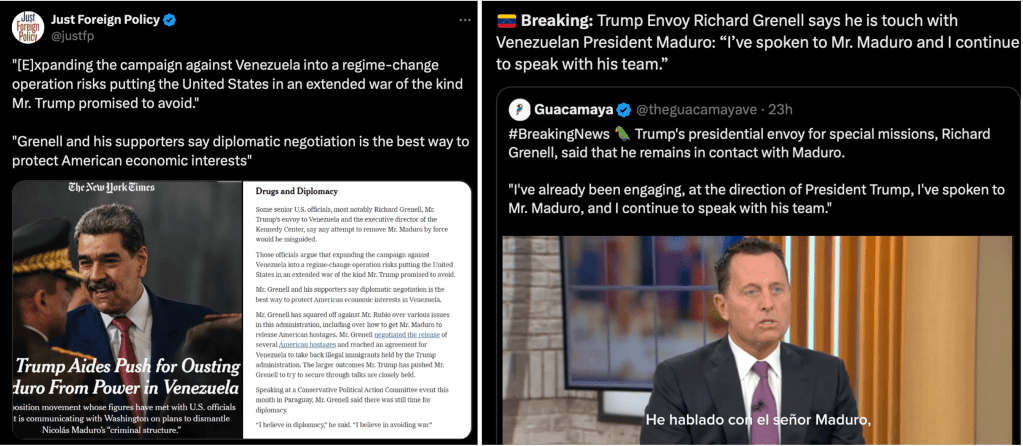
Among Trump administration opponents to use of force to provoke regime change in Venezuela is Richard Grenell, Trump’s special envoy to the country, said Drop Site News on Sept. 29. Grenell has successfully re-opened channels for export of Venezuelan oil to the United States. Grenell and his supporters say diplomatic negotiation is the best way to protect U.S. economic interests. Among those who oppose Grenell is U.S. Secretary of State Marco Rubio. 

From Bogotá, the Global South charges Israel with genocide

A two-day meeting this week in the Colombian capital ended with renewed commitment to pursue accountability for Israeli abuses in Gaza, including by preventing the transfer of weapons to Israel.

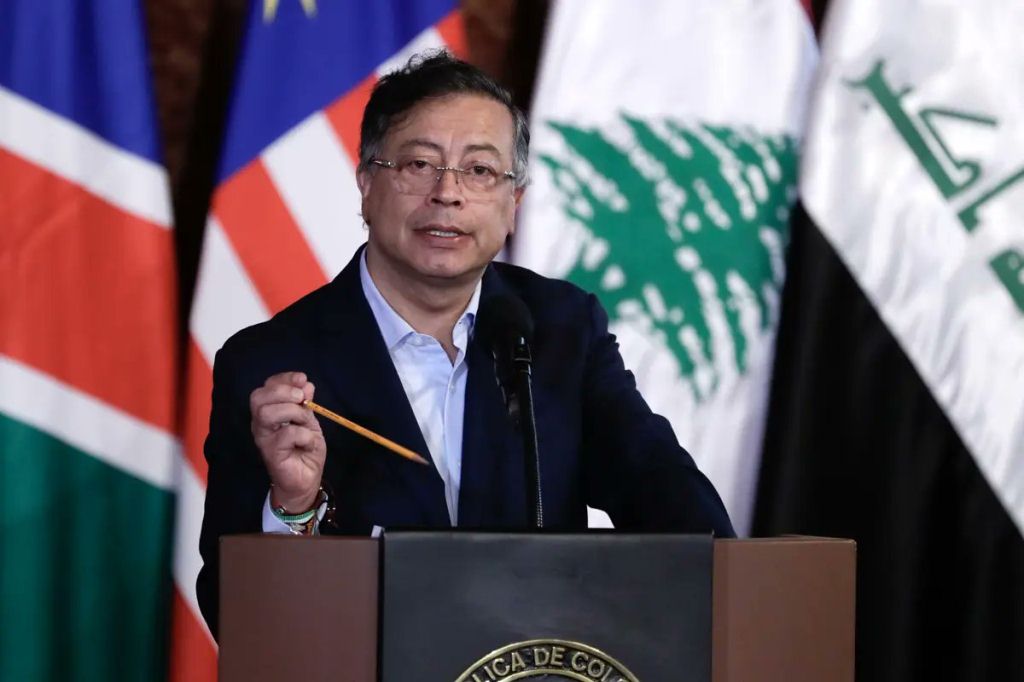
As the event drew to a close Wednesday (July 16), Colombian President Gustavo Petro (above) told participants, “Gaza is simply an experiment by the ultra-rich to show the impoverished people of the world how they will respond to humanity’s rebellion.”

Petro also distanced himself further from the North Atlantic Treaty Organization (NATO), which in 2022 had designated Colombia as a “non-member strategic ally.” 

“What are we doing in NATO, if its principal leaders are with the genocide?” he asked. “We must leave.”

A coalition known as The Hague Group organised the summit. It was born in January last year through the help of Progressive International (PI), an organization founded in 2020 to unite, organize, and mobilize progressive forces around the world. PI called the Bogotá meeting the “most ambitious multilateral action since the start of Gaza genocide 21 months ago.”

Jointly convened by the governments of Colombia and South Africa as co-chairs, the Hague Group also includes Bolivia, Cuba, Indonesia, Iraq, Libya, Malaysia, Namibia, Nicaragua, Oman and Saint Vincent and the Grenadines. At least 18 other countries, plus the United Nations and the World Council of Churches, sent representatives. Qatar and Egypt, which are overseeing negotiations between Hamas and the Israeli government, attended.

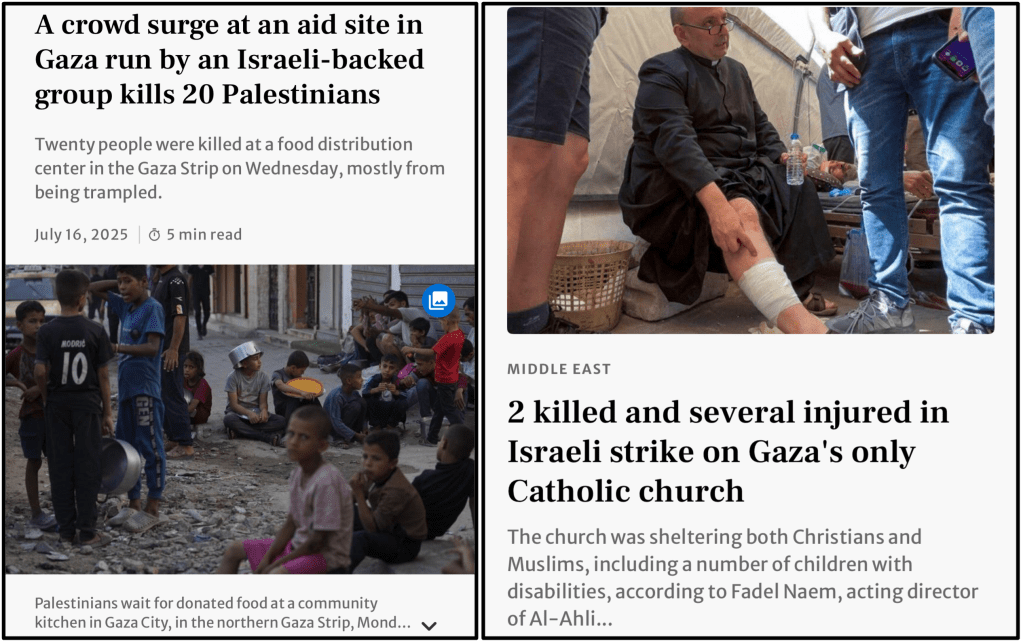
Israel’s offensive in Gaza has killed more than 58,000 Palestinians, according to Gaza’s Health Ministry, which has said women and children make up more than half of the dead. At least 90 were killed on Thursday (July 16), including those who were crushed at an Israeli-controlled food distribution site. Holy Family Church also came under attack, sparking criticism and new calls for peace from Pope Leo XIV and from the World Council of Churches.

During Tuesday morning’s opening event, various officials spoke, calling for an end to Israel’s attacks on Gaza. Colombia’s foreign minister, Rosa Yolanda Villavicencio, said during her morning address that Israel’s attacks constitute an unequivocal “genocide.”

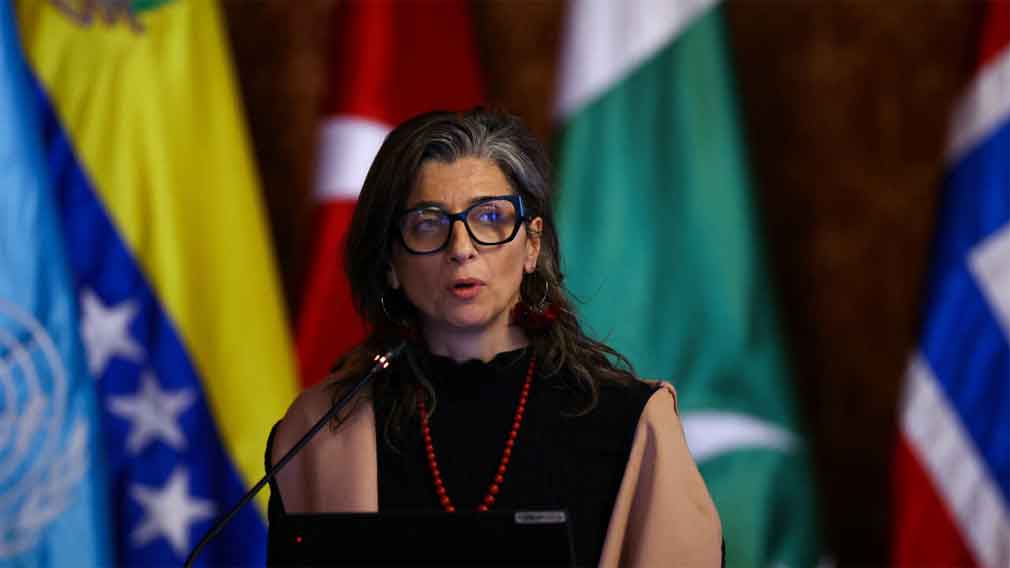
Another key participant was Francesca Albanese (above), the U.N. special rapporteur for the Palestinian Territories. She denounced the inaction of the international community. She accused the West of justifying Israeli actions as the “right to defense” and said the vetos in the U.N. Security Council “protect war crimes” carried out in the sight of all.

“Palestine has changed global consciousness, drawing a clear line between those who oppose genocide and those who accept it or are part of it,” she said. Albanese was recently sanctioned by the US for her outspoken criticism of Israel’s actions.

“We believe in protagonism, not supplication,” said Varsha Gandikota-Nellutla, the executive secretary of The Hague Group. “Today marks an end to the era of the impunity and the beginning of collective state action by governments of conscience.”

The group members committed to implementing six measures immediately through their domestic legal and administrative systems to break the ties of complicity with Israel’s campaign of devastation in Palestine. They set September 20 as a date for other states to join them, coinciding with the 80th U.N. General Assembly. Consultations with capitals across the world are now ongoing.

“We hereby announce the following measures,” the Joint Statement on the Conclusion of the Emergency Ministerial Conference on Palestine reads, “to be adopted based on states’ domestic legal and legislative frameworks:”

  • Prevent the provision or transfer of arms, munitions, military fuel, related military equipment, and dual-use items to Israel…
  • Prevent the transit, docking, and servicing of vessels at any port…. in all cases where there is a clear risk of the vessel being used to carry arms, munitions, military fuel, related military equipment, and dual-use items to Israel
  • Prevent the carriage of arms, munitions, military fuel, related military equipment, and dual-use items to Israel on vessels bearing our flag… and ensure full accountability, including de-flagging, for non-compliance with this prohibition.
  • Commence an urgent review of all public contracts, to prevent public institutions and funds from supporting Israel’s illegal occupation of the Palestinian Territory and entrenching its unlawful presence.
  • Comply with obligations to ensure accountability for the most serious crimes under international law, through robust, impartial and independent investigations and prosecutions at national or international levels, to ensure justice for all victims and the prevention of future crimes.
  • Support universal jurisdiction mandates, as and where applicable in national legal frameworks and judiciaries, to ensure justice for victims of international crimes committed in the Occupied Palestinian Territory.

“These 12 states have taken a momentous step forward,” said Albanese about the joint statement. “The clock is now ticking for states—from Europe to the Arab world and beyond—to join them.”

The full joint statement is here.

Complete text of Albanese’s remarks is here.