United States takes modest step towards easing its long embargo against Cuba

By Jim Hodgson

A modest step forward in the long struggle to end the failed U.S. embargo came this week when the United States removed Cuba from its short list of countries it alleges are “not cooperating fully” in its fight against terrorism. “This move… could well be a prelude to the State Department reviewing Cuba’s designation as a state sponsor of terrorism,” William LeoGrande, a professor at Washington’s American University, told Reuters.

Left: Reuters coverage. Right: As reported by CubaDebate – “State Department recognises the lie, but does not remove Cuba from the list of state sponsors of terrorism.” President Miguel Diaz-Canel told interviewer Ignacio Ramonet that many of Cuba’s economic woes begin with the U.S. blockade, tightened in 2021 with “the inclusion of Cuba in a spurious list determined at will by the U.S. government of countries that supposedly support terrorism.”

Until this week, the administration of President Joe Biden had made only minor reforms—easing some restrictions on travel and family remittances in May 2022—but had scarcely budged from the harsh measures taken by his predecessor, Donald Trump, much less attaining Barack Obama’s level of engagement.

It was just days just before the end of Trump’s administration in January 2021 that Cuba was added to the list of “state sponsors of terrorism” (SST)—because Cuba was hosting peace talks between the Colombian government and one of the guerrilla armies, the Ejército de Liberación Nacional (ELN). Despite occasional setbacks, the Colombian peace process moves forward slowly.

Biden’s new move comes after three years of non-stop advocacy by churches and other non-governmental organizations to end the embargo and to have Cuba removed from the SST list.

Efforts by churches, unions and other groups are driven by a sharp deterioration of the Cuban economy that is partly a consequence of the SST and other measures as banks and other corporations fear running afoul of the U.S. measures. The economic downturn is also related to reduced tourist visits to the country during the Covid pandemic and Cuba’s abandonment of its former two-currency system (one tied to the U.S. dollar, and the other that effectively subsidized local transactions).

In April 2023, an informal alliance of more than 20 Canadian churches, trade unions, development agencies and community solidarity groups wrote to Foreign Affairs Minister Mélanie Joly and to then-International Development Minister Harjit Sajjan to express alarm at the “deterioration of the Cuban economy and consequent impacts on the Cuban people.”

They called on the government to press the United States to ease sanctions and to remove Cuba from the SST list. They also asked that Canada “scale up its efforts to provide immediate food, medicines, and medical supplies to Cuba” (whether directly with the Cuban state or via NGOs and multilateral organizations). 

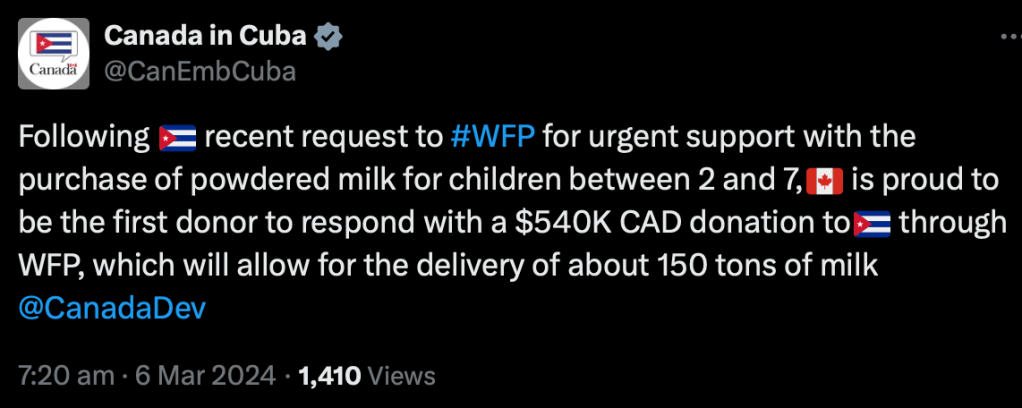
Canada has made some efforts, notably the announcement March 6 of a $540,000 contribution to the World Food Program to support provision of 150 tons of milk that will assist Cuban children. Canada’s response followed just two days after the Cuban government had made its first-ever request to WFP for food aid. Canada continues to fund the work of NGOs such as Oxfam and CARE Canada in Cuba.

The Canadian letter echoed earlier calls from Cuban and U.S. churches. In a joint letter sent Feb. 18, 2021, they asked Biden to to restore travel, remittances and trade with Cuba; to remove Cuba from the list of “state sponsors of terrorism;” to rescind Trump’s mandate to use extraterritorial provisions of the Helms-Burton law; and to rebuild U.S. diplomatic presence in Cuba. On March 13, 2023, more than 20 U.S. faith groups wrote to Biden to ask that Cuba be removed from the SST list.

The SST designation, along with Trump’s application of measures contained in the 1995 Helms-Burton Act, have extraterritorial impacts. Foreign-owned ships won’t dock in Cuba and foreign banks are reluctant to transfer funds for fear of running afoul of the U.S. laws. To understand better the impact of the SST in Cuba, please read a long report by the Washington Office on Latin America (WOLA).

The extraterritorial features of the Helms-Burton law provoked anger in Canada and Europe, but those features were effectively waived by Presidents Clinton, Bush and Obama. In April 2019, Trump revived them. Canada repeated its objection, and reminded Canadians that amendments in 1996 to Canada’s Foreign Extraterritorial Measures Act (FEMA) stipulate that any judgment issued under Helms-Burton “shall neither be recognized nor enforceable in any manner in Canada.”

But Canada, to my knowledge, has yet to say anything publicly about the SST list.

Meanwhile, churches, NGOs and solidarity groups continue to provide aid to Cuba, including in response to damage caused by Hurricane Ian in western Cuba in 2022 and after the oil storage facility fire in Matanzas in 2022. 

Vancouver-based CoDevelopment Canada is collecting material to send in a container to Cuban trade unions later this summer. 

The U.S. Cuba Normalization Coalition has a fact sheet about U.S.-backed attacks on Cuba. “Cuba has endured 64 years of a U.S. economic blockade.This intensified when President Trump unjustifiably put Cuba on a list of so-called State Sponsors of Terrorism (SSOT).President Biden has continued that listing. Companies worldwide that want to sell medicines or food to Cuba often can’t because their own bank refuses to accept Cuba’s payment under threat of enormous fines from the U.S.treasury for dealing with ‘terrorists’.”

Human rights, ecology, in the spotlight as Canada-Ecuador trade talks move forward

Behind all the bad-news headlines from Ecuador these days (political murdersgang violence, a government crackdown, a police raid on the Mexican embassy), Indigenous people and environmental groups continue to organize in opposition to resource extraction industries.

On April 21, they claimed victory when voters rejected two government proposals that would have fortified investments by transnational corporations and provided “flexibility” in their ways of contracting workers. Those victories, however, are overshadowed by approval of a range of security measures that, in turn, provoke greater concern about human rights under President Daniel Noboa.

Headlines in English about the April 21 referendum focused on President Noboa’s security agenda. La Jornada (Mexico) and TeleSUR (Venezuela) examined Noboa’s failure to advance his market-oriented economic agenda.

The proposals to expand public security that were approved include: involvement of the armed forces in fighting crime, increased penalties for serious crimes, the possibility of extradition of citizens to face charges in other countries, seizure of illicitly-obtained good, and restrictions on private ownership of weapons.

In contrast, the package of measures sought by corporations were rejected: international arbitration of investment and trade disputes, and a measure that would establish time-limited contracts and hourly-work—the “flexibility” to replace permanent, full-time jobs. 

Meanwhile, in the face of human rights and security concerns, Canada is pressing ahead with plans for a free trade agreement with the South American nation.

Canada’s objectives for negotiating this FTA look nice: “a modern, ambitious and inclusive trade agreement, reflecting the latest approaches, including in areas such as digital trade, trade and gender, environment and labour.” Mention is made of women, Indigenous peoples and labour rights.

But it is the experience of Indigenous people in Ecuador with Canadian mining companies and with the Chevron Texaco oil giant that drives opposition to free trade and one of its hallmarks: protection of foreign investors.

Canadians have seen the harmful effects of investor-state dispute settlement (ISDS) processes, both with corporate lawsuits against Canada and others involving Canadian companies overseas. (One of the latter with which I became very involved was that launched by mining companies against the government of El Salvador after it rejected an application to re-open a gold mine in Cabañas department. Salvadoran water defenders and their international allies won that fight, but such victories are rare—and our victory has provoked a cruel response by the present government.)

Stuart Trew of the Canadian Centre for Policy Alternatives (CCPA) points to a “litany of expensive and controversial ISDS awards against Ecuador involving natural resources” that led the former government of Rafael Correa to withdraw his country from ISDS processes. Constitutional reforms in 2008 include a ban on such arbitrations, and it was this article of the constitution that the Noboa government sought to amend in the referendum. 

Throughout the lead-up to the vote, the Union of People Affected by Texaco/Chevron Operations (UDAPT), the Indigenous and peasant movement led by the Confederation of Indigenous Nationalities of Ecuador (CONAIE), and others like Acción Ecológica campaigned to ensure the “no” vote.

On its website, Acción Ecológica maintains ongoing actions on mining, petroleum, protection of nature defenders, and free trade.

Christian Pino, a lawyer who specializes in investment law, welcomed the result, saying that approval of international arbitration of investment disputes would have benefited the transnationals and those Ecuadorans who hold their investments in offshore “fiscal paradises.”

I like to say that I have been fighting free trade since 1848, when Karl Marx and Friedrich Engels described it in The Communist Manifesto as “that single, unconscionable freedom” that drowns all others. But no: more like 1988, when Canadians gave Brian Mulroney a mandate to sign the first FTA with the United States, abandoning more than a century of caution in Canada-U.S. trade relations, transforming modes of production, and provoking the loss of more than 300,000 jobs

So this is not our first free trade fight or struggle to defend human and ecological rights in the face of resource extraction companies. As these FTA negotiations proceed, bear two things in mind: 

  • In the Harper years, when Canada was negotiating free trade with Colombia, we called for a “human rights impact assessment” (HRIA) but ended up with a fake mechanism that has failed to protect rights. 
  • We also pressed for a ombudsperson who could press for accountability by Canadian companies operating overseas so as to protect individuals and organizations who complain about abuses. But we ended up with a toothless office, the Canadian Ombudsperson for Responsible Enterprise (CORE), that has no investigatory power.

CCPA, together with MiningWatch Canada and Amnesty International, have amplified the concerns of Ecuadoran organizations and shared them with Canadian parliamentarians.

While any Canada-Ecuador FTA cannot now include ISDS, the deal could still exacerbate the human rights situation in Ecuador.

“Amnesty International Canada’s Human Rights Agenda for Canada calls for guarantees that no free trade agreement will advance without meaningful consultation with affected Indigenous Peoples and their organizations and their free, prior and informed consent. The organization is also calling for credible, independent human rights and environment impact assessment of any proposed trade agreement,” states an April 30 news release from the three Canadian organizations.

We can do better this time.

No Ecuador trade deal without human rights, consultation and consent

If you too wish to express your concern about Canada’s free trade plans for Ecuador, Amnesty International has set up a page from which you can send a message to Trade Minister Mary Ng telling Canada to put human rights and the environment first.

Haitian claim for slavery reparations at the heart of a UN forum

by Jim Hodgson

A United Nations forum on the historic wrongs committed against people of African descent is building momentum in favour of an international tribunal on atrocities dating back to the transatlantic trade of enslaved people.

When the UN Permanent Forum on People of African Descent (PFPAD) held its third session in less than two years in Geneva in mid-April, African and Caribbean governments together with civil society organizations pressed forward with plans to create a tribunal that would be similar to that which oversaw the Nuremberg trials of Nazi war criminals after World War II.

Proponents say such a tribunal would help establish legal norms for international and historical reparations claims.

Supporters include many members of the Caribbean Community (CARICOM), made up of 15 member states, and the African Union (AU), which includes 55 states—and Antonio Guterres, the UN General Secretary. “We call for reparatory justice frameworks, to help overcome generations of exclusion and discrimination,” he said March 25.

Supporters argue that Western countries and institutions that continue to benefit from the wealth slavery generated should be held accountable, particularly given ongoing legacies of racial discrimination. Opponents say that contemporary states and institutions should not be held responsible for historical slavery.

The World Council of Churches was among faith-based and civil society organizations that came together at the PFPAD forum to examine what states and other actors may do to redress the historic exploitation and harms that Africans and people of African descent have suffered. (You can learn more here about global ecumenical efforts to overcome racism, discrimination and xenophobia.)

Righting the wrongs in Haiti

Given that Haiti’s claim for reparations is among the strongest, the voices of Haitian civil society groups and their diaspora counterparts were heard at the PFPAD forum. 

Those groups used the forum to put a spotlight on the crucial role that Haiti played in the struggle to end slavery. “To recognize the historic context is essential to understand the unique position of Haiti in the global struggle for justice and egality,” they said in a statement before the forum. Participating groups—including the Montana Accord network and of the Haitian-American Foundation for Democracy (HAFFD)—said they strongly approve calls for reparations to Haiti.

Le Marron Inconnu, and in the background, the National Palace before the 2010 earthquake.

Haiti was born as an independent nation in 1804 after the enslaved people revolted against their French colonial masters. The values of “liberté, égalité et fraternité,” expressed in the triumph of the French Revolution in 1789, resonated among slaves in Saint-Domingue, France’s richest colony. In 1804, the world’s first successful slave rebellion resulted in the birth of the Republic of Haiti. 

Beginning in 1825, France squeezed an “independence debt” from Haiti that adds up to at least $21 billion in today’s dollars. That estimate comes from The New York Times, but backers of the reparations claim say the amount is much higher.

“It’s $21 billion plus 200 years of interest that France has enjoyed so we’re talking more like $150 billion, $200 billion or more,” Jemima Pierre, professor of Global Race at the University of British Columbia, told Reuters.

Despite the obvious injustice of that debt, France continues to resist pressure to join in reparations. In August 2010, about 100 prominent academics, authors, and human rights activists signed on to an open letter to then-President Nicolas Sarkozy, arguing that the case for repayment was “morally, economically, and legally unassailable.” France dismissed the petition, pointing to its record of delivering other aid to Haiti and not addressing the legitimacy of the debt.

“What’s important is that it’s time that France recognises this and we move forward,” Haitian civil society activist Monique Clesca told Reuters. France, whose development agency has given hundreds of millions of dollars in aid to Haiti, has previously referred to a “moral debt” owed to Haiti.