Canada has increased aid to Cuba, but it should also press Biden to ease sanctions

by Jim Hodgson

In these final months of his administration, Joe Biden could take some steps to at least temporarily ease hardship in Cuba and to complicate whatever his successor does. 

With power outages, hurricanes and then two earthquakes on Nov. 10 that measured 6.0 and 6.7, Cuba is having a hard year. And it comes on the heels of several hard years as measures by Donald Trump’s 2017-21 administration took hold—suspension of family remittances, restrictions on banks, among others—and with the decline of tourism revenue during and after the Covid pandemic.

For almost two years, Canadian churches, trade unions and solidarity groups have called on the government of Canada to increase humanitarian aid to Cuba and to press the Biden administration to ease sanctions and to remove Cuba from its list of so-called “state sponsors of terrorism.” Their work complimented the work of U.S. and other international groups that sought to get Biden to at least bring the U.S. relationship back to where it was near the end of Barack Obama’s administration in 2017—before Trump made things worse. 

Canadian embassy Nov. 1 announcement of support to UNICEF’s delivery of medical kits in Guantánamo area, and a photo of delivery of 28 of the kits Nov. 10.

Now they’re asking for letters to be sent to Canadian politicians to press for more aid and for action with Biden on the sanctions. 

Here’s what Katrina vanden Heuvel had to say to Biden about Cuba after the U.S. election in The Nation

In another common-sense change that would undo decades of senseless policy, the president could also finally normalize relations with Cuba. That would mean the restoration of official diplomatic ties, removal of the island from the State Sponsors of Terrorism List, and honoring the 22 bilateral agreements signed during the Obama administration before being torn up by Trump. It would also mean lifting sanctions that have fuelled Cuba’s ongoing economic crisis, and providing robust aid to people beset by severe fuel shortages and food rationing. Closing Guantánamo Bay Naval Base and returning it to Cuba as a hospital would disassemble the starkest symbol of American domineering on the island. And though Trump will almost certainly seek to reverse any executive actions on Cuba, Biden could make that politically complicated by opening up private-sector investment there.

Here in Canada, we’ve had more success with our request for more aid. Canada announced Nov. 1 that it will provide $350,000 to Care Canada to provide water, sanitation, and hygiene services, and distribute relief supplies to 25,000 people for up to 6 months in Guantanamo, and for $50,000 to UNICEF-Cuba for delivery of medical kits that will sustain up to 12,000 people over three months. A further announcement that would bring aid up to $900,000 is expected soon.

Headlines Nov. 13 in the English-language version of Granma newspaper.

Now, with Trump set to take office on Jan. 20, the available window for Canada to press the Biden administration has become short.

What you can do:

Here’s a way that you can write to Canada’s foreign minister and other leaders to press for increased humanitarian aid and to press the U.S. government to ease sanctions and to remove Cuba from its list of “international sponsors of terrorism.”

Please act: https://petition.web.net/CanadaActNowOnCuba 

As you request more Canadian assistance, you may also wish in your letter to thank the government of Canada for its announcement Nov. 1 of $350,000 to Care Canada to provide water, sanitation, and hygiene services, and distribute relief supplies to 25,000 people for up to 6 months in Guantanamo, and for $50,000 to UNICEF-Cuba for delivery of medical kits that will sustain up to 12,000 people over three months.

United States takes modest step towards easing its long embargo against Cuba

By Jim Hodgson

A modest step forward in the long struggle to end the failed U.S. embargo came this week when the United States removed Cuba from its short list of countries it alleges are “not cooperating fully” in its fight against terrorism. “This move… could well be a prelude to the State Department reviewing Cuba’s designation as a state sponsor of terrorism,” William LeoGrande, a professor at Washington’s American University, told Reuters.

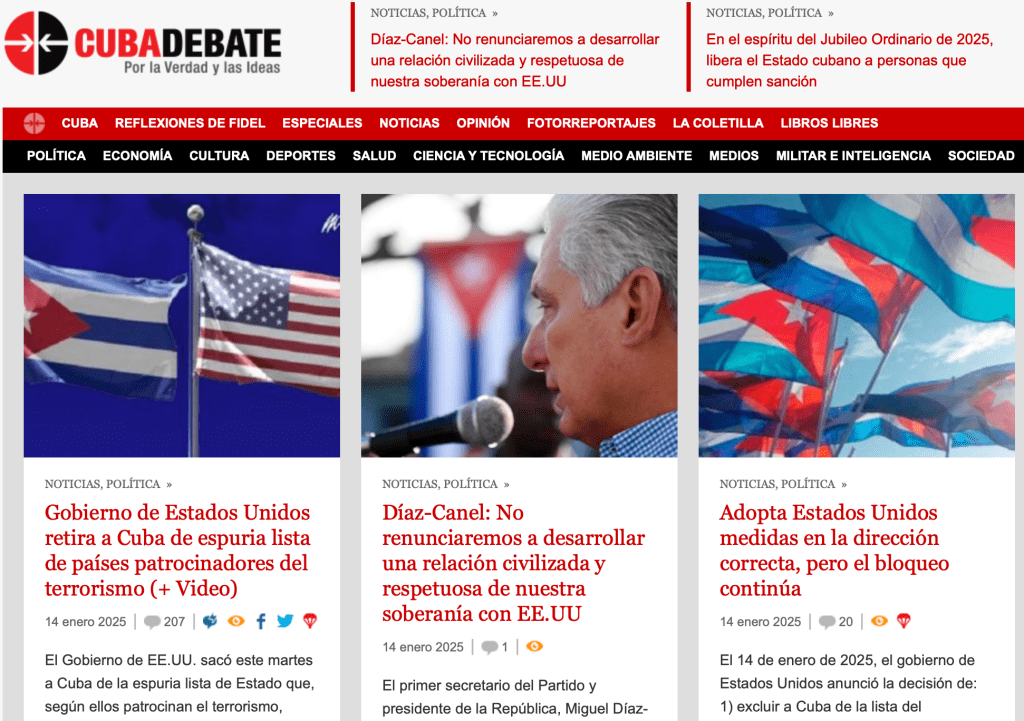
Left: Reuters coverage. Right: As reported by CubaDebate – “State Department recognises the lie, but does not remove Cuba from the list of state sponsors of terrorism.” President Miguel Diaz-Canel told interviewer Ignacio Ramonet that many of Cuba’s economic woes begin with the U.S. blockade, tightened in 2021 with “the inclusion of Cuba in a spurious list determined at will by the U.S. government of countries that supposedly support terrorism.”

Until this week, the administration of President Joe Biden had made only minor reforms—easing some restrictions on travel and family remittances in May 2022—but had scarcely budged from the harsh measures taken by his predecessor, Donald Trump, much less attaining Barack Obama’s level of engagement.

It was just days just before the end of Trump’s administration in January 2021 that Cuba was added to the list of “state sponsors of terrorism” (SST)—because Cuba was hosting peace talks between the Colombian government and one of the guerrilla armies, the Ejército de Liberación Nacional (ELN). Despite occasional setbacks, the Colombian peace process moves forward slowly.

Biden’s new move comes after three years of non-stop advocacy by churches and other non-governmental organizations to end the embargo and to have Cuba removed from the SST list.

Efforts by churches, unions and other groups are driven by a sharp deterioration of the Cuban economy that is partly a consequence of the SST and other measures as banks and other corporations fear running afoul of the U.S. measures. The economic downturn is also related to reduced tourist visits to the country during the Covid pandemic and Cuba’s abandonment of its former two-currency system (one tied to the U.S. dollar, and the other that effectively subsidized local transactions).

In April 2023, an informal alliance of more than 20 Canadian churches, trade unions, development agencies and community solidarity groups wrote to Foreign Affairs Minister Mélanie Joly and to then-International Development Minister Harjit Sajjan to express alarm at the “deterioration of the Cuban economy and consequent impacts on the Cuban people.”

They called on the government to press the United States to ease sanctions and to remove Cuba from the SST list. They also asked that Canada “scale up its efforts to provide immediate food, medicines, and medical supplies to Cuba” (whether directly with the Cuban state or via NGOs and multilateral organizations). 

Canada has made some efforts, notably the announcement March 6 of a $540,000 contribution to the World Food Program to support provision of 150 tons of milk that will assist Cuban children. Canada’s response followed just two days after the Cuban government had made its first-ever request to WFP for food aid. Canada continues to fund the work of NGOs such as Oxfam and CARE Canada in Cuba.

The Canadian letter echoed earlier calls from Cuban and U.S. churches. In a joint letter sent Feb. 18, 2021, they asked Biden to to restore travel, remittances and trade with Cuba; to remove Cuba from the list of “state sponsors of terrorism;” to rescind Trump’s mandate to use extraterritorial provisions of the Helms-Burton law; and to rebuild U.S. diplomatic presence in Cuba. On March 13, 2023, more than 20 U.S. faith groups wrote to Biden to ask that Cuba be removed from the SST list.

The SST designation, along with Trump’s application of measures contained in the 1995 Helms-Burton Act, have extraterritorial impacts. Foreign-owned ships won’t dock in Cuba and foreign banks are reluctant to transfer funds for fear of running afoul of the U.S. laws. To understand better the impact of the SST in Cuba, please read a long report by the Washington Office on Latin America (WOLA).

The extraterritorial features of the Helms-Burton law provoked anger in Canada and Europe, but those features were effectively waived by Presidents Clinton, Bush and Obama. In April 2019, Trump revived them. Canada repeated its objection, and reminded Canadians that amendments in 1996 to Canada’s Foreign Extraterritorial Measures Act (FEMA) stipulate that any judgment issued under Helms-Burton “shall neither be recognized nor enforceable in any manner in Canada.”

But Canada, to my knowledge, has yet to say anything publicly about the SST list.

Meanwhile, churches, NGOs and solidarity groups continue to provide aid to Cuba, including in response to damage caused by Hurricane Ian in western Cuba in 2022 and after the oil storage facility fire in Matanzas in 2022. 

Vancouver-based CoDevelopment Canada is collecting material to send in a container to Cuban trade unions later this summer. 

The U.S. Cuba Normalization Coalition has a fact sheet about U.S.-backed attacks on Cuba. “Cuba has endured 64 years of a U.S. economic blockade.This intensified when President Trump unjustifiably put Cuba on a list of so-called State Sponsors of Terrorism (SSOT).President Biden has continued that listing. Companies worldwide that want to sell medicines or food to Cuba often can’t because their own bank refuses to accept Cuba’s payment under threat of enormous fines from the U.S.treasury for dealing with ‘terrorists’.”

From Palenque, Chiapas, Latin American leaders call for migration solutions

In recent weeks, my partner and I took a long drive from British Columbia through the western United States and then almost the length of Mexico to arrive in Chiapas.

While people who migrate northwards either for seasonal work or for more permanent refuge from poverty, violence and impacts of climate change were on our minds and in the news, at least some of the people we met alongside us in gas stations and cafés were seasonal workers heading home for the winter. 

Migration, my friends, is normal. In southern Texas and northern Mexico, we encountered thousands of monarch butterflies as they headed for Michoacán. And here in Chiapas, the migratory birds are arriving daily.

At around the time of our trip, leaders of ten nations of Latin America and the Caribbean – frustrated by slow progress with the United States (and other northern countries) in advancing meaningful human development and managing the flow of people – gathered in the historic Maya city of Palenque, Chiapas, and proposed some ways forward.

Photo from the Office of the President of Mexico

Led by Mexico, the governments of Belize, Colombia, Costa Rica, Cuba, El Salvador, Haiti, Honduras, Panama and Venezuela signed the Palenque Declaration on Oct. 22 and called for solutions. (A representative of the newly-elected government in Guatemala also joined the talks.)

In the declaration, presented by the Mexican Foreign Minister, Alicia Bárcena, the leaders described several structural causes of migration: internally political, economic, social factors and the effects of climate change. But they also pointed to “external factors such as unilateral coercive measures of an indiscriminate nature – dictated from the United States – that negatively affect entire populations and, to a greater extent, the most vulnerable people and communities.”

They urged the United States to lift the sanctions imposed on Cuba and Venezuela that help drive the exodus. Such sanctions are against international law and, as the migration flow shows, they have impacts beyond the countries to which they are applied.

The document also proposed undertaking efforts to modify the financial architecture of debt; to close social gaps to as to reduce the impulse to migrate; push for measures aimed at increasing agricultural activity to promote food self-sufficiency in the region; and to promote intraregional trade and investment for socioeconomic development.

The signatory nations stressed that measures must be taken to confront transnational organized crime, human trafficking and corruption, as well as promote joint cooperation in security matters.

They called for destination countries to “adopt immigration policies and practices in line with the current reality of our region and abandon those that are inconsistent and selective, to avoid arbitrarily producing both ‘call effects’ and ‘deterrent effects’ – advantages given to certain countries for political reasons while nationals of other countries are blocked.

They encouraged destination countries to widen their regular migration pathways, with emphasis on labour mobility and promotion of re-integration and safe return of temporary workers to their homes.

The declaration makes special mention of Haiti, and called on nations to support efforts by the United Nations and others to re-establish conditions for human security so that the political, economic and social situation may be normalized, and to focus on sustainable development. (The presence of the Haitian president at the gathering angered some of the Haitian migrants camped out in the centre of Palenque, reported La Jornada.)

Undated photo from Prensa Latina.

The declaration’s emphasis on economic drivers of migration did not satisfy everyone. Eunice Rendón of the Mexican advocacy group Agenda Migrante told Courthouse News Service that while insecurity was mentioned as a factor driving migration, “it’s not one of the causes, it’s the principal cause,” Rendón said.

“People go because the gang members threaten to kill them, because they try to forcibly recruit them,” she said. (Some might argue that the lack of education and employment opportunities are drivers as well in recruitment for organized crime.)

Meanwhile, migration dramas continue. On Nov. 9, authorities reported that they found found 123 Central and South American migrants trapped in a trailer in Matehuala, San Luís Potosí (less than a week after we passed through there). And than 400,000 migrants have crossed the Darien Gap from Colombia into Panama in 2023, according to the Panamanian government, up from 250,000 in 2022.