Trump says U.S. is ‘starting to talk with Cuba’ even as he tries to block oil imports

by Jim Hodgson

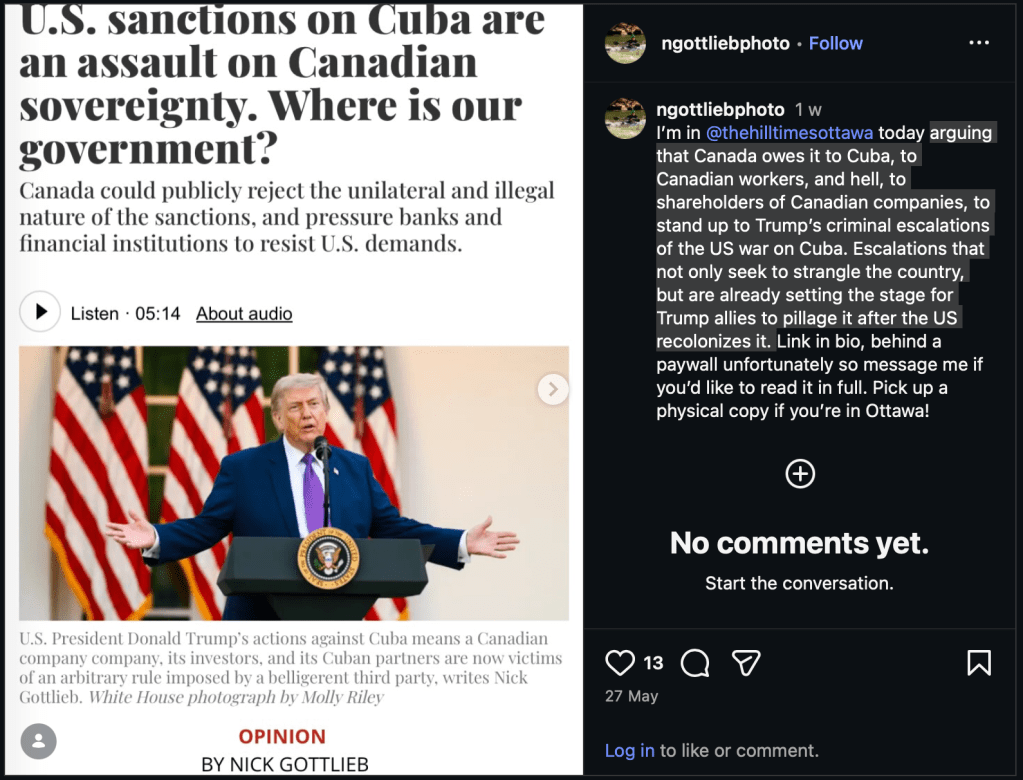
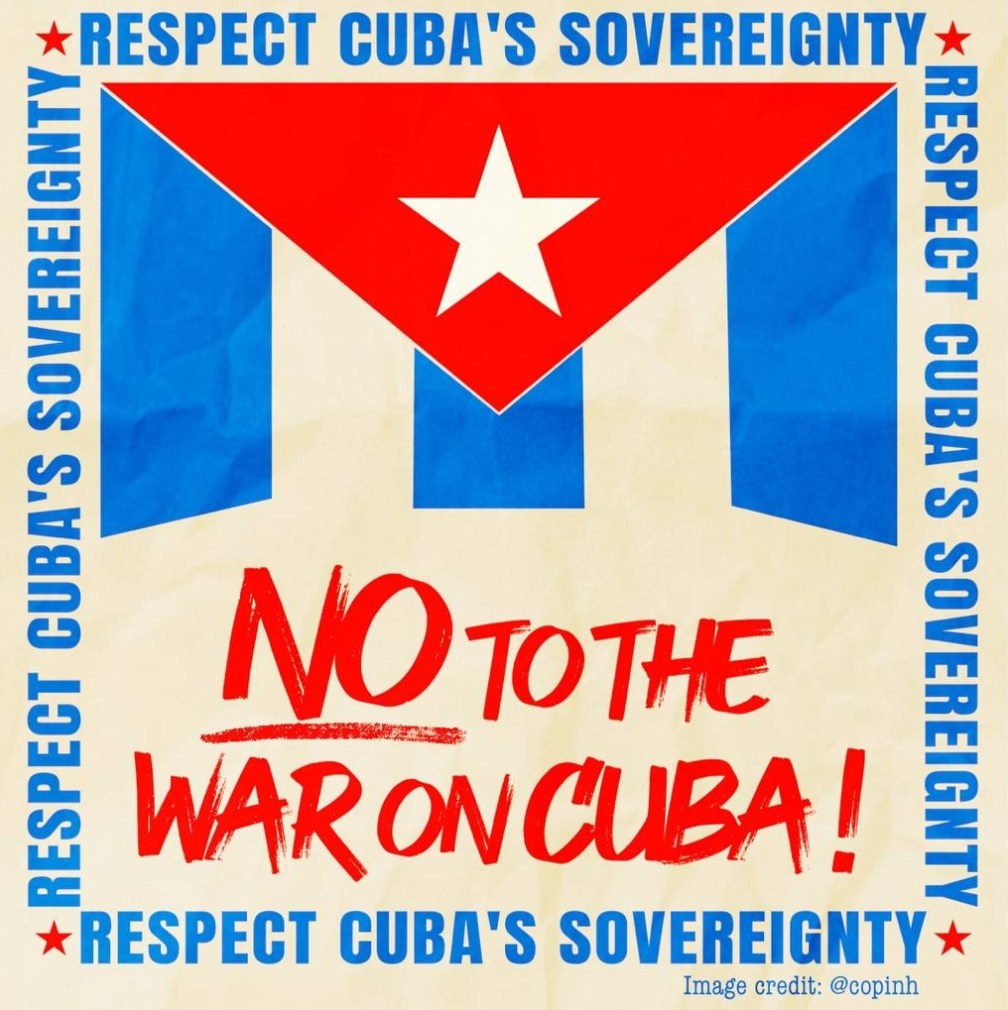
In the face of U.S. President Donald Trump’s threats to impose new tariffs on any nation that exports oil to Cuba, we all need to stand firm. Here are two ways to send messages to Canadian leaders.

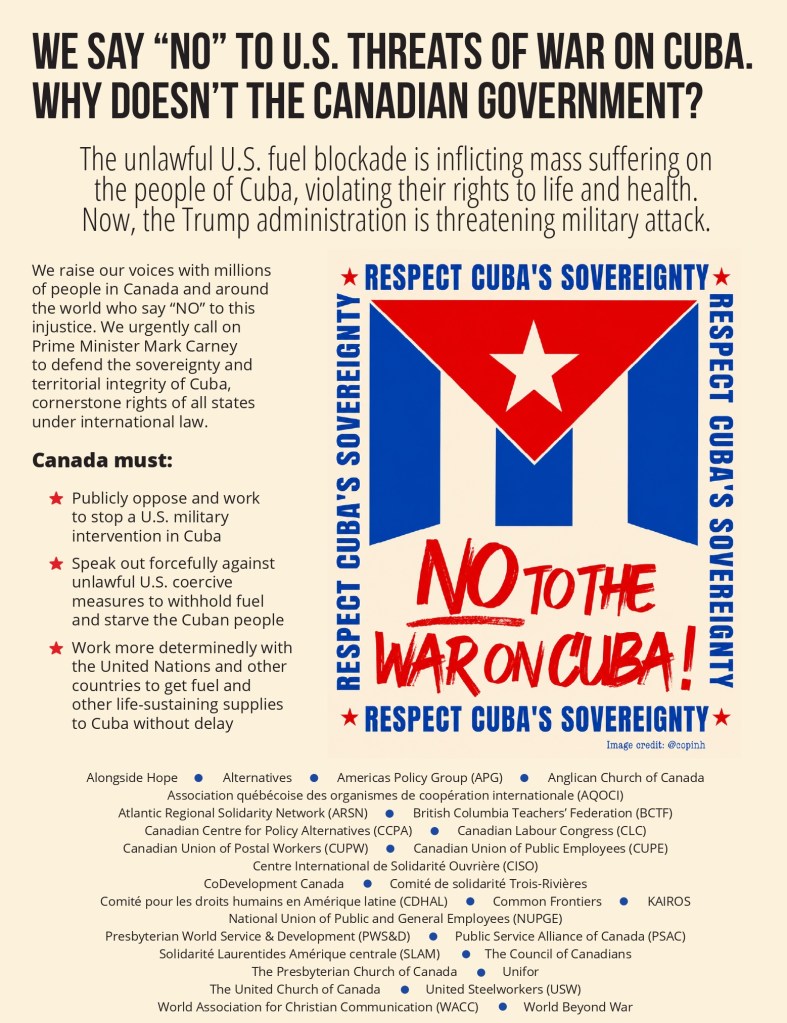
First, the Take Action proposed by Canadian churches, trade unions and NGOs. Yes: it pre-dates the current crisis, but its message is vital. Canada cannot be silent.

Second, the Canadian Network on Cuba has an on-line petition to Canadian parliamentarians. It too pre-dates the immediate crisis, but is still an important means to communicate.

Of course you can write your own letters to leaders in whichever country you live.

Take heart from increasingly strong messages from Mexican President Claudia Sheinbaum.

Today, she denied Trump’s claim a night earlier that they had talked about Cuba, much less that he had asked her to stop sending Mexican oil to Cuba and that she would comply.

La Jornada

The only such conversation, she said while travelling in Sonora state, had been between her foreign affairs secretary, Juan Ramón de la Fuente, and U.S. Secretary of State Marco RubioSheinbaum has said several times this week that her country will continue to send humanitarian aid including oil to Cuba. Various sources report that Cuba has only enough oil to satisfy needs for another 15 to 20 days.

For his part, de la Fuente told Mexican legislators today that Mexico considers it “unacceptable that there not be humanitarian aid where it is needed, when some country in the world requires it.”

Saturday night, while travelling from Washington DC to his home in Florida, Trump said the United States was beginning to talk with Cuban leaders. (There is no confirmation as of Sunday evening from Cuba that such talks have begun.)

In comments to reports on Air Force One, he added: “It doesn’t have to be a humanitarian crisis. I think they probably would come to us and want to make a deal,” Trump said Saturday. “So Cuba would be free again.”

He predicted they would make some sort of deal with Cuba and said, “I think, you know, we’ll be kind.” (U.S. interventions since 1812 have not been known for their kindness.)

The comments follow more than six decades of U.S. sanctions aimed at inducing regime change in revolutionary Cuba, the kidnapping four weeks ago of Venezuelan President Nicolás Maduro, and Trump’s threat to impose tariffs on any country that continued to sell oil to Cuba. 

On Wednesday night, Jan. 29, he declared a “national emergency” to protect “U.S. national security and foreign policy from the Cuban regime’s malign actions and policies.”

Granma photo: Ricardo López Hevia

Cuban leaders have condemned and denounced this new escalation of the “U.S. economic blockade.”

“Surrender will never be an option, and hard times like these must be faced with courage and bravery,” said President Miguel Díaz-Canel Saturday.

The Trump regime’s tactic of confiscating Venezuelan oil tankers has worsened a fuel and electricity crisis in Cuba. The Cuban people face rolling blackouts and struggle to cope without reliable fuel and electricity supplies.

"Another World is Possible," World Social Forum, Porto Alegre, Brasil (2005)

The old order is dead. Let’s make a new, more just order.

by Jim Hodgson

It was too much to hope that the well-heeled audience at Davos would boo Donald Trump from the stage a day after they had offered Mark Carney a standing ovation. But by the end of Wednesday, it seemed that the wall of resistance to any U.S. take-over of Greenland was successful, and the president backed down. An important victory.


Still, “la rupture de l’ordre mondial” of which Carney spoke remains. And he’s right: we shouldn’t mourn it. The international financial institutions invented in 1944 at Bretton Woods, New Hampshire, gave overwhelming power to the rich countries of the Global North. 

And the United Nations system that followed, with a veto given to each of the five most powerful countries, has protected their interests – even in the face of overwhelming contrarian votes in the UN General Assembly. Think, for example, of the annual vote to end the cruel U.S. blockade of Cuba.

That order was designed by the nations that existed at the end of World War II, especially the colonial or neo-colonial states of Europe and the Americas. Most of the Caribbean, Africa and large parts of south Asia were still under colonial rule. That order imposed and perpetuated a Global North-based order on all the new nations that were born in the 25 years or so after the war: the majority of nations that exist today.

And that order, at least in the eyes of three of the five veto-holders, effectively imposed capitalism as a synonym for democracy. The United States and its allies were satisfied with a sort of formal democracy, a certain alternance between parties of the right and centre-right, and if that failed, then a military government was a useful interlude until the real order could be re-established and markets were safe. 

Canada would “go along to get along,” as Carney admitted. 

Just as it did less than three weeks ago when the United States bombed Venezuela and kidnapped its president. And just as it has for more than two years over Israel’s genocide in Gaza.

In his speech, Carney seemed to offer a vision of capitalism without the now-erratic United States. It’s still reliant on resource extraction, military spending, and massive capital investment.

But if we are all to grow and thrive, we must demand more. We require an end to practices that exploit social inequities and our shared ecology. 

Alternatives

Because of the paths on which my life has taken me, one that is especially close to my heart is the call from the Indigenous people of Zapatista communities in southern Mexico for “a world with room for all” – “un mundo donde quepan muchos mundos.” But other visions come from other places, including three decades of gatherings of the World Social Forum.

More than 50 years ago, the majority world united behind a vision of economic decolonization, sovereign development, and international cooperation across areas such as debt, trade, finance, and technology. That vision became known as the New International Economic Order (NIEO) and was adopted by the UN General Assembly. But, power relations being what they are, it was never implemented. (Progressive International put together a set of reflections that trace its history and update the proposals for the 21st century.)

In March last year, the World Council of Churches and several global communions of churches repeated their call for a New International Financial and Economic Architecture (NIFEA). “It is immoral that over a billion people – half of them children – subsist in poverty whilst billionaires increased their wealth by over 15% in 2024 to US$15 trillion. It is outrageous that the richest 10% of the global population receives more than half of global income, whereas the poorest half earns merely 8.5% of it,” they said in a statement.

They expressed deep concern about “a rapidly escalating climate and biodiversity emergency that jeopardises livelihoods and poses an existential threat to all life.” It notes that “several tipping points are close to being crossed or have already been crossed, leading us to recognise that we may be beyond a point of no return.”

The old order is dead. The time in which we are living demands we do better.

U.S. approach to Venezuela is “imperial madness”

by Jim Hodgson

The claim by U.S. President Donald Trump that his forces attacked “a big facility” in Venezuela left me wondering if he was (again) flat-out lying, having another cognition meltdown, or maybe speaking some sort of truth.

In a radio interview Dec. 26, Trump said: “We just knocked out – I don’t know if you read or you saw – they have a big plant or big facility where they send the, you know, where the ships come from. Two nights ago, we knocked that out. So we hit them very hard.”

In Venezuela, officials reacted hesitantly. It turns out there was a fire earlier that day at a chemical warehouse run by a company called Primazol in Maracaibo, a major hub for the export of petroleum. But in Venezuela, the fire was treated as a minor event, and the company issued a statement rejecting “the versions circulating on social media,” stating that they “have no relation to the incident and it does not correspond to official or verified information.”

Headline and photo from TeleSur English site.

The Primazol plant is located five km from the sea, making it doubtful that there was any facility there from which boats carrying drugs could depart, much less a “dock,” as Trump claimed in a second set of comments at Mar-a-Lago Dec. 29. (“There was a major explosion in the dock area where they load the boats up with drugs.”)

Today’s New York Times morning newsletter quotes U.S. officials who may be trying to provide cover for their boss or offering a semi-truthful account:

A port strike

The C.I.A. [Central Intelligence Agency] conducted a drone strike on a port facility in Venezuela last week, people briefed on the operation said. The strike was on a dock where U.S. officials believe a Venezuelan gang was storing narcotics, and it did not kill anyone, they said. The strike is the first known American operation inside Venezuela.

This Times story offers new details on the strike, which President Trump has already discussed openly, despite the secrecy that typically surrounds C.I.A. operations. 

The Trump administration has focused on three goals — to limit Nicolás Maduro’s power, to use military force against drug cartels and to secure access to Venezuela’s vast oil reserves for U.S. companies.

“We’ve had 27 weeks of imperial madness”

Venezuelan Interior Minister Diosdado Cabello denounced the silence of the international community, particularly the United Nations (UN) and other multilateral organizations, regarding the months-long offensive waged against his country by the United States government.

“We’ve had 27 weeks of imperial madness… harassment, threats, attacks, persecution, theft, piracy, murder, and the world – I mean the world, that UN and its cronies – is silent; nobody says a word,” he stated during the activation of a new security program in Aragua state. 

He added that “imperialism, those who think they own the world,” not only intend to steal Venezuela’s natural resources, but “want to go further” and subjugate the Venezuelan people because “they don’t like dignified peoples who demand respect and respect themselves.”

Cabello, who highlighted the character of the Venezuelan people in the face of years of attacks of various kinds, offered assurance: “They are not going to ruin our Christmas or New Year, they cannot because of how many things we have endured, how many things they have tried against this people.”

On Monday afternoon, the U.S. Southern Command announced that it had struck another small boat in the eastern Pacific, killing two more men. The new strike means that the U.S. military has killed more than 100 individuals in an operation widely condemned as illegal.

Mexico’s president rejects interventions, call for greater UN leadership

Speaking at a news conference early on Dec. 30, President Claudia Sheinbaum said that the UN should play a more prominent role in these cases.

“What we have to say is that we do not agree with interventions, especially military ones. That is enshrined in our country’s constitution, and that is what we will continue to defend,” she said in response to a question about the case.

When asked if there should be a call in the region to support Venezuela, she replied, “Yes, and as we have said, the United Nations must take a more prominent role in these cases.”

Mexico and other countries backed Venezuela in a Dec. 23 meeting of the UN Security Council, but the United States used its veto power to block a Venezuelan resolution from even coming to a vote

Diverse parts of the UN Office of the High Commissioner for Human Rights (OHCHR) are responding to the situations facing Venezuela in different ways. 

On Dec. 24, several UN experts (“special rapporteurs”) denounced the partial maritime blockade imposed by the United States on Venezuela as violating fundamental rules of international law. The same day, Venezuelan Foreign Minister Yván Gil welcomed the statement: “The truth about Venezuela is breaking through around the world.”

Meanwhile, the OHCHR has announced a new “fact-finding” mission to Venezuela that will include Alex Neve, former secretary general of Amnesty International Canada.

And Canada?

Silence from Ottawa regarding U.S. aggression towards Venezuela has been resounding – even in the face of reports that Canada helps the United States in those boat attacks. It’s clear that the government of Prime Minister Mark Carney is choosing its words carefully in the face of U.S. threats to Canada’s sovereignty.

But Canada should at least uphold the 2014 declaration by Latin America and Caribbean countries that their region is a “zone of peace,” support calls for UN leadership in peace-making, and reject the new U.S. National Security Strategy