In Venezuela, the opposition follows a familiar script

In the face of controversy and even violence in the wake of Sunday’s presidential election in Venezuela, responsible Latin American leaders have called for two things: no foreign interference and release of detailed results from polling stations.

Colombia’s Gustavo Petro, Brazil’s Luiz Inácio da Silva (Lula), and Mexico’s Andrés Manuel López Obrador(AMLO)—along with AMLO’s successor, Claudia Scheinbaum—all emphasized the principles of non-intervention and transparency.

You might not learn this in mainstream media, but today (July 31), Venezuelan President Nicolás Maduro promised to release all the electoral tally sheets. (These are poll-by-poll results that are called “actas” in Spanish and translated into English variously as minutes, receipts or tally sheets.)

After affirming Maduro’s victory early Monday, the National Electoral Commission (CNE) has 30 days to publish full results, but it is impeded this week by various hacking attempts and by the need to protect staff from protesters outside their regional offices.

Maduro also asked his country’s Supreme Court to conduct an audit of the election. “I am asking the Court to rule on the attack against the electoral process and the attempted coup. Let the Court clarify everything that needs to be clarified… Venezuela has strong institutions,” he told reporters.

But will that be enough to satisfy long-time opponents of Venezuela’s 25-year attempt to break from rule by a wealthy minority and to turn the nation’s resources to the benefit of the impoverished majority?

U.S. and allies block profound change

Not likely. To me it feels like we’ve seen this show before. Whether excusing a military coup (Honduras 2009), a clever parliamentary ruse (Paraguay 2012, Peru 2022), or justifying an outright invasion (Panama 1989, Iraq 2003), the United States and its allies have found many ways to block profound change.

This election took place in the face of more than 900 different sanctions and in the wake of other measures that stripped the country of assets held abroad.
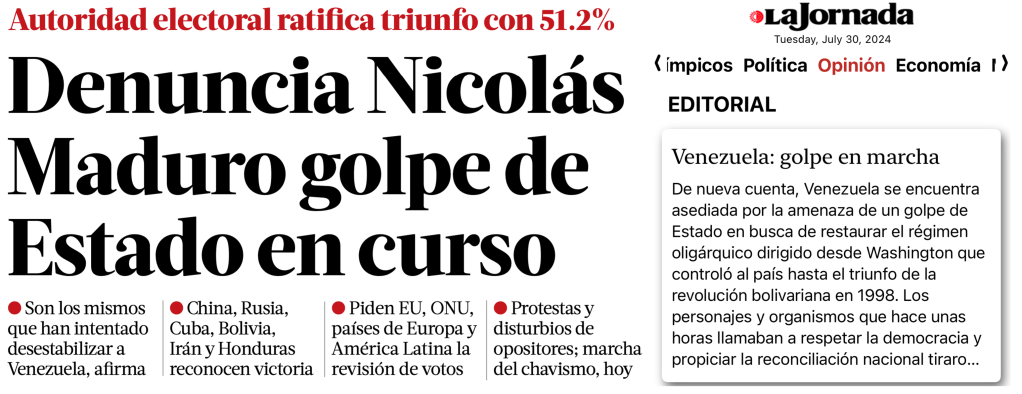
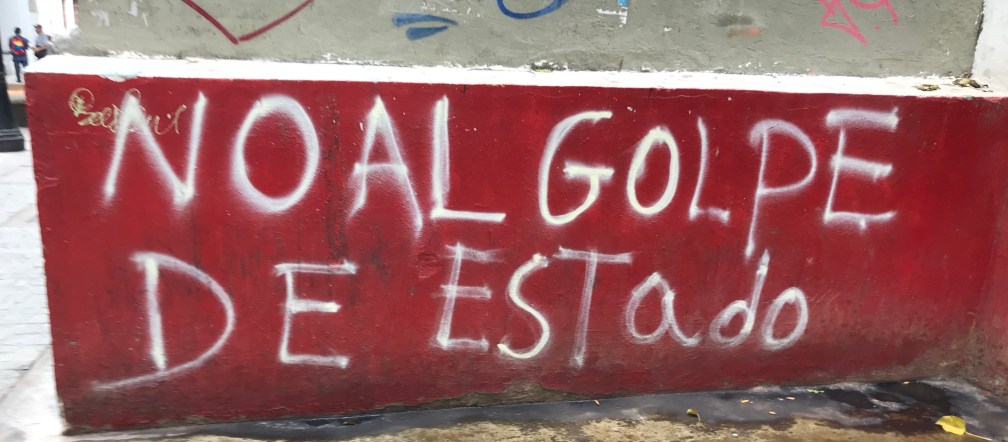
Yesterday, the Mexico City independent daily newspaper La Jornada warned in an editorial that a coup is underway in Venezuela. My translation follows: 

Once again, Venezuela finds itself besieged by the threat of a coup d’état that seeks to restore the oligarchic regime run from Washington that controlled the country until the triumph of the Bolivarian revolution in 1998. The personalities and organizations that a few hours ago called for respect for democracy and offered national reconciliation threw down their masks once they realized that their candidate had been defeated at the polls by President Nicolás Maduro.

The attempt that is now underway to unseat the constitutional government of Venezuela and to impose a puppet administration has followed a prepared script from which the Caribbean nation has already suffered in 2002, 2014, 2017 and 2019, the same one that has been replicated in other parts of Latin America. Large communications media reproduce accusations of fraud as if they were proven facts, do not recognize Venezuelan law and paint the far-right shock groups as heroes in the struggle for democracy. Multinational organizations with clear conservative biases put the results in doubt and legitimate violent actions instigated by the opposition. Opposition leaders proclaim their triumph in a unilateral way and put in action the perfectly-coordinated mechanisms for destabilization with which they have gained much skill through decades of coups.

Recall that the strawman candidate Edmundo González and the true leader of the Venezuelan right, María Corina Machado, are only the most recently-chosen by the White House and the CIA to take over the Miraflores Palace, and with it, the largest oil reserves of the planet. Just in 2019, the legislator Juan Guaidó was the useful idiot with whom the West mounted its parallel government ruse, stole Venezuelan foreign assets and tightened its homicidal blockade that prevented the country from acquiring all kinds of goods, including food and medicine. Today relegated to history’s wastebin, Guaidó inflicted immeasurable damage to his country and is directly responsible for the hunger, illness and misery of millions of his compatriots who could not make a normal life because of imperialist aggression. Just as in the worst moments of the Cold War and in Plan Condor with which the United States orchestrated the genocide of leaders and militants of the left in this hemisphere, a group of Latin American governments joined the attack on Venezuela and backed the coup-supporters….It is imperative that Western powers and media aligned with them take their hands off Venezuela and allow Venezuelans to arrange their own differences through institutional and democratic means. Without financing, advice and foreign media amplification, the local right would not dare to try over and over again to overthrow the Chavismo that it has not been able to defeat by voting. 

A day later (July 31), La Jornada warned in a new editorial that Venezuela is again consumed by a “spiral of violence” driven by the United States and its local agents who will not recognize any “electoral result that is counter to the plans of the superpower to impose a puppet government that will turn over political, diplomatic and economic control of the country and its natural resources.”

It continues: “Think what you may of the Maduro government, nothing justifies interference in the internal affairs of Venezuela beyond the channels established by international law.”

Visiting scenes of climate disaster and getting ready for the next one

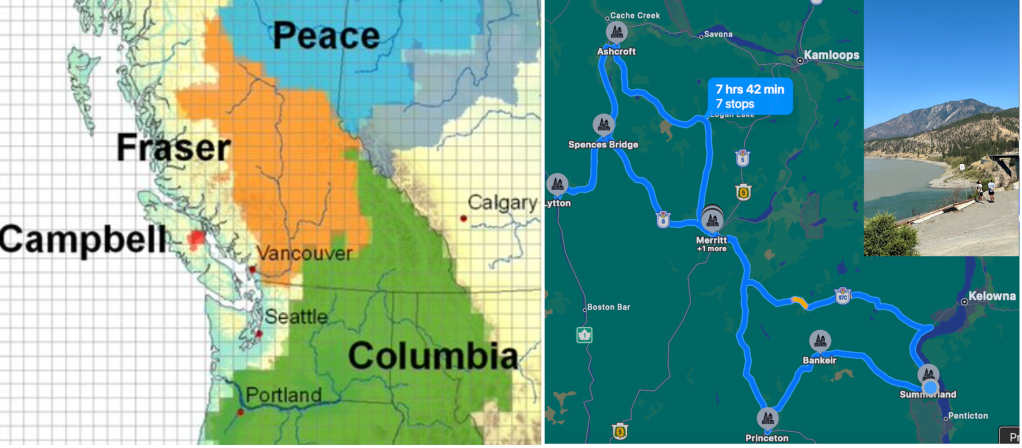
Contrasts: trees near Osprey Lake between Summerland and Princeton, and trees east of Spences Bridge, July 15, 2024.

by Jim Hodgson

David, Kamill and I headed out by car last Monday for a quick visit to a small patch of territory northwest of our Okanagan home where a forest fire and an extreme flood wrought havoc just months apart in 2021. 

We drove west from Summerland on a beautiful mountain route that follows an ancient Indigenous trail—later part of the Kettle Valley Railroad and now a bike path—to just north of Princeton. Then we turned north to Merritt. From there, we followed the Nicola River northwest on Highway 8.

Left: Southern British Columbia watersheds: the Okanagan valley is in the Columbia watershed; the Nicola and Thompson rivers are in the Fraser watershed.
Centre: our route (the inset shows where the Thompson enters the Fraser at Lytton).

On Nov. 14 and 15, 2021, an atmospheric river brought an unprecedented amount of rain to southern British Columbia. All highways leading east from Vancouver and into the province’s Interior were blocked by floods or landslides. Princeton and Merritt were among many communities flooded.

The Nicola valley was particularly hard hit. It’s a narrow valley, and areas along both sides of the river were farmland. It’s home to the Nooaitch, Shackan and Cook’s Ferry First Nation communities and to their settler neighbours. The flood destroyed homes, farms, the old rail bed and parts of the highway. You can see the devastation of the Nicola valley in a Globe and Mail photo essay or in a B.C. highways department video. In November 2022 after a year of work, the highway re-opened with partial repairs. 

As we drove towards Spences Bridge, we also passed through an area severely damaged in a forest fire some years ago. At the same time, we could see a new fire spreading on a mountainside ahead of us above the Thompson River—likely what came to be called the Shetland Creek fire.

We had lunch in a nice little restaurant called The Packing House in Spences Bridge—just next to the Baits Motel. We drove south on Highway 1 (the Trans-Canada) along the Thompson River to its confluence with the Fraser River. 

And here we came to Lytton, the town of 3,000 people that was destroyed by a wildfire on June 30, 2021. Back in the late 90s, David and I began stopping here occasionally on trips to or from Vancouver. (We like to vary our routes.) It was a lovely town. It had a museum about the history of Chinese migration to the area—and its creator hopes to rebuild. Elsewhere in town, there is more construction: signs that the community will recover.

As we observed how the blue Thompson flows into the muddy Fraser, we could see a helicopter collecting water to drop on another fire burning in the mountains across the river.

We drove home via Ashcroft, whose residents are now on evacuation alert because of the Shetland Creek fire. After passing the massive tailings pond of the Highland Valley Copper Mine—a disaster of a different sort—we returned to Merritt and took the Okanagan connector highway to Peachland, and then turned south on Highway 97 back to Summerland. We drove about 600 km that day.

Of flood and fire

On Tuesday, Toronto had another “once-in-a-century” rainstorm after previous ones in 2005, 2013 and 2018. That day, we were back on Highway 97 as we drove Kamill to the airport in Kelowna for the trip home to Ottawa.

On Wednesday, a wildfire south of Peachland closed Highway 97 for most of the day. Traffic was later restricted to “single-lane alternating” (a phrase I am getting used to) and fully re-opened Friday afternoon.

As the week progressed (and U.S. climate-change deniers held their party’s convention in Milwaukee), I gathered some stories of effects of the climate catastrophe elsewhere in the world. (I did this in post back in January as well.)

These AP stories were published June 20, the summer solstice. Eight days later, Hurricane Beryl formed in the Atlantic Ocean just east of the Caribbean’s Windward Islands. In just 10 hours, it jumped to Hurricane 4 level before striking Grenada, St. Vincent and the Grenadines, and other islands before easing as it moved west across the Caribbean, the Yucatan peninsula and south Texas.

Back in April, U.N. secretary general Antonio Guterres warned that “we cannot replace one dirty, exploitative, extractive industry with another” as we reshape how we power our societies and economies. Some developing countries have large reserves of “critical minerals” such as copper, lithium, nickel and cobalt. But they “cannot be shackled to the bottom of the clean energy value chain. The race to net zero cannot trample over the poor.”

In May, Raúl Zibechi, longtime observer of the role of social movements in processes of political change in Latin America, warned that the climate crisis cannot be stopped. Politicians won’t act for profound change; those who prefer wars over struggles for peace won’t change. His suggestion is that impoverished or otherwise marginalized peoples (“los de abajo”) build collective “arks.” The rich and powerful (“los de arriba”) already have theirs. The example he points toward is that of the Zapatista movement in Mexico’s southern Chiapas state, where for 30 years Indigenous communities have been living in a mostly self-sufficient and self-governing way.

Summers were always hot in the Fraser Canyon and up along the Thompson River towards Kamloops, just as they are where I live in the Okanagan valley. But it feels different now. There were always forest fires, but I don’t remember living in dread of them or having to put up with the long smoky days we have now. In the winter, there were cold spells, but I don’t remember the peach and grape crops being wiped out as has happened this year.

We are putting our emergency kit together (as we did last year) and placing all the important documents in one metal box. North American-style, I suppose: it’s an individualist sort of “ark.” We’re okay with having to take these steps. But we’re also talking about the election in B.C. later this year and a likely national one next year. How do we recover momentum for the dramatic changes necessary to carve a new way forward?

Venezuelans head to the polls July 28 under shadow of sanctions

President Nicolás Maduro (left) is challenged by retired diplomat Edmundo González. (TeleSUR graphic)

by Jim Hodgson

Just over a week from now, Venezuelans will again head to the polls. For the election in 2018, I was there as an observer. This time, I’m watching with concern but from a distance as Venezuelans vote under the pressure of U.S., European and Canadian sanctions that have made living conditions worse for most people.

I got involved with Venezuela soon after the election of Hugo Chávez in December 1998. Those of us concerned about the expansion of corporate-driven “free trade” across the Americas had created the Hemispheric Social Alliance (HSA), a coalition of networks that included Common Frontiers Canada, the Mexican Action Network on Free Trade, Brazil’s Network for Peoples Integration and the U.S. Alliance for Responsible Trade.

At a meeting in Toronto in November 1999 with some of the region’s trade ministers, we found we had a new ally. Venezuela’s trade minister won applause when she said that concern for the rights of the poor needed to be central in trade talks and public policy.

The trade ministers, nevertheless, forged ahead with plans for a Free Trade Area of the Americas (FTAA).When their heads of government gathered in Quebec City in 2001, President Chávez was the one participant who refused to endorse the timetable for FTAA by 2005. By 2005, spurred by pressure from social movements, Chávez and other new leaders were able to defeat the FTAA.

Between 2004 and 2019, I visited Venezuela about a half-dozen times. I observed the 2004 recall referendum and the 2018 presidential election. With encouragement from faith-based organizations in Cuba and Colombia, I joined ecumenical encounters in 2004, 2006 and 2019, and attended the Americas Social Forum in Caracas in 2006.

Inside Venezuela, opposition to Chávez and to his successor Nicolás Maduro has been unrelenting. But their coup in 2002 failed. Their recall referendum in 2004 failed. Their attempt in 2019, in alliance with Canada’s then-foreign minister Chrystia Freeland and the “Lima Group,” to impose an interim head of a past national assembly, Juan Guaidó, as president failed—along with three coup attempts and then a botched invasion.

The May 2018 elections followed months of internationally-sponsored negotiations in the Dominican Republic between the government and opposition that, by February that year, achieved an agreement. But at the last minute, part of the opposition movement said no: other parties, notably that of Henri Falcón, did participate. Our Canadian delegation saw the May election as free and fair. Maduro won. I wrote about our experience in a series of articles for rabble.ca

After the vote, the pressure continued: the Lima Group’s Guaidó gambit; sanctions strengthened again in order to force regime change; and assets of the state oil company, PDVSA, and its U.S. subsidiary, CITGO, were blocked or seized, as were gold reserves held in London. Humanitarian aid became heavily politicized, even blocking access to vaccines during the Covid pandemic. In those circumstances, migration became a normal response. (International organizations set the number of Venezuelan who have left over the past dozen years above 7 million. The government says their figure is about 2.5 million and that of those, about 1.2 million returned between 2020 and 2023—almost half of them with government support.)

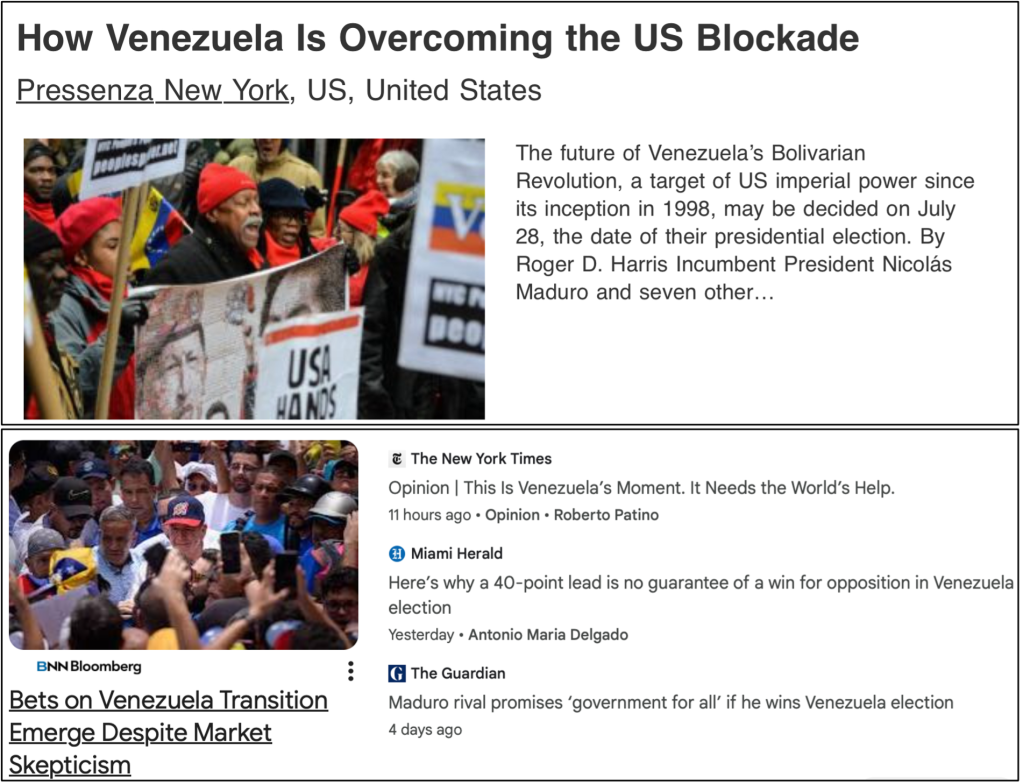
A deep dive into both mainstream media and alternative media (Pressenza, Orinoco Tribune, Venezuelanalysis, TeleSUR, among others, is necessary to get a reasonable sense of what is happening in this election. The far-right may reject official results, much as Trump did in the United States in 2020.

The July 28 vote

This election takes place while Venezuelans suffer under more than 930 “unilateral coercive measures”—sanctions—imposed by the United States, Canada and their European allies. “These should be elections without imperial sanctions,” argued the Mexican philosopher Fernando Buen Abad Domínguez recently. But that is not what is happening.

Early in 2023, UN High Commissioner for Human Rights Volker Türk said sanctions on Venezuela “have exacerbated the economic crisis and hindered human rights,” and called for the measures to be lifted. Türk visited Venezuela in January 2023. His comments reflected similar remarks made two years earlier by Alena Douhan, the UN special rapporteur on the negative impact of unilateral coercive measures on the enjoyment of human rights. She said that the Venezuelan “government’s revenue was reported to shrink by 99% with the country currently living on one per cent of its pre-sanctions income.”

Again this time, complex international negotiations unfolded to produce a basis for the election, finally established through the Barbados Accords. The document was signed in October 2023 by the Maduro government and an alliance of opposition parties known as the Unitary Platform.

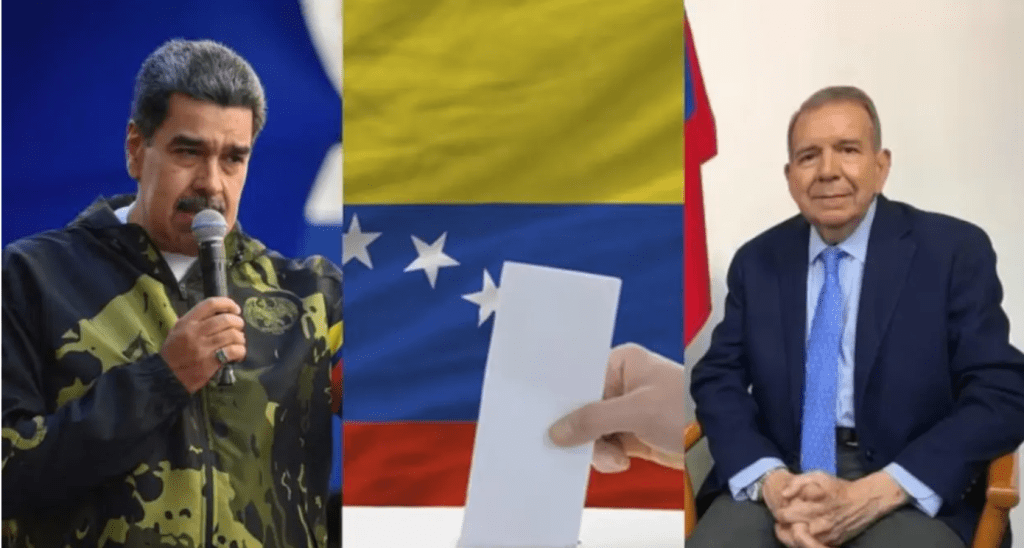
The leading opposition candidate is retired diplomat Edmundo González. He is regarded as a stand-in for María Corina Machado whose candidacy was blocked because of her involvement in organizing violent street protests (sometimes called guarimbas) between 2014 and 2018, and for demanding sanctions. González and another far-right candidate, Enrique Márquez, refused to sign a declaration requested by the Electoral Authority promising they would respect the elections results and refrain from violence in its aftermath.

In the campaign, Maduro and his allies report a number of gains made over the past decade with regard to child care, medical attention, job-training and education. More recently, the inflation rate has dropped to 7.8 per cent, and that the GDP is up by seven per cent. The government has sought ways to diversify the resource-dependent economy and increase national production.

Throughout these 25 years, the government has expanded access to health care, education, housing, public transit, food and pensions through misiones—popular campaigns that use oil revenue for public benefit. 

A recent example is the “Great Mission Return to the Homeland” (Vuelta a la Patria). “We want to ensure that the vast majority of those who have not returned come here, with their family, with their friends,” said Maduro. Pointing to foreign sanctions as the principal cause of emigration, he added that it is his desire to “heal this wound” that the departure of millions of people caused , inviting them to return and to invest and enjoy their country.

It’s not that there are no legitimate criticisms to be made of the government. One might wish, for example, that much more had been done long ago to reduce criminal violence, advance LGBTQIA+ rights,* protect the country’s ecology, reduce dependence on oil revenue, and stimulate food production. If only such criticism could be made in an atmosphere of civil debate without threats to overthrow the government or to foment violence.

Since the 1970s in Latin America, the left in power has tried to govern according to the rules of liberal democracy, perhaps without sufficient regard for the roles of money, foreign interference and private media conglomerates. When the poor win power and actually have a shot at changing the rules of politics and economics—at transforming the structures that made them poor—what may they do to hold on? 

“It is not just any election. It is an election that defines the future,” said former vice-president Jorge Arreaza recently. In the face of strong external and internal opposition, Venezuelans sought to transform democracy so that they could continue re-inventing Latin American politics and economics in ways that benefit most people, not just the rich and not the corporations.

Will they have a chance to continue the effort? Or must they rebuild the social movements and networks necessary for a new attempt that may be decades away?

* Regarding LGBTQIA+ rights. In 2016, Venezuela’s Supreme Court declared that the state will provide protection without distinction to all families, including to children born into same-sex families. In the same year, Venezuela’s Public Ministry announced that transgender people may request a new identity card according to their gender identity.

Recent Pride celebrations are reported in the Orinoco Tribune, with some critical comments:

Venezuela is among the few countries in Latin America that have not legalized marriage equality and, unfortunately, a marriage equality bill has been languishing for nearly a decade in the Venezuelan National Assembly.

Recently, some Chavista politicians have been using socially conservative slogans that replicate US conservative approach towards the LGBTQ+ community and promoting so-called “family and traditional values” against what they call the “perversion” of “Western LGBTQ+ values.”

The ruling PSUV has failed to achieve adequate protections for the LGBTQ+ community which is both a failure of its responsibility to the nation and a national security vulnerability that is being exploited by the imperialists.