Canada must reject U.S. coercion against Cuba and countries that would help

by Jim Hodgson

Canada must condemn the ongoing U.S. embargo against Cuba, say two coalitions of Canadian non-governmental organizations (including churches, trade unions, aid groups and human rights defenders).

The Americas Policy Group (APG) and Common Frontiers wrote Feb. 20 to Prime Minister Mark Carney,Foreign Minister Anita Anand, and Secretary of State (International Development) Randeep Sarai. Their letter condemned the new “coercive measures” – threats of higher tariffs – announced by the Trump administration that make it harder to get food, medicine and fuel.

Before I go too far into this, here’s an action you can take. (And thank you if you already did so!) The Canadian Network on Cuba has worked with MP Alexandre Boulerice to promote an important on-line petition to the members of Parliament. (Once you have signed, be sure to respond to an email asking you to confirm your signature.)

Text of the letter is available in EnglishFrench and Spanish.

The English version follows below: 

February 20, 2026

Re: CANADA MUST REJECT UNLAWFUL U.S. COERCIVE MEASURES TO WITHHOLD FUEL FROM CUBA AND EXPEDITE HUMANITARIAN ASSISTANCE

Dear Prime Minister Mark Carney, Foreign Affairs Minister Anita Anand and Secretary of State (International Development) Randeep Sarai:

The Americas Policy Group (APG) and Common Frontiers, coalitions formed by dozens of respected Canadian civil society organizations, are deeply concerned about the human rights impacts of a U.S. executive order imposing a fuel blockade on Cuba. We call on Canada to immediately reject this dangerous, coercive action which is incompatible with principles of sovereignty, non-intervention and self-determination, essential for a democratic, equitable and peaceful international order.

A month ago, our coalitions called on the Government of Canada to unequivocally condemn U.S. attacks and threats of intervention in Venezuela, Colombia, Mexico, and Cuba as violations of the United Nations Charter and longstanding international norms. We warned about the implications of U.S. security policy that promises to “reassert and enforce the Monroe Doctrine,” a doctrine used in the past to justify brutal interventions in Latin America and the Caribbean.

In October 2025, United Nations member states at the General Assembly voted for the 33rd consecutive time for an end to a decades-long U.S. embargo against Cuba, which has caused enormous hardship and scarcity for the Cuban people. This is reaching crisis proportions as a result of an executive order signed by President Trump on January 29 authorizing the imposition of trade tariffs on any country that directly or indirectly provides oil to Cuba.

UN human rights experts have stated “there is no right under international law to impose economic penalties on third States for engaging in lawful trade with another sovereign country.” The UN experts conclude that the imposition of a fuel blockade on Cuba is “a serious violation of international law and a grave threat to a democratic and equitable international order.”

Member organizations of the Americas Policy Group and Common Frontiers have a long history of cooperation with Cuban civil society organizations and are hearing from them about the impacts of blocking oil supplies to their country. Cuba is highly dependent on imported fuel for essential services, including electricity generation, hospitals, health services, water and sanitation, public transportation, food production and distribution. Moreover, Cuba has been experiencing a deepening socio-economic crisis due to a 60-year financial and trade blockade by the United States, as well as the impacts of increasing extreme weather events. U.S. unilateral measures of economic and political coercion deliberately seek to deepen the suffering of the Cuban people to force regime change. We condemn these measures in the strongest possible terms and are horrified by the collective punishment of the civilian population that we are witnessing.

As an illustration of the dire situation on the ground, the Secretary General of the Provincial Union of Public Administration Workers of Havana shared this message with us: “Our members are experiencing firsthand the effects of the measures taken to prevent fuel from entering the country. For example, our municipal services have been affected; services that are vital to the population like solid waste collection. Without fuel we have no way to collect the garbage. The population, along with municipal workers, are doing everything we can to prevent consequences such as an epidemic or the spread of diseases. We will not give up.”

The UN High Commissioner for Human Rights Volker Türk has sounded the alarm about other consequences and reiterated his call “to lift unilateral sectoral measures, given their broad and indiscriminate impact on the population.” As the High Commissioner has reported, intensive care units, emergency rooms, and ambulance services are compromised, as are the production, delivery, and storage of vaccines, blood products, and other temperature-sensitive medications. Power cuts are undermining access to safe water, sanitation, and hygiene. The fuel shortage has also disrupted the rationing system, the regulated basic food basket, and social protection networks, including school meals, maternity homes, and nursing homes. Vulnerable groups are disproportionately affected. The right to life and the ability to enjoy many other rights are in jeopardy.

Our coalitions are heartened by Canada’s long, highly respected history of independent foreign policy towards Cuba and uninterrupted diplomatic relations with the country since 1945. This includes the Foreign Extraterritorial Measures Act (FEMA), Canadian legislation that protects Canadian sovereignty and commercial interests from U.S. laws and policies that try to impose their jurisdiction inside Canada. We also welcome Canada’s past support for multilateral efforts to end the unjust U.S. economic embargo, such as repeated votes in the United Nations General Assembly condemning the blockade. We call for this principled stance to be upheld and strengthened.

Without delay, we urge the Government of Canada to:

  • Publicly and unequivocally condemn the ongoing U.S. trade embargo against Cuba, including coercive measures announced by the Trump administration that threaten access to the necessities of life: including food, medicine and fuel.
  • Reaffirm Canada’s commitment to the UN Charter, international law, and the human rights obligations Canada has willingly undertaken, including respect for sovereignty, self-determination and the rights to food, health, and wellbeing.
  • Deepen bilateral humanitarian cooperation with Cuba, including direct Canadian assistance to alleviate suffering among the civilian population.
  • Work with regional allies – including at the UN and in other spaces for multilateral action – to end the oil blockade and other punitive economic measures against Cuba, as well as to expand access to humanitarian supplies.
  • Reject all threats of intervention or coercion against countries in the Americas and promote peace, diplomacy, dialogue and regional stability, in accordance with Canada’s stated values and international obligations.

We welcome the opportunity to discuss our recommendations with you and stress that while humanitarian relief is urgently needed, access to fuel and respect for sovereignty are indispensable.

Sincerely,

Americas Policy Group Steering Committee

Common Frontiers Steering Committee

The Americas Policy Group (APG) is a national network of Canadian civil society organizations working for human rights and social and environmental justice in Latin America and the Caribbean. It brings together international development and humanitarian NGOs, human rights organizations, labour unions, faith-based and solidarity groups, and research institutions.

Common Frontiers is a national coalition composed of labour, environmental, faith based and social justice organizations focused on the Americas. We amplify the struggles of organizations and communities with which our members hold long-term relationships throughout the region, and who work to defend democracy, human rights, labour rights, strong public services and the environment.
As Haiti’s transitional government comes to an end, the U.S. flexes its muscles

by Jim Hodgson

In April 2024, I welcomed the formation of Haiti’s transitional council (known as the CPT). It was the product of negotiations among a broad spectrum of Haitian political parties and civil society organizations, including the business sector.

Within a month, fractures that would block steps toward a new election became apparent. And efforts to create conditions for an election were undermined by a rapid and ongoing increase in neighbourhood-based gang violence – despite the presence of UN-backed soldiers and police.

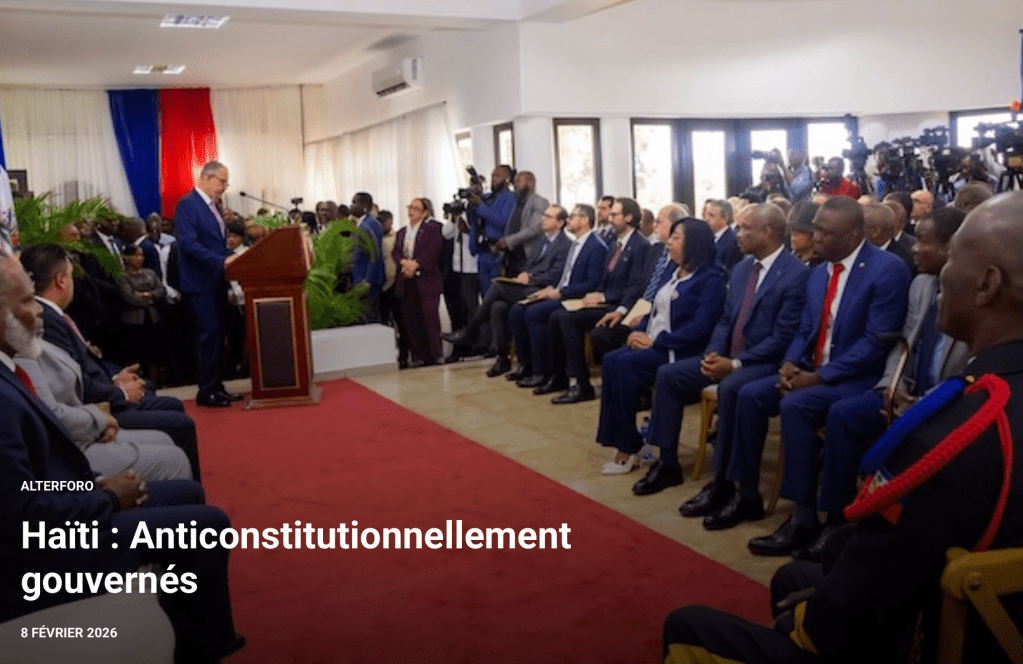
The mandate of the CPT expired on Saturday, Feb. 7, which also happened to be the 40th anniversary of the fall of the Duvalier family dictatorship. 

The transition ceremony Feb. 7: Haitians are “anti-constitutionally governed” (AlterPresse)

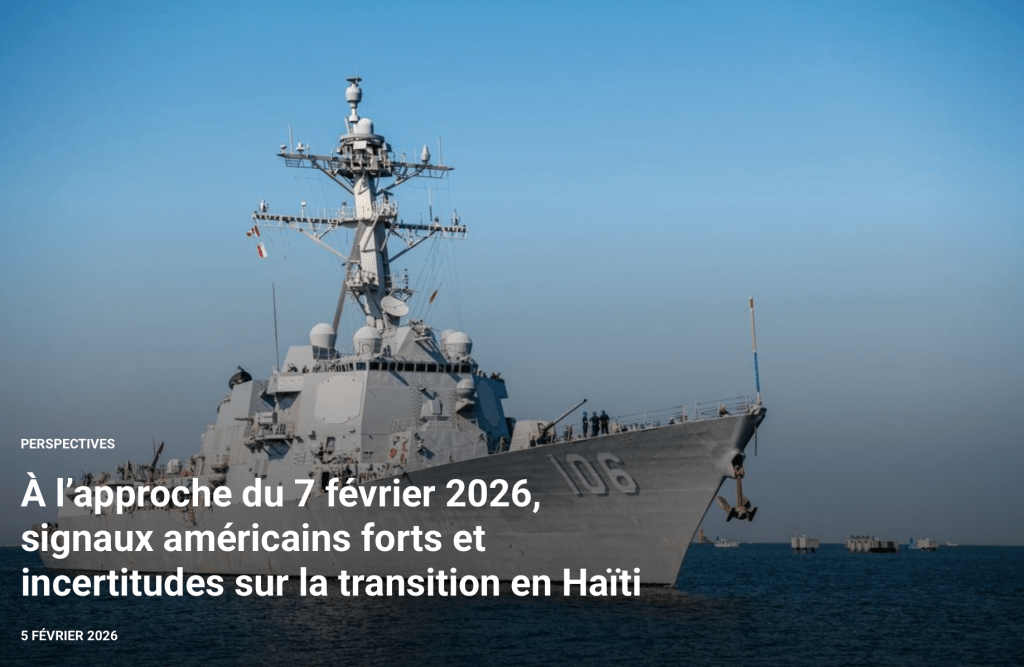
A U.S. warship and two Coast Guard ships sit in the Port-au-Prince harbour and a military plane was on the ground at the international airport. As many as 1.4 million people are displaced by gang violence. The political in-fighting rages.

In moments like this, I try to look at a variety of media sources to understand what is going on. The one I trust most is AlterPresse, a civil society initiative that emerges from among the groups that have worked for decades for a better future for people afflicted by poverty and violence. Haitian elites and their neoliberal allies abroad, meanwhile, seem determined again to impose a new totalitarian state, which is a predator state (like that of Duvalier) safe only for the rich and their cronies.

In the absence of any elections, Prime Minister Alix Didier Fils-Aimé (a businessman named to the post by the CPT in November 2024) will hold on to power beyond the CPT’s expiry. He will rule like former de facto Prime Minister Ariel Henry did from July 2021 through February 2024: a head-of-government without a head-of-state or Parliament. 

Accountability? Only to the foreign governments that have backed him: the United States, France and Canada.

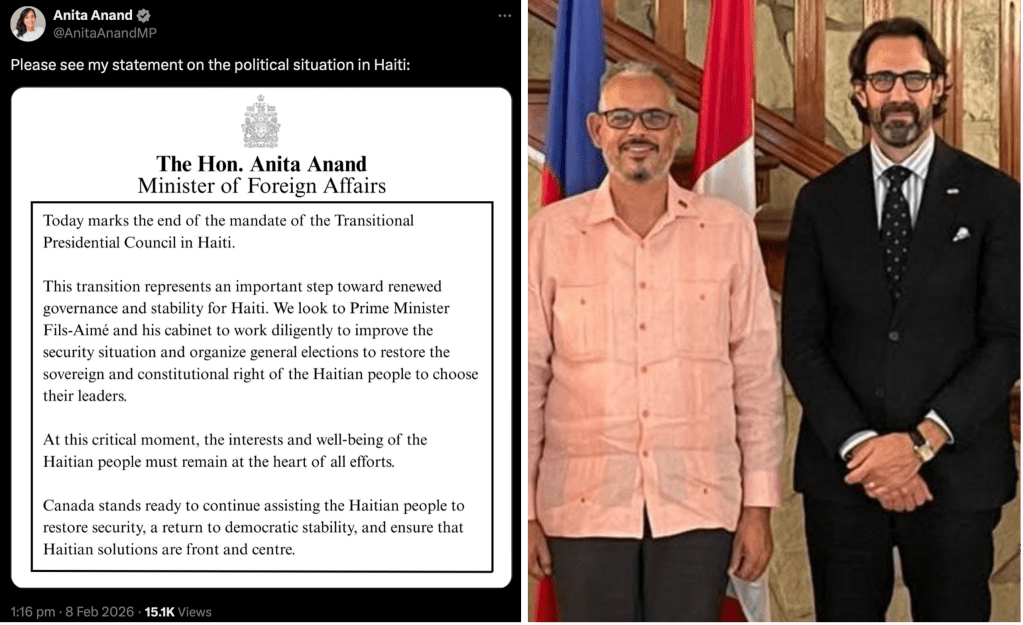
Left: Statement by Foreign Affairs Minister Anita Anand. Right: Prime Minister Alix Didier Fils Aimé and Canadian ambassador to Haiti André François Giroux (Le Nouvelliste).

In several recent public statements, U.S. authorities affirmed their support for Fils-Aimé. He is presented as the key figure capable of ensuring institutional continuity. They particularly emphasize his role in building a Haiti that is “strong, prosperous, and free.”

But it is those ships in the Port-au-Prince harbour that remind Haitians that pleasant statements barely mask the history of U.S. hard power in Haiti. 

AlterPresse: strong signals from the United States and uncertainty about the transition in Haiti.

“The naval presence appears to provide the latest proof of Washington’s willingness to use the threat of force to shape politics in the Western Hemisphere,” Diego Da Rin, an analyst with the International Crisis Group, told AP News. Arrival of the ships comes during a months-long build-up of U.S. military force in the Caribbean – already used against Venezuela on Jan. 3. 

An essential historical overview

Gotson Pierre, editor at AlterPresse, wrote Feb. 5 (text is translated and lightly-edited for clarity and length):

For many observers, these developments cannot be understood without a historical overview of relations between Haiti and the United States. This history is marked by repeated interventions, both military and political.

From the occupation of 1915 to 1934, with its devastating human, economic, and institutional consequences, to the [interventions in 1994 and 2004], and including the massive deployment of troops in 2010 following the earthquake, the United States has played a central role in major Haitian crises. Added to this are non-military political interventions, notably during the 2010-2011 elections, and more recently, the case of former Prime Minister Ariel Henry.

Many analysts also believe that regional bodies such as the Caribbean Community (CARICOM) and the Organization of American States (OAS) operate within a framework heavily influenced by Washington. 

Haiti maintains a complex relationship with the United States, characterized by geographical proximity, strategic interdependence, and asymmetrical power dynamics. This proximity … continues to influence the country’s political trajectory.

On the eve of February 7, 2026, amid institutional uncertainties, increased international pressure, and a reinforced military presence, the equation remains unresolved. The coming days will reveal whether these signs signal a simple continuation within established frameworks or a new phase of political realignment under strong external influence.

"Another World is Possible," World Social Forum, Porto Alegre, Brasil (2005)

The old order is dead. Let’s make a new, more just order.

by Jim Hodgson

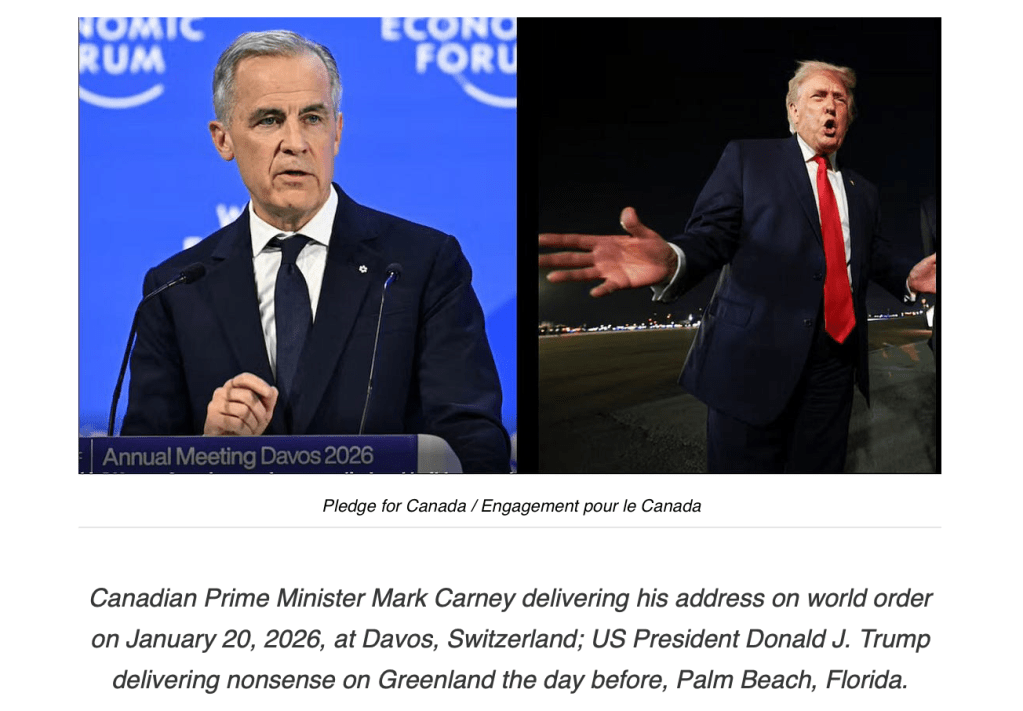
It was too much to hope that the well-heeled audience at Davos would boo Donald Trump from the stage a day after they had offered Mark Carney a standing ovation. But by the end of Wednesday, it seemed that the wall of resistance to any U.S. take-over of Greenland was successful, and the president backed down. An important victory.


Still, “la rupture de l’ordre mondial” of which Carney spoke remains. And he’s right: we shouldn’t mourn it. The international financial institutions invented in 1944 at Bretton Woods, New Hampshire, gave overwhelming power to the rich countries of the Global North. 

And the United Nations system that followed, with a veto given to each of the five most powerful countries, has protected their interests – even in the face of overwhelming contrarian votes in the UN General Assembly. Think, for example, of the annual vote to end the cruel U.S. blockade of Cuba.

That order was designed by the nations that existed at the end of World War II, especially the colonial or neo-colonial states of Europe and the Americas. Most of the Caribbean, Africa and large parts of south Asia were still under colonial rule. That order imposed and perpetuated a Global North-based order on all the new nations that were born in the 25 years or so after the war: the majority of nations that exist today.

And that order, at least in the eyes of three of the five veto-holders, effectively imposed capitalism as a synonym for democracy. The United States and its allies were satisfied with a sort of formal democracy, a certain alternance between parties of the right and centre-right, and if that failed, then a military government was a useful interlude until the real order could be re-established and markets were safe. 

Canada would “go along to get along,” as Carney admitted. 

Just as it did less than three weeks ago when the United States bombed Venezuela and kidnapped its president. And just as it has for more than two years over Israel’s genocide in Gaza.

In his speech, Carney seemed to offer a vision of capitalism without the now-erratic United States. It’s still reliant on resource extraction, military spending, and massive capital investment.

But if we are all to grow and thrive, we must demand more. We require an end to practices that exploit social inequities and our shared ecology. 

Alternatives

Because of the paths on which my life has taken me, one that is especially close to my heart is the call from the Indigenous people of Zapatista communities in southern Mexico for “a world with room for all” – “un mundo donde quepan muchos mundos.” But other visions come from other places, including three decades of gatherings of the World Social Forum.

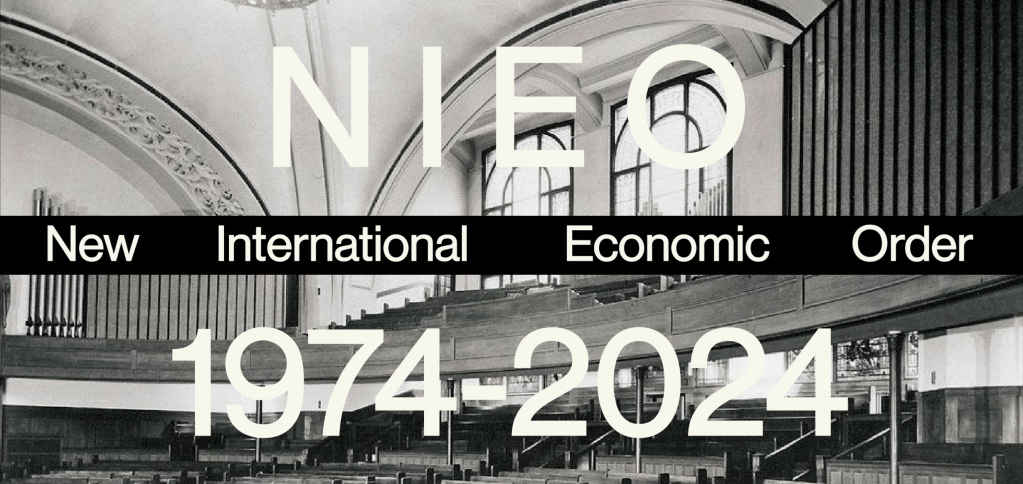
More than 50 years ago, the majority world united behind a vision of economic decolonization, sovereign development, and international cooperation across areas such as debt, trade, finance, and technology. That vision became known as the New International Economic Order (NIEO) and was adopted by the UN General Assembly. But, power relations being what they are, it was never implemented. (Progressive International put together a set of reflections that trace its history and update the proposals for the 21st century.)

In March last year, the World Council of Churches and several global communions of churches repeated their call for a New International Financial and Economic Architecture (NIFEA). “It is immoral that over a billion people – half of them children – subsist in poverty whilst billionaires increased their wealth by over 15% in 2024 to US$15 trillion. It is outrageous that the richest 10% of the global population receives more than half of global income, whereas the poorest half earns merely 8.5% of it,” they said in a statement.

They expressed deep concern about “a rapidly escalating climate and biodiversity emergency that jeopardises livelihoods and poses an existential threat to all life.” It notes that “several tipping points are close to being crossed or have already been crossed, leading us to recognise that we may be beyond a point of no return.”

The old order is dead. The time in which we are living demands we do better.