Justice denied: U.S. sends Venezuelan asylum-seekers to Salvadoran prison

Even in the face of the Trump regime’s horrific arrests, extraordinary renditions, and forced disappearances of immigrants and asylum-seekers, there are shreds of hope.

Activists and journalists are gradually identifying and sharing the stories of victims, including the 238 Venezuelans and 23 Salvadorans shipped to a prison in El Salvador on March 15. And judges and some politicians are more vocal in support of “due process”—the U.S. constitutional guarantee of at least being heard before being deprived of liberty—for all migrants.

One group has built a website: thedisappeared.org. They make prominent use of the blue triangle, the symbol used by Nazis in their concentration camps to designate migrants. About the 238 Venezuelans, they say: “There is no evidence to support the allegations that they are hardened criminals.” The group also posts on Facebook.

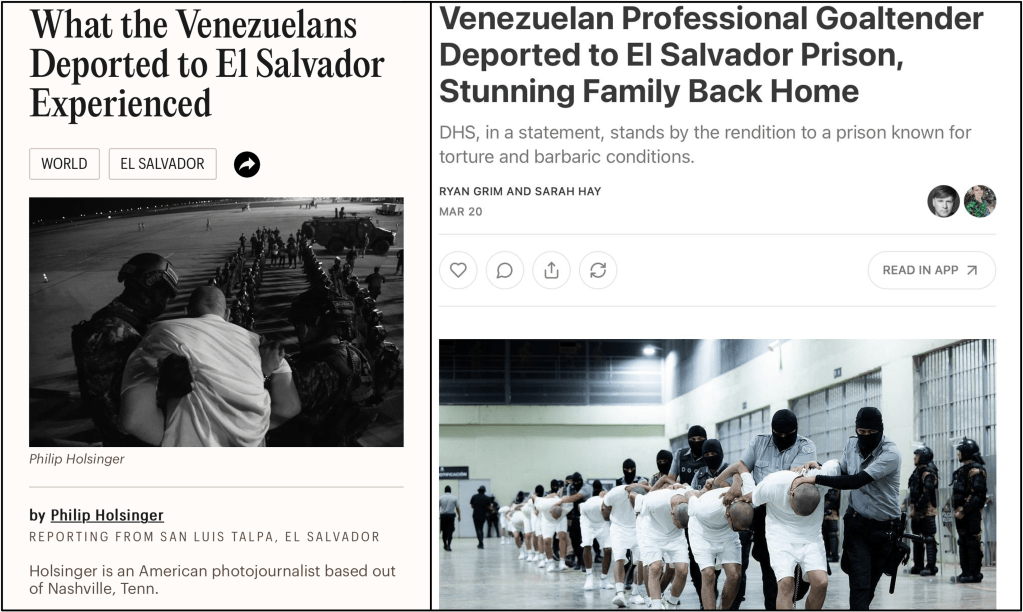
Above on the left is Andry Hernández Romero, age 31. I learned of his case the way many others did. A photojournalist, Philip Holsinger, met the airplanes that brought the Venezuelans to El Salvador and then accompanied them to the prison. A man who caught Holsinger’s attention shouted “I’m innocent” and “I’m gay,” and was crying as his head was shaved. From Holsinger’s photo, friends and family members identified him as Andry. Details of his situation were covered first in LGBTQIA+ media (The Advocate and the Washington Blade) and later by NBCCBS and elsewhere. His lawyer has mobilized political support in California, including that of Gov. Gavin Newsom and U.S. Rep. Robert Garcia.

The disappeared.org site draws attention to many other cases, including that of two-year-old Maikelys Antonella Espinoza Bernal (below) whose father, Maiker Espinoza Escalona, was sent to the prison in El Salvador. She and her mother Yorely Bernal Inciarte, were supposed to be sent together on a deportation flight back to Venezuela—part of her homeland’s “Vuelta a la Patria” program for citizens willing to go home. But the United States refused to return the child to her mother before she left.
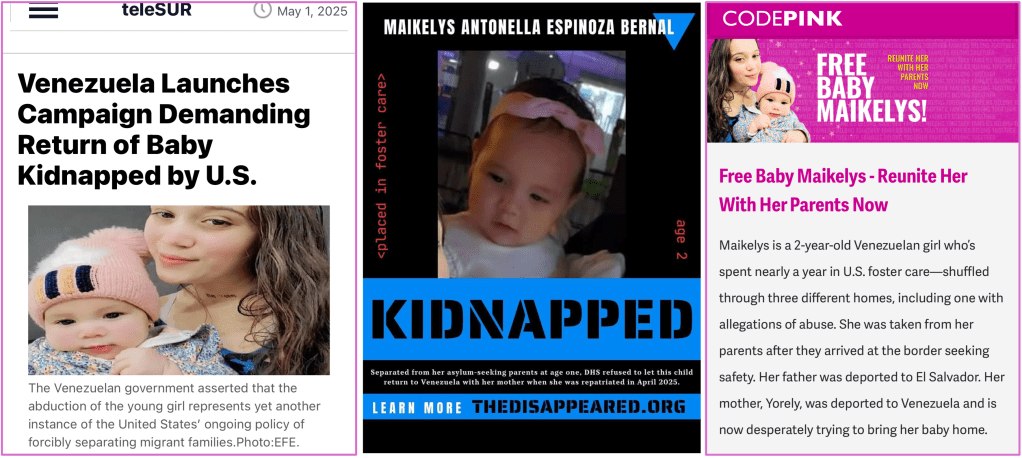
When Yorely arrived back home alone, Venezuelan media and the government took up the family’s cause (image on the left, above). So too did CodePink (right), a women’s peace network in the United States with which I have collaborated to draw attention to the negative impact on Venezuelans of U.S. economic sanctions

The Disappeared shared a piece from a group called United Strength for Action about the U.S. role in creating the disaster that Venezuelans face. I can’t concur with all the group said–many people in the United States just can’t see the historical context of U.S. imperialism–but I am relieved that they at least acknowledged the role of U.S. sanctions in creating a humanitarian crisis that drives the exodus of refugees. “This wasn’t foreign policy; it was collective punishment that pushed millions of Venezuelans past their breaking point.”

Since 1998, successive U.S. administrations have done all they could to be rid of Nicolás Maduro and his predecessor, Hugo Chávez: a coup attempt in 2002, a “revocatory” referendum in 2004, the effort to impose a “president” (Juan Guaidó) whom nobody had voted for, and through waves of sanctions. Given the failure of those efforts to induce regime change and seeing the flow of migrants out of Venezuela, President Joe Biden for a time tried a different approach, one of dialogue and engagement. The early weeks of Trump’s administration gave some hope this could continue, but the hard-liners seem to hold sway once again.

At a May Day march, President Maduro vowed to “rescue” Maikelys along with the Venezuelans now held by El Salvador. He also spoke directly to the hundreds of thousands of Venezuelans who have tried to reach the United States in recent years: 

“Stop going there. The true dream is that of our land to build with our hands. Stop being victims of xenophobia, of abuse… The only land that will welcome you and serve you like the prodigal son is called the Bolivarian Republic of Venezuela. We must take care of it, fertilize it, and build it. This homeland belongs to all!”

Maduro emphasized Venezuela’s right to build its own social model. “We have the right to true democracy, to our cultural identity. We are not gringos. We are proudly Bolivarian, Latin American, Caribbean. We are Venezuelans!”

Venezuela says it is willing to receive people deported from other countries. Between February and April 25 this year, 3,241 Venezuelans had returned on 16 government-funded flights. Yorely (the mother of Maikelys) came home on just such a flight.

Two more issues. Trump officials say that the people sent to jail in El Salvador were linked to the Tren de Aragua criminal gang, and that they used tattoos to identify the gang members.
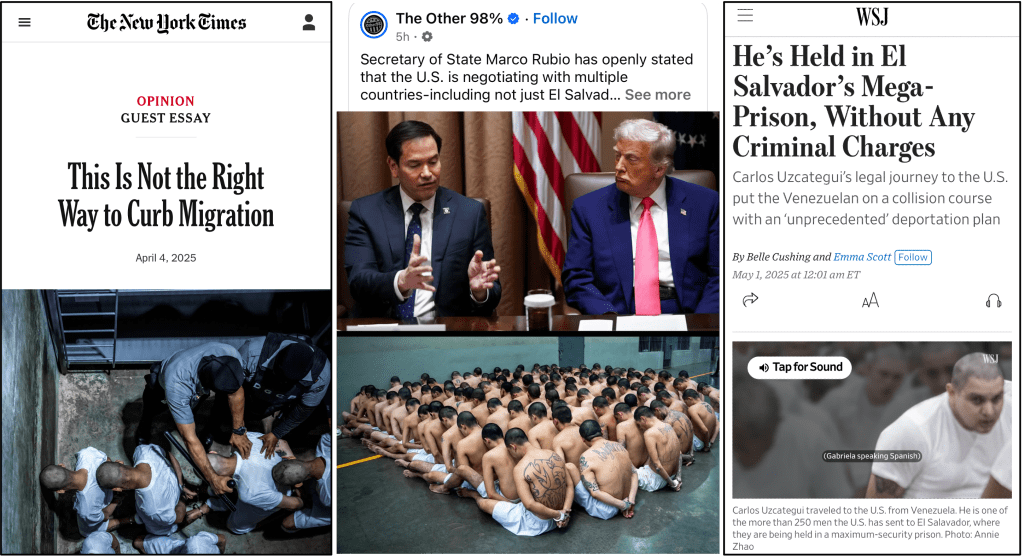
It’s good to see “mainstream” media like The New York Times (left) and Wall Street Journal (right) join the rest of us rabble-rousers in calling attention to the Trump regime’s actions.

Trump’s executive order decreeing the deportations said the gang is “conducting irregular warfare and undertaking hostile actions against the United States.”

But that is not true. In an article for The New York Times, a team of experts on violence in Venezuela said Tren de Aragua is not invading the United States. Nor is it a “terrorist organization,” and to call such “criminal groups terrorist is always a stretch since they usually do not aim at changing government policy.” The article goes on to show that Tren de Aragua is not centrally organized, though members were involved in migrant smuggling and the sexual exploitation of Venezuelan migrants in Colombia, Chile and Peru. 

The NYT piece adds that even U.S. intelligence officials do not believe the Maduro government is colluding with the gang, the key assertion in Trump’s justification for invoking the 1798 Alien Enemies Act to render Venezuelan migrants to El Salvador.

Immigration officials used tattoos to “determine” if someone was linked to Tren de Aragua, but the authors of the NYT piece say Venezuelan gangs (unlike Salvador groups like the MS-13) do not use tattoos that way. “Many young Venezuelans, like young people everywhere, borrow from the global culture of iconic symbols and get tattoos. That doesn’t mean they’re in a gang,” they wrote.

Moreover, the Tren de Aragua gang network in Venezuela is largely dismantled.

“The Tren de Aragua is cosmic dust in Venezuela; it no longer exists, we defeated it,” President Maduro said March 19. He was quoted by the English-language Orinoco Tribune in a longer article about the gang’s history in Venezuela.

Interior Minister Diosdado Cabello questioned whether all deportees were Tren de Aragua members, and demanded the US extradite captured suspects. “The US is acting in a confusing manner. They promised to send us Tren de Aragua members, but they have not. Someone there is lying.”

* Update, May 14 * Two-year-old Maikelys has been re-united with her mother in Venezuela. Her father remains in the Trump-Bukele prison in El Salvador. See the statement from CodePink.

Right to Truth Day sparks reflection on human rights in Argentina, El Salvador and the United States

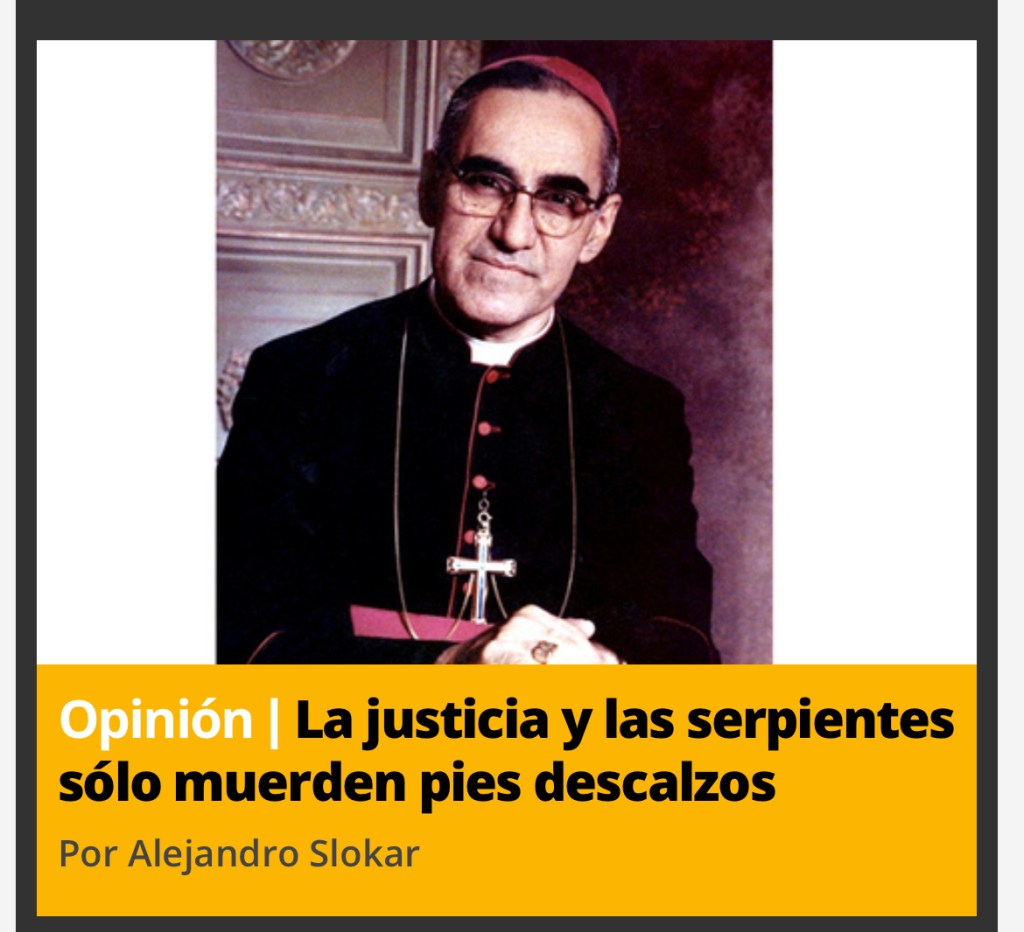
A headline and a photo in the Buenos Aires newspaper Página 12 caught my eye today. Together with a photo of Saint Óscar Romero was this phrase: “Justice and snakes only bite bare feet.” *

The writer, Alejandro Slokar, is a judge in Argentina’s federal court for appeals of criminal cases (Cámara Federal de Casación Penal). Here, he is writing about the International Day for the Right to the Truth Concerning Gross Human Rights Violations and the Dignity of Victims—or more simply, the Right to Truth Day, marked now every March 24.

March 24 is not only the date when we recall the martyrdom of San Salvador’s archbishop, the human rights defender Óscar Romero in 1980. It’s also when Argentineans recall the 1976 military coup that ushered in a “dirty war” against the popular movements of the impoverished—those with bare feet—along with trade unionists, journalists, writers, artists and human rights defenders. As many as 30,000 people were killed or disappeared over the next five years.

In El Salvador, about 80,000 people were killed or disappeared between 1979 and the end of the civil war in 1992.  In both countries, as elsewhere across Latin America, movements to find the “historical truth.” 

In recent weeks, families of people who disappeared during Mexico’s long “war on drugs” have drawn attention to a half-hectare farm in Teuchitlán, about 60 km west of Guadalajara in the state of Jalisco. The farm had been used to recruit new traffickers, but also to execute those who refused the cartel’s orders. State and federal authorities had known about the site since last September but did nothing to secure it or to identify human remains and other items found on the land. Predictably, state and federal authorities point fingers of blame at each other.

About 120,000 people have gone missing in Mexico since 2006 when then-President Felipe Calderón launched a military-led offensive against the drug cartels in an attempt to curb their violent turf wars. Instead, the violence became worse. And Calderón’s security chief, Genaro García Luna, was convicted in October in a U.S. court for his deep ties to the Sinaloa cartel. 

Among the disappeared (still) are 43 students from a training school for rural teachers in Ayotzinapa, Guerrero state, taken in 2014.

The “right to truth” cannot only be about historical cases. It must be the demand now in the case of the young men taken by the Trump regime and dumped into El Salvador’s infamous Terrorism Confinement Centre (CECOT). Certainly, some of the 238 Venezuelans may be criminals who were members of the “Tren de Aragua” gang but, as stories leak out, it’s clear that some of those deported were never accused, much less tried or convicted, of any crime. 

TIME magazine published a stunning photo essay about the deportations. The photojournalist, Philip Holsinger, included this description of one of his encounters: “One young man sobbed when a guard pushed him to the floor. He said, ‘I’m not a gang member. I’m gay. I’m a barber.’ I believed him. But maybe it’s only because he didn’t look like what I had expected—he wasn’t a tattooed monster.”

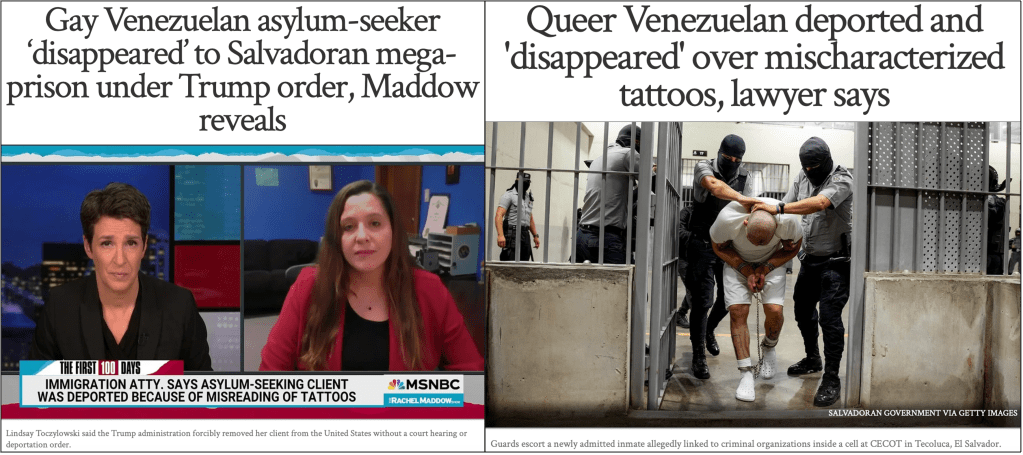
Drop Site News reported that another deportee was a Venezuelan professional soccer player and youth soccer coach with no criminal record. “The family only discovered that their loved one, Jerce Reyes Barrios, had been sent to El Salvador when they saw him in viral videos posted by the Trump administration, in which it celebrated what it said was the mass deportation of violent members of the Venezuelan gang Tren de Aragua.”

The LGBTQIA+ Advocate magazine shared reporting on PBS by Rachel Maddow about a gay makeup artist who was among the deported prisoners—forcibly removed from the United States without a court hearing or deportation order.

Those stories, combined with reports of detentions of visa holders and other visitors, and harassment of legal residents and citizens, suggest that what happened in Argentina and El Salvador has begun in the United States. Can paramilitary death squads be far behind?

Writing of historical events and of the present-day right-wing populist regimes of Nayib Bukele in El Salvador and Javier Milei in Argentina, Slokar’s article argued that such abuses derive from the “neocolonial models”—European feudalism—applied in throughout the Americas. “While those responsible die in their beds without sanction, the consequences are almost infinite, farce and tragedy at the same time, and expressed in the inhumane neoliberal experiment that laughs at the Constitution, bitcoin, extractivism and punitive demagoguery that converge in the present.”

* The quote is variously attributed to both Óscar Romero and to the Uruguayan journalist Eduardo Galeano. It may be that Galeano was quoting Romero, but I cannot find the original source: just partial citations.

Dismantling USAID: Yes, No, Maybe?

In late 1980, more than a year after the triumph of the Sandinista Revolution, the administration of President Jimmy Carter was still funding infrastructure in Nicaragua through USAID. By November 1984, with President Ronald Reagan’s “Contra War” well underway, your future bloguista was amused by this left-over sign at a road rebuilt near Matagalpa.

by Jim Hodgson

Back on launch day of Trump 2.0, the president issued an executive order that suspended international aid programs for 90 days, including those of the U.S. Agency for International Development (USAID).

The move came with a lot of over-the-top rhetoric and outright lies: that USAID spent “$100 million on condoms to Hamas” and that it “bankrolled” the Politico digital news company. “It’s been run by a bunch of radical lunatics. And we’re getting them out,” Trump told reporters on the evening of Feb. 2.

There are, of course, dozens of issues about which to criticize the Trump regime. But this is a blog that sets out to unwrap development issues, so let’s get into it.

Congress established USAID in 1961 to bring together programs that were administering foreign aid. Focusing on long-term social and economic development, USAID disbursed about $72 billion in 2023, less than 1% of the U.S. annual budget. It is one of the largest aid agencies in the world. 

You’ll remember, of course, that the United Nations target for spending on Official Development Assistance is 0.7 per cent of gross domestic product. Only five countries meet or exceed that goal: Norway, Luxembourg, Sweden, Germany and Denmark. In 2023, Canada contributed 0.37 per cent of GDP; the United States contributed just 0.24 per cent, seventh lowest among 31 OECD countries

Trump’s order, carried out by his government efficiency hatchet-man, Elon Musk, chopped humanitarian programs around the world: famine relief in war zones; programs to stall malaria in 22 African nations; vaccinations in vulnerable areas; and access to medications by people living with HIV and AIDS. Several U.S. government websites also removed resources on HIV. (That also happened when Trump first took office in 2017).

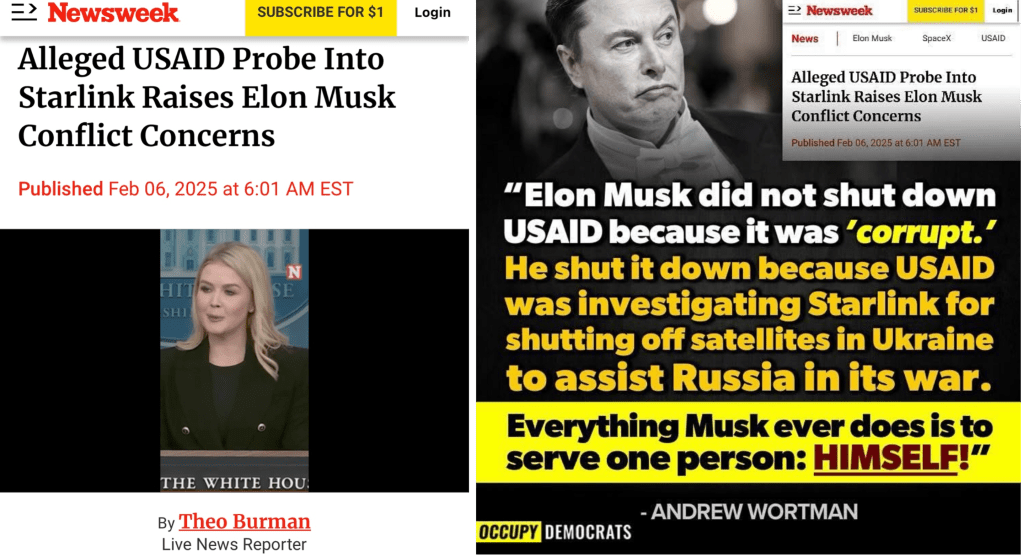
Newsweek reported Feb. 6 that just months before Musk shut down USAID, the agency was investigating its relationship with Musk’s Starlink satellite company.

In days since the order, enough voices were raised in alarm to get funding for HIV and other essential medicines restored—though it wasn’t clear if that included preventative drugs like PrEP. For more than 20 years, PEPFAR (the President’s Emergency Plan for AIDS Relief) worked within and alongside the Global Fund to Fight AIDS, TB and Malaria and the Joint United Nations Program on HIV/AIDS (UNAIDS).

Also, a federal judge on Feb. 7 temporarily blocked the administration from placing 2,200 USAID employees on paid leave, siding with workers who argued Trump and Musk lack the authority to immediately dismantle an agency created by congressional legislation.

The Trump regime blames “migrants” for much of what supposedly ails the United States, but in this time of unparalleled worldwide migration of people, the USAID cuts hit the United Nations High Commissioner for Refugees and the International Organization for Migration (IOM)—two agencies that are critical in managing and measuring the flows of people.

No one should argue against humanitarian aid, although Musk and Republican members of congress who see empathy as a character flaw will do so. In a world still suffering from massive inequality, such aid is urgently needed. The U.S. Christian magazine Sojourners offered a strong defence of the humanitarian work of USAID.

What happens after the 90-day review? My guess is that some functions will be folded into the State Department and thus more susceptible to narrow political goals, like subversion of other countries’ governments. I feel badly for beneficiaries of the humanitarian programs and for many well-intentioned employees; not so much for the vast array of U.S.-based independent contractors who get rich from the misery of others.

Sheinbaum: “It’s better they close it”
As noted above, USAID was created in 1961—just two years after the triumph of the Cuban Revolution. There was no artifice: USAID was to counter the influence of Soviet Union. In recent years, USAID has been at the heart of U.S. challenges to the growing influence of China, which has a successful “Belt and Road” foreign aid program of its own.
My venerable Mac laptop computer tells me that I have 226 files that mention USAID. Almost all of the documents are about the ways that USAID is used as an instrument of U.S. foreign policy, especially its work alongside other U.S. institutions that promote—or subvert—democracy in other countries: the National Endowment for Democracy (NED), the International Republican Institute, the National Democratic Institute for International Affairs and even the Central Intelligence Agency.

USAID even had an Office of Transition Initiatives (OTI) that gained infamy in 2014 over its covert “Cuban Twitter” (ZunZuneo) social media program that was aimed at overthrowing the Cuban government was revealed by Associated Press. 

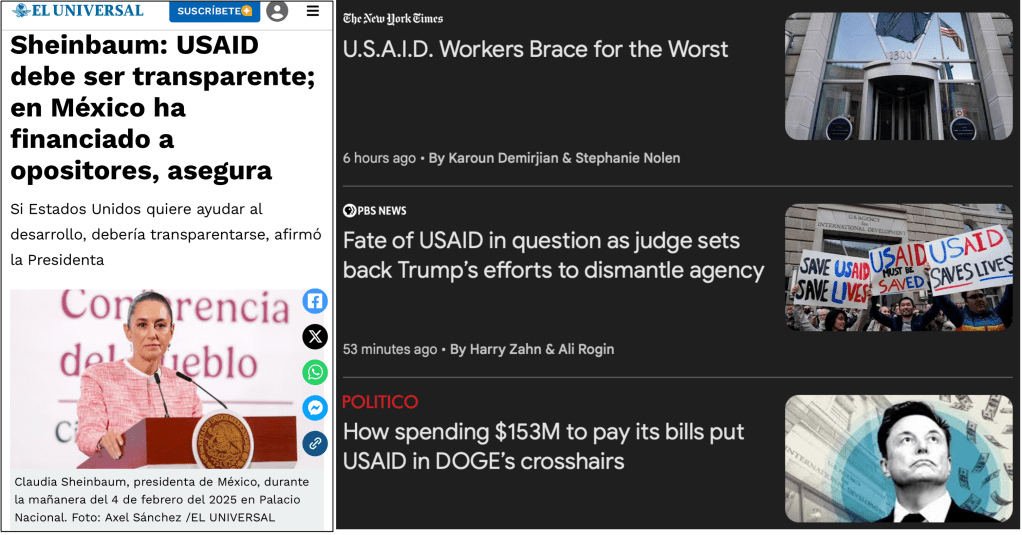
Sheinbaum (left): USAID must be transparent; in Mexico, it has funded the opposition. Right: USAID still in the headlines Feb. 8.

In her morning news conference on Feb. 4, Mexican President Claudia Sheinbaum, breaking away from the dispute over tariffs, lashed out at the overt political activity of USAID. “This agency has funded research projects and groups opposed to the government. That’s the case with Mexico.”
She mentioned an organization that she called, “Mexicans for Corruption.” (She was only half-joking: it’s Mexicans against Corruption. The group actively opposed her predecessor Andrés Manuel López Obrador’s effort to reform the judicial system, and it had support from USAID.) 
“And how is it that they get involved in politics, those agencies that are about aid. In that sense, if the United States wants to help with development, it should be transparent,” she continued.  “The truth is that there are so many things USAID does that in truth it is better they close it.”
In a similar vein, Colombian President Gustavo Petro said some U.S. help is not welcome and has to go. “Hundreds of immigration officials who guard our borders were paid by the United States. This aid is poison,” he said during a Feb. 3 cabinet meeting. “That should never be allowed. We are going to pay with our money.” In 2024, the agency paid nearly $385 million to Colombia.

Haïti chérie

Which brings me to Haiti, a country whose heartbreak I know well. For more than 45 years, it has been particularly afflicted by HIV and AIDS. The ongoing political crisis, worsened by uncontrolled activity by criminal gangs, continues to hamper relief efforts including support to people living with HIV and AIDS

Repeated U.S. interventions have made things worse. From 2011, with the presidencies of Michel Martellyand Jovenel Moïse and then the unelected leadership of Prime Minister Ariel Henry through early 2024, the United States and the local elites had the leaders they wanted: men close to the business sector who had close ties in the United States.

That fruitless model was finally shoved aside last June 11 with the installation of a transitional council (CPT). It’s wobbly but hope persists that it can finally organize new elections that produce leaders that Haitians want. A truth commission and an electoral council have been named.

In the meantime, the problem of gang violence is being addressed (though ineffectively) with the addition of the Multinational Security Support Mission (known as MMAS), led by police from Kenya and bolstered with police from El Salvador and Guatemala. Despite UN backing and many promises, it is underfunded and understaffed.

Feb. 4: U.S. aid to the security mission is frozen. Feb. 6: aid is renewed

A new blow came Feb. 4 when the UN announced that the shutdown of USAID meant funds for the MMAS were frozen. But two days later, U.S. Secretary of State Marco Rubio announced that MMAS would be protected despite the USAID cut, adding to speculation that Rubio, Musk and Trump are not all operating from the same playbook.

In the wake of the axing of USAID, the best piece that I have read about its activities in Haiti is by a long-time observer, Jake Johnston of the Center for Economic Policy and Research (CEPR). At the end of a Feb. 4 essay about the agency’s work in Haiti, he writes:

The term “aid” encompasses many different things: humanitarian assistance and development programming, contracts and grants, support to local organizations and multimillion dollar contracts to DC-area firms. 

There are many parts of the US foreign aid industry that can and should be stopped or significantly reformed. But that doesn’t mean that shutting down USAID, or making its assistance even more overtly political by placing it under the umbrella of the State Department, is going to be a good thing, either in the short or long term. 

The reality is that, where foreign assistance is least effective, it is largely because it is designed to promote US interests rather than address the needs of those ostensibly on the receiving end. The changes announced by the Trump administration are not likely to truly disrupt US soft power abroad. If anything, it will make political interventionism an even more explicit aim of US foreign assistance.