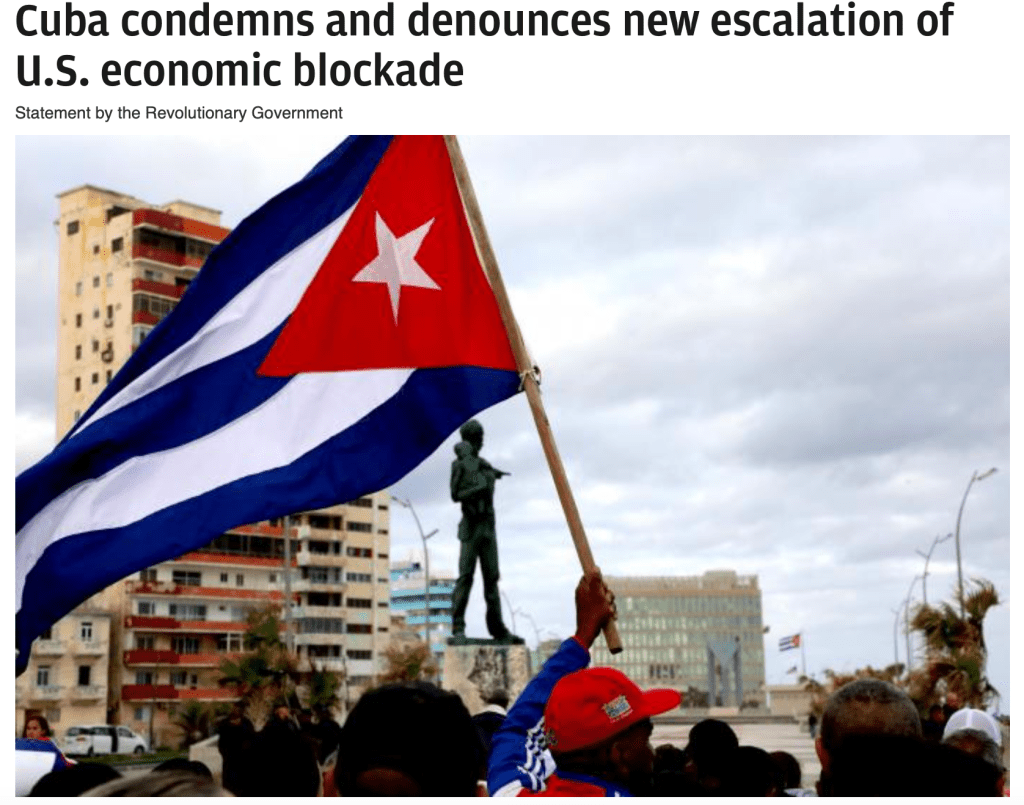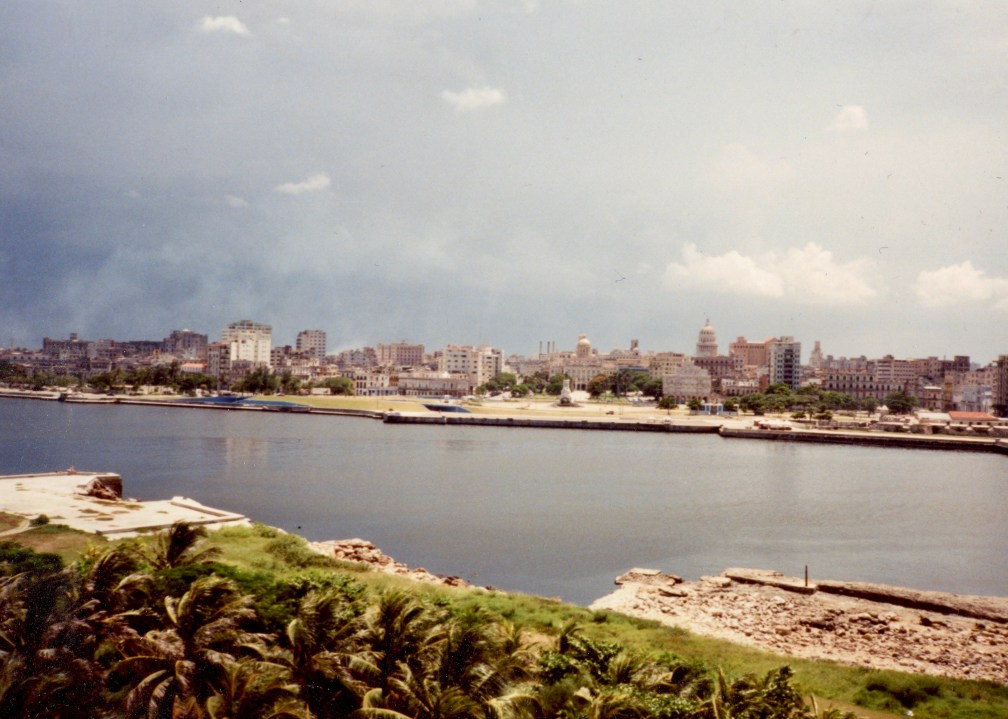
The White House has a new document on Cuba. To those of us who have been watching for a while, it seems more acute: it tightens the screws on a people already suffering severe effects—shortages of power, food, and medicine—provoked by the U.S. blockade.
Esteban Lazo, president of Cuba’s National People’s Power Assembly, called the statement aggressive and unjust.
The statement talks about freedom for the people, democracy, respect for human rights and human dignity, and protection for dissidents and “peaceful demonstrators.” But it also tightens restrictions on U.S. citizens who travel to Cuba. Academic travellers must “engage in a full-time program of activities that enhance contact with the Cuban people, improve civil society, and promote the independence of the people from the authorities.”
It limits how Cubans might seek asylum in the United States and how family members send money back home. It gives U.S. Secretary of State Marco Rubio (a second-generation Cuban-American) the power to identify any entity under the control of, or acting for or on behalf of Cuban companies, as well as to regulate their financial transactions.
It also specifies that that the Trump administration will oppose petitions before the United Nations and other international forums that demand the lifting of the embargo.
There’s a new list of “prohibited officials,” including ministers, deputy minister, members or employees of Cuba’s Parliament and Supreme Court and even the editors of Cuban state media organizations.
“Who are they trying to deceive?” ask the editors of Granma, the newspaper of the Communist Party of Cuba, in a front-page article today. “All this has been suffered by the Cuban people for more than 60 years.”
In social media posts June 30, President Miguel Díaz-Canel said that the new U.S. policy statement “responds to narrow interests that are not representative of the majority in that country, and further reinforces the economic blockade.” The goal, he added, is to cause the greatest harm and suffering to the Cuban people. “The impact will be felt, but we will not be defeated.”
Two weeks earlier, Cuba’s Catholic bishops recognized the critical situation faced by the Cuban people. In a Message for the Jubilee Year, they described: “the avid search for essential goods, the prolonged lack of electricity, the growing emigration, the disillusion, the apathy due to the repetition of promises that never come to fruition… the sadness.” Among the victims of the crisis are: “the elderly, who are alone and abandoned… those who feel they can’t freely express their convictions,” as well as those who are living on the streets, eating from the garbage bins, suffering from addictions. “They’re resentful or broken, and becoming ever more violent… lacking love, and empty of hope.” They comprise an “uncertain future,” and not only in Cuba, but also for the world.
The bishops called on “everyone, but primarily those who hold higher responsibilities” to “create a climate without pressures nor internal or external restrictions” for the “changes that Cuba needs.” The use of “external” refers to the blockade and other measures of the U.S. government; the “internal” to the political actions of the Cuban government.
Trump and Rubio use sanctions and other measures to try to force regime change. They pay no heed to the needs of the Cuban people, but churches, unions and non-governmental organizations around the world continue to press for an end to the blockade and for increased humanitarian aid.
Even in the face of the Trump regime’s horrific arrests, extraordinary renditions, and forced disappearances of immigrants and asylum-seekers, there are shreds of hope.
Activists and journalists are gradually identifying and sharing the stories of victims, including the 238 Venezuelans and 23 Salvadorans shipped to a prison in El Salvador on March 15. And judges and some politicians are more vocal in support of “due process”—the U.S. constitutional guarantee of at least being heard before being deprived of liberty—for all migrants.
One group has built a website: thedisappeared.org. They make prominent use of the blue triangle, the symbol used by Nazis in their concentration camps to designate migrants. About the 238 Venezuelans, they say: “There is no evidence to support the allegations that they are hardened criminals.” The group also posts on Facebook.
Above on the left is Andry Hernández Romero, age 31. I learned of his case the way many others did. A photojournalist, Philip Holsinger, met the airplanes that brought the Venezuelans to El Salvador and then accompanied them to the prison. A man who caught Holsinger’s attention shouted “I’m innocent” and “I’m gay,” and was crying as his head was shaved. From Holsinger’s photo, friends and family members identified him as Andry. Details of his situation were covered first in LGBTQIA+ media (The Advocate and the Washington Blade) and later by NBC, CBS and elsewhere. His lawyer has mobilized political support in California, including that of Gov. Gavin Newsom and U.S. Rep. Robert Garcia.
The disappeared.org site draws attention to many other cases, including that of two-year-old Maikelys Antonella Espinoza Bernal (below) whose father, Maiker Espinoza Escalona, was sent to the prison in El Salvador. She and her mother Yorely Bernal Inciarte, were supposed to be sent together on a deportation flight back to Venezuela—part of her homeland’s “Vuelta a la Patria” program for citizens willing to go home. But the United States refused to return the child to her mother before she left.
When Yorely arrived back home alone, Venezuelan media and the government took up the family’s cause (image on the left, above). So too did CodePink (right), a women’s peace network in the United States with which I have collaborated to draw attention to the negative impact on Venezuelans of U.S. economic sanctions.
The Disappeared shared a piece from a group called United Strength for Action about the U.S. role in creating the disaster that Venezuelans face. I can’t concur with all the group said–many people in the United States just can’t see the historical context of U.S. imperialism–but I am relieved that they at least acknowledged the role of U.S. sanctions in creating a humanitarian crisis that drives the exodus of refugees. “This wasn’t foreign policy; it was collective punishment that pushed millions of Venezuelans past their breaking point.”
Since 1998, successive U.S. administrations have done all they could to be rid of Nicolás Maduro and his predecessor, Hugo Chávez: a coup attempt in 2002, a “revocatory” referendum in 2004, the effort to impose a “president” (Juan Guaidó) whom nobody had voted for, and through waves of sanctions. Given the failure of those efforts to induce regime change and seeing the flow of migrants out of Venezuela, President Joe Biden for a time tried a different approach, one of dialogue and engagement. The early weeks of Trump’s administration gave some hope this could continue, but the hard-liners seem to hold sway once again.
At a May Day march, President Maduro vowed to “rescue” Maikelys along with the Venezuelans now held by El Salvador. He also spoke directly to the hundreds of thousands of Venezuelans who have tried to reach the United States in recent years:
“Stop going there. The true dream is that of our land to build with our hands. Stop being victims of xenophobia, of abuse… The only land that will welcome you and serve you like the prodigal son is called the Bolivarian Republic of Venezuela. We must take care of it, fertilize it, and build it. This homeland belongs to all!”
Maduro emphasized Venezuela’s right to build its own social model. “We have the right to true democracy, to our cultural identity. We are not gringos. We are proudly Bolivarian, Latin American, Caribbean. We are Venezuelans!”
Venezuela says it is willing to receive people deported from other countries. Between February and April 25 this year, 3,241 Venezuelans had returned on 16 government-funded flights. Yorely (the mother of Maikelys) came home on just such a flight.
Two more issues. Trump officials say that the people sent to jail in El Salvador were linked to the Tren de Aragua criminal gang, and that they used tattoos to identify the gang members.
It’s good to see “mainstream” media like The New York Times (left) and Wall Street Journal (right) join the rest of us rabble-rousers in calling attention to the Trump regime’s actions.
Trump’s executive order decreeing the deportations said the gang is “conducting irregular warfare and undertaking hostile actions against the United States.”
But that is not true. In an article for The New York Times, a team of experts on violence in Venezuela said Tren de Aragua is not invading the United States. Nor is it a “terrorist organization,” and to call such “criminal groups terrorist is always a stretch since they usually do not aim at changing government policy.” The article goes on to show that Tren de Aragua is not centrally organized, though members were involved in migrant smuggling and the sexual exploitation of Venezuelan migrants in Colombia, Chile and Peru.
The NYT piece adds that even U.S. intelligence officials do not believe the Maduro government is colluding with the gang, the key assertion in Trump’s justification for invoking the 1798 Alien Enemies Act to render Venezuelan migrants to El Salvador.
Immigration officials used tattoos to “determine” if someone was linked to Tren de Aragua, but the authors of the NYT piece say Venezuelan gangs (unlike Salvador groups like the MS-13) do not use tattoos that way. “Many young Venezuelans, like young people everywhere, borrow from the global culture of iconic symbols and get tattoos. That doesn’t mean they’re in a gang,” they wrote.
Moreover, the Tren de Aragua gang network in Venezuela is largely dismantled.
“The Tren de Aragua is cosmic dust in Venezuela; it no longer exists, we defeated it,” President Maduro said March 19. He was quoted by the English-language Orinoco Tribune in a longer article about the gang’s history in Venezuela.
Interior Minister Diosdado Cabello questioned whether all deportees were Tren de Aragua members, and demanded the US extradite captured suspects. “The US is acting in a confusing manner. They promised to send us Tren de Aragua members, but they have not. Someone there is lying.”
* Update, May 14 * Two-year-old Maikelys has been re-united with her mother in Venezuela. Her father remains in the Trump-Bukele prison in El Salvador. See the statement from CodePink.
In the face of the flood of orders spewing from the White House since January 20, I feel compelled to attack all of them, everywhere, and all at once.
Today I am taking a deep breath to encourage you to take action in solidarity with Cuba. The item below focuses on what Canadians can do, but if you are in another country, please write to your government to encourage them to increase humanitarian aid to Cuba and not to be cowed by U.S. pressure.
A day before the new U.S. administration took power, I spoke about Cuba with my friends Dean Detloff and Matt Bernico for their Magnificast podcast. I feel now I was too optimistic, but have a listen. The image shows a bus given for use by churches and civil society organizations by Pastors for Peace.
Take Action for Cuba
You are invited to join other Canadians and Canadian international cooperation, trade, faith and civil society organizations to join forces in taking action in response to the economic hardships being faced by Cubans.
In the midst of the difficult political situation in the U.S. and the leadership transition in Canada, advocacy is still necessary.
Cuban partner organizations and recent visitors say conditions in Cuba today are much more difficult than in the early 1990s when the implosion of the Soviet Union led to a sharp deterioration in living standards. The pandemic shuttered the tourism industry, a main source of revenue used to acquire food, medicines and fuel from abroad. Cuba has also suffered a series of hurricanes, droughts and floods, leading to lost crops and food shortages. Energy shortages limit public transit and even the collection of garbage.
The Canadian government has responded to calls from civil society to increase humanitarian assistance but more is needed.
In 2024, Canada contributed $1.7 million in humanitarian assistance in response to several emergencies including Hurricanes Oscar and Rafael. Funds were shared via multilateral agencies including the World Food Program and UNICEF, along with NGOs including CARE Canada, the Canadian Red Cross and Humanity and Inclusion.
In his first days in office, the new US president has revoked revoked Biden’s measures to remove Cuba from the U.S. list of sponsors of terrorism. The difficulties of sending money and engaging in trade will continue.
2. Use the information provided in the Take Action and its demands to engage candidates in your riding. While the election period has not started yet, we know it’s coming.
3. Many Canadians are part of efforts to fill a container, carry a suitcase of medical supplies, are organizing a people-to-people delegations, or making a donation through a church, union, or humanitarian agency. Please tell your MP and other politician to raise the profile of the economic crisis in Cuba. Send them pictures, and post them on social media.
Thank you!
PS: Over the past two years, I have worked with my former colleagues at The United Church of Canada, other churches, several trade unions and international development organizations to draw attention to the impact of U.S. sanctions (“the blockade”) on the Cuban people. We hoped for more positive change from the Biden administration and of course feel disappointment that the new U.S. government has reverted to harsh measures. In these times, Canada must maintain its independent foreign policy and not cave to U.S. pressure.]