“Cuba does not live in peace. Cuba lives with permanent aggression.”

The Mexico City daily newspaper, La Jornadapublished an interview May 9 with Cuba’s vice-minister of external relations, Carlos Fernández De Cossío.

Cuba’s lack of peace, he emphasized, is caused by Washington’s policies against the people of Cuba, characterized by economic coercion with the blockade. He warned that while practically the whole world has been the object of tariff threats by the administration of Donald Trump, “towards Cuba, the onslaught is already underway, and only military aggression is lacking” to complete the siege.

In the face of new global geopolitics, with Trump in power, he warned that the White House now attacks several countries: “you see this in Panama, Greenland, Canada;” the focus could also be the progressive governments elsewhere in Latin America.

“There are threats against several governments, and the United States will attempt, through force, economic pressure, and other methods, to influence the political processes of our countries. Venezuela is a country under attack. It’s evident that the region faces that reality….  The absence of armed conflict does not mean living in peace.” He also said that there is pressure on nations in the hemisphere to adopt measures to “reduce the ‘harmful influence’ of China.”

Over the past two-and-a-half years, I have worked with my former colleagues at The United Church of Canada, other churches, several trade unions and international development organizations to draw attention to the impact of U.S. sanctions (“the blockade”) on the Cuban people. Now that Canada’s new cabinet ministers are confirmed, we’ll likely launch a new call to “take action” in solidarity with Cuba.

Fernández de Cossío was in Mexico City for meetings May 8 with Mexico’s External Relations department (SRE) to talk about migration issues. 

With a long career in diplomacy, Fernández de Cossío has served as director for the United States in the Cuban foreign ministry. He also served as ambassador in Canada (2004-05) and South Africa, and was Cuba’s representative in the peace process between the government of Colombia and the Revolutionary Armed Forces of Colombia (FARC).

He said spaces like the Community of Latin American and Caribbean States (CELAC) are key to creating a counterweight to Washington. “They must move beyond declarations and formality. Getting there is not easy.” What follows is a lightly-edited translation of his interview with La Jornada writers, Emir Olivares and Arturo Sánchez Jiménez.

Migration challenges

Q: What are the challenges to the region from the new anti-migration policies of Trump?

R: If the great gap between the industrialized, developed countries and the countries in processes of development is not reduced, it’s natural that there will be a growing flow from the south toward the north to seek better living conditions. That goes on in Africa, in Asia and in our continent, where the flow toward the United States, whether it be regular or irregular. The reality varies by each country.

Q: And for Cuba?

R: The case of Cuba is unique. The United States has applied a dynamic against it that both pushes and pulls migration, whether regular or irregular. Washington’s official policy is economic coercion. The blockade, aimed at depressing and making living conditions as difficult as possible, provokes a migration drive.

Furthermore, since the 1960s, Cuban immigrants have been privileged, regardless of how they cross the border, by sea or by land. They are assimilated, granted refugee status, protected, and provided with employment. Additionally, there is the Cuban Adjustment Act, which means that regardless of how they entered the United States, Cuban migrants can acquire residency within one year of arriving in the United States. No citizen of any other country in the world has that privilege. If Washington does not put an end to this reality, the irregular flow will continue.

Q: What do you think of the U.S. propaganda shared in mass media and internet platforms against migration, headed by the secretary of homeland security, Kristi Noem?

R: It’s media opportunism that seeks support in the population. They unfairly criminalize all immigrants. To a certain extent, society has been polarized since its inception, with cultural and racial prejudices. And it’s not difficult for these politicians to try to stir up those feelings to promote a policy of rejecting immigrants and blaming them for many of the problems: drug use, unemployment, crime, and social polarization. If some migrants participate in crime and social unrest, it’s because these phenomena already exist in the United States.

Historically, the United States has believed that Cuba belongs to them, but in reality, it is an inability to accept that Cuba is, and has the right to be, a sovereign state.

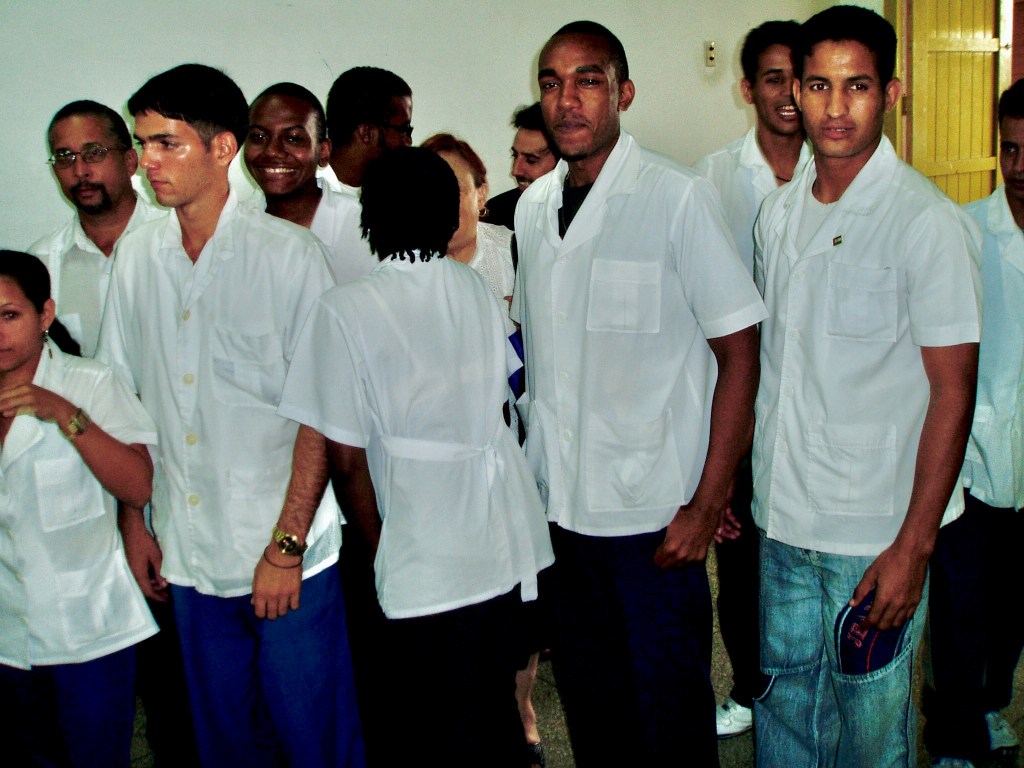
Medical students at the University of Medical Sciences in Matanzas come from around the world. (Photo: Jim Hodgson, 2007)

Campaign against the health brigades

Q: The campaign against Cuba’s medical brigades is within these new coercive measures?

R: Yes. Since February, they have threatened that countries that continue medical cooperation programs with Cuba, their officials and family members will lose their visas and their ability to travel to the United States. Today, around 60 nations have these programs. They provide care to thousands of people. It is a historic project, for which Cuba has been praised by governments, several UN secretaries-general, and even a US president (Barack Obama).

The campaign seeks two things: to discredit this symbol of the success of Cuban society, since one of the priorities of anti-Cuban sectors is to prevent recognition of Cuba’s successes. The second is to cut off a legitimate source of income obtained from agreements with countries that are more favourable (such as Mexico), although historically these are services for which not a cent has been received.

Q: Do Trump’s new geopolitics bring additional pressures to the hemisphere?

R: It’s part of the US government’s hostile and imposing behavior toward the region, and it’s a challenge not only for Cuba but for the entire region. There’s pressure to adopt measures to reduce “China’s harmful influence.” We find it absurd. In a recent congressional hearing, they showed alleged Chinese military bases in Cuba (they used to say they were Russian, during the Cold War). They presented images of what could have been a soccer field or a rice field to say: “This is evidence that there are Chinese military bases in Cuba,” but there wasn’t a single military officer there, no one from the Pentagon or the CIA, from the institutions that are supposed to bear witness to this.

There’s threatening behavior that tries to impose their will on the hemisphere. We saw this in Panama. We see it in Greenland (even though it is not part of the region) and with Canada. It’s a challenge for us all and it’s dangerous.

Q: What have been the errors of the revolutionary regime?

R: Fidel Castro once said that the biggest mistake was thinking that anyone knew how to build socialism and that it would be easy to do so. In Cuba, specific errors may have been made in some aspects of economic policy, in elements of social policy, but it’s very difficult to judge if one takes into account the challenges posed by the aggression of a power like the United States.

Q: Are the ideals of Martí, Castro and others still valid?

R: The ideas of Martí, Fidel, Marx, Engels, Lenin and other Marxists remain relevant and continue to shape our thinking. The challenge we face with youth is enormous, due to the communication influence that large corporations have exerted, a monopoly that is difficult to break. This, combined with a very depressed economic situation, has a serious and dangerous impact on the population. We are working with this; we accept it as a challenge, a very great challenge facing Cuban society.

Karl Marx in the Rose Garden

By Jim Hodgson

I take my title today from a subhead in a column by Enrique Galvan Ochoa in the Mexico City daily La Jornada. I’ll translate and summarise from his text here:

Not even Karl Marx would dare to imagine such a spectacular coup against neoliberalism and globalization as that carried out by President Donald Trump with his explosion of tariffs to the whole world on April 2 in the Rose Garden of the White House. The cathedrals of capitalism tumbled, from Wall Street to all the other global stock markets. In just a week, investors fled in search of refuge for their money: in gold, government bonds—swallows in search of a nest. The blow from that unpredictable businessman installed in Washington will have lasting effects. And it will hit the poor as well as the rich.

With respect, I am not so sure that it was a blow against neoliberalism so much as its logical next step: away from unrestricted movement of capital and toward concentration of wealth in ever-fewer hands. 

But that’s my point: I’m not sure. Daily—this has been going on since Trump began his run for political office a decade ago—new opinion pieces land in my inbox, many of them making strong historical analogies. Is he trying to restore a golden age/Belle Époque—think of the 1870s through to the start of the First World War and the beginning of income tax—for oligarchic billionaires and their closest allies, the mere millionaires? 

I loved seeing the rapper Lizzo on Saturday Night Live this past weekend wearing a cropped t-shirt emblazoned TARIFFIED. On the right: Trump in a storm.

What to make of these tariff wars and consequent stock market losses? I find myself pushed to go deeper.

You don’t have to be a Marxist—I think here of sociologist Max Weber and Canadian social democrat Tommy Douglas—to see how societies (including the liberal ones) are divided between the dominant structures defended by the elites and the counter movements supported by those with fewer privileges. 

And you don’t have to be a Marxist to appreciate his writing. A passage in The Communist Manifesto describes how love and poetry, religion and community, are “drowned in the icy waters of selfish calculation.”  All of these are drowned so that personal worth becomes exchange value—you sell your labour—and numberless freedoms are abolished in favour of “that single, unconscionable freedom—Free Trade.” * 

We might be forgiven if we thought free trade was invented at the time of the great debates ahead of the North American Free Trade Agreement (NAFTA) in 1994, or the Canada-U.S. agreement in 1989, or the advent of the common market in Europe in the 1960s. Some might know that elections in Canada were fought and lost at the end of the 19th and early 20th centuries over various proposals for free trade with the United States: “No truck or trade with the Yankees!” cried the Conservatives in 1911, defeating the Liberals of Sir Wilfred Laurier. 

Just before Marx and his co-author Friedrich Engels published their Manifesto in 1848, debate raged in Britain over the “Corn Laws.” These were tariffs and other trade restrictions on imported food enforced between 1815 and 1846. Large land-owners wanted the tariffs kept high to keep out competition. Industrialists wanted them lowered because cheaper food meant they could pay workers less. (The industrialists won.) In a speech in Brussels in January 1848, Marx said protectionism was conservative and free trade was destructive. But he also saw that free trade in that context “hastens the social revolution” and thus merited his support. 

I like to say that I have been fighting free trade since 1848. But truth is the first time I wrote about the free trade debate was in 1986 (above).

My issue wasn’t so much having about rules for international trade—and we always press for protection for labour, the environment and human rights—as it was the protections that were built into the trade agreements for corporations (always referred to as “investors”). Under those waves of free trade deals, governments were blocked from protecting public health or the environment. Corporations would bring their complaints to an “investor-state” dispute resolution tribunal. Most times, the tribunals would rule in favour of the corporation and the state would be on the hook for the corporation’s imagined future earnings. Or they would succumb to the threat of the suit, as Panama is doing now in the face of a $20-billion suit.

Now that Trump has thrown away the rule book, it may seem that people like me are suddenly defending free trade. I think we’re defending the idea of at least having rules. Even as we fight specific battles (I think of the lawsuit brought by Canadian mining companies against El Salvador), we learned to live with economic integration: even after the havoc caused in Canada to industrial jobs and farmers after the 1989 FTA with the United States; even after U.S. abandonment of its industrial workers; and even after two million Mexican farmers were forced from their land and into the cities and across the border after NAFTA in 1994. 

But let’s not lose sight of longer-term objectives. In the face of this crisis in capitalism, what are the opportunities? The “social revolution” envisioned by Marx may be distant, but in these last 40 years, social movements have never ceased to uphold human rights broadly understood: economic, social, cultural and environmental. 

Manuel Pérez Rocha works now with the Institute for Policy Studies and writes an occasional column for La Jornada. (In the late 90s, we both worked with the Mexican Action Network on Free Trade, RMALC). Recently, he pointed to a long list of actions taken together by Mexican, Canadian and U.S. organizations. He continued: 

“Under Trump, we suffer from a savage neoliberalism that evades treaties, written rules, and multilateral organizations. He sees no friends and only enemies. The only laws are those of the strongest and ‘I’m in charge.’ Mexico must respond by demanding a thorough review of the USMCA [called CUSMA in Canada and T-MEC in Mexico], chapter by chapter, since its purpose and content are largely the same as those of NAFTA: to make Mexico an export platform to take advantage of cheap labour. Together with Canada, we must promote this review by generating spaces and resources for democratic participation, not only for business leaders but also for grassroots organizations in all three countries.”

Meanwhile, Charlie Angus continues his resistance campaign. (In the current federal election, he is not running again.) On April 14, he reminded his Substack readers of Rules for Radicals by Saul Alinsky.

Angus points to what Alinsky would say about our collective sense of loss over what is happening in the world today:

“Do one of three things. One, go and find a wailing wall and feel sorry for yourselves. Two, go psycho and start bombing – but this will only swing people to the right. Three, learn a lesson. Go home, organize, build power.”

* Karl Marx and Friedrich Engels (1848), The Communist Manifesto in Essential Works of Marxism (18th ed., 1979), New York: Bantam, p.15.

Empathy: a basic element of human decency

by Jim Hodgson

Back in the late 1990s, I travelled frequently by bus over the mountains between my home in Cuernavaca and my job in Mexico City. Even when the traffic was bad, the trip usually took less than two hours. The bus company almost always showed a film.

When not working or looking at the views, including the Popocatepetl volcano, I watched the movies. I can’t guess how many movies I saw without ever seeing how they ended. My friends and I joked about organizing a Pullman de Morelos film festival, renting or borrowing some of the movies, and just watching the last half hour of all of them to see how they ended.

Among those movies was a favourite of mine, Smilla’s Sense of Snow (Bille August, 1997). The shocking death of a small boy in Copenhagen opened a tale of conflict between corporate greed and the Inuit people of Greenland. But I never saw how it ended. 

Years went by and then, in a used bookstore in Strathroy, Ontario, I found the novel by Peter Høeg on which the film was based. It’s an excellent book with a satisfying ending. 

Among parts that have stayed with me was this:

“…[W]e read Karl Marx’s Das Kapital. It was a book I grew quite fond of. For its trembling, feminine empathy and its potent indignation. I know of no other book with such a strong belief in how much you can accomplish if you simply have the will to change.” *

Hmm. Empathy as a feminine virtue? Let’s see. Google offers this definition: “the ability to understand and share the feelings of another.” 

To me, it’s a basic element of human decency. A measure of empathy is vital in action to transform the plight of those made miserable by any who abuse their power. To empathize doesn’t mean you have to agree with someone: just recognise their different circumstances. Maybe some of us would rather say solidarity.

“In a time when empathy is increasingly treated as a vice, we must not turn our backs on the world’s most impoverished,” wrote Andy Harrington after a recent visit to South Sudan. Harrington is the executive director of the Canadian Foodgrains Bank (CFGB), a Winnipeg-based NGO that enables food aid to reach people in need and communities to move toward food sovereignty. He said people are already dying because of Trump’s cuts to USAID, adding that Canadian support is more essential than ever. (Eight people in South Sudan, including five children, died as they tried to walk for three hours to seek treatment for cholera after U.S. cuts forced local health services to close, Save the Children said April 9.)

Elon Musk said recently that empathy is killing Western civilization. But it seems the far-right has been attacking empathy for a long time now. And it does so with some masculine archetypes.

MAGA influencers have begun to talk of the tariffs as a way to make the United States ‘manly’ again, by bringing old-time manufacturing and mining back,” asserts historian Heather Cox Richardson in her Substack post on April 8. In these first three months of the disastrous Trump regime in the United States, she has found her way into my daily reading as she sets current events in historical context. She adds: 

In a larger sense, Trump’s undermining of the global economy reflects forty years of Republican emphasis on the myth that a true American man is an individual who operates outside the community, needs nothing from the government, and asserts his will by dominating others.

Associated with the American cowboy, that myth became central to the culture of Reagan’s America as a way for Republican politicians to convince voters to support the destruction of federal government programs that benefited them. Over time, those embracing that individualist vision came to dismiss all government policies that promoted social cooperation, whether at home or abroad, replacing that cooperation with the idea that strong men should dominate society, ordering it as they thought best.

The Trump administration has taken that idea to an extreme, gutting the U.S. government and centering power in the president, while also pulling the U.S. out of the web of international organizations that have stabilized the globe since World War II. …

Now Trump is demonstrating his power over the global economy, rejecting the conviction of past American leaders that true power and prosperity rest in cooperation.

In less than 100 days, the Trump regime has dismantled that “liberal consensus” that at least regulated corporate excess, provided very basic social welfare, and promoted infrastructure. (This is not to ignore some of the United States’ greatest failures. Among them: slavery and Indigenous genocide, of course. But also not providing universal health care and maintaining racial segregated schools by underfunding the public education systems.)

* Peter Høeg, Smilla’s Sense of Snow, Toronto: McClelland-Bantam, 1997, pp.144-45.

Tomorrow: Karl Marx in the Rose Garden