Haiti: “The biggest disgrace is indifference”

by Jim Hodgson

More than 42 years after my first visit to Haiti, I can’t disagree with that assessment. It was offered June 16 by UN secretary general António Guterres near the end of his one-day visit to Port-au-Prince.

The visit came 40 years after the fall of the Duvalier family dictatorship; 36 years after the election of a liberation-theology-inspired priest named Jean-Bertrand Aristide; 35 years after the first coup against him; 22 years after the second coup; 16 years after the earthquake killed at least 220,000 people; five years after the assassination of Haiti’s last elected president; and after a decade of still-surging gang violence in the capital city and beyond.

A week after the visit by Guterres, Canada’s Foreign Affairs Minister Anita Anand announced $35 million in new funding Tuesday for projects aimed at shoring up security and curbing violence in the Caribbean. Just $7.5 million was to support the Haitian National Police service’s fight against gang violence.

Now two-and-a-half months have passed since Guterres denounced indifference and Anand offered money. But by any measure, everything has gotten worse. 

Two events caught my attention over in recent days.

Gang coalition attacks Kenscoff

First was a vicious gang attack in Kenscoff, a farming community high in the mountains above Port-au-Prince. At least 47 people were killed, including five children. Fifty others were abducted, though six children and seven women in the group were later released. Many of those killed had sought refuge in a church compound at L’église de l’Arche de la Nouvelle Alliance.

Days later, Pope Leo XIV called for release of all remaining hostages. Bishop Pierre André Dumas of the diocese of Anse-à-Veau et Miragoâne called for more action from Haiti’s government to protect the population and to end impunity:

“Haiti cannot become an immense cemetery where we come now and then to leave flowers, recite our condolences and publish statements.”

Gang violence has displaced about 1.5 million people in Haiti, where at least 3,050 people were reported killed from January to June, according to U.N. statistics released Aug. 25.
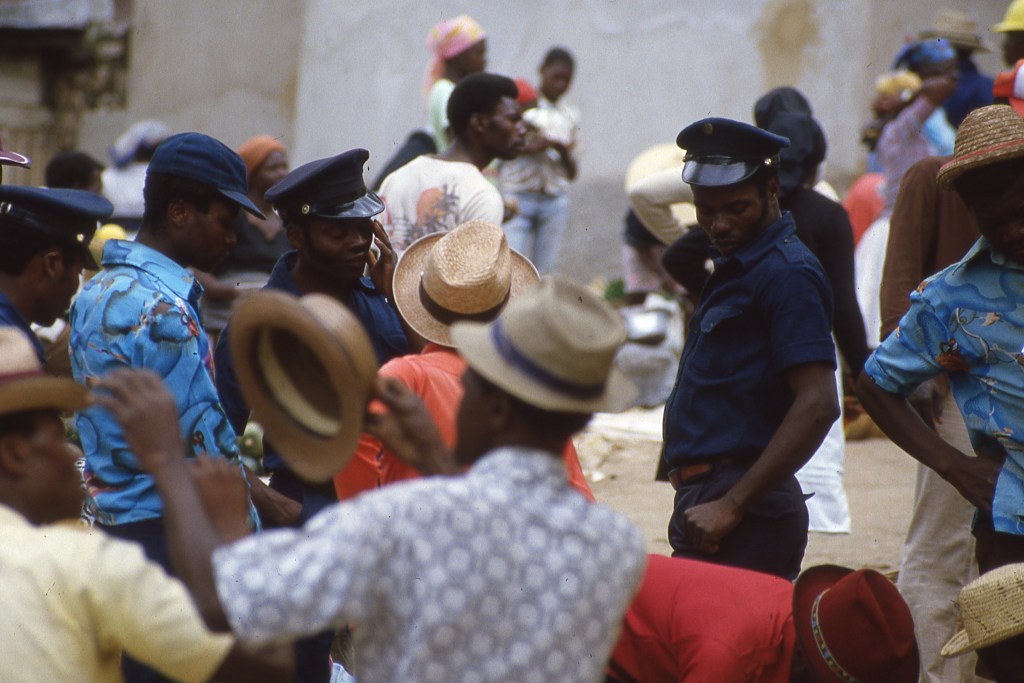
My first visit to Kenscoff came during my first visit to Haiti in March 1984. In Kenscoff, the repression was blatant. Duvalier was still in power, and we watched as his militia, the infamous Tontons Macoutes, extorted payments from vendors in a market. In subsequent years, I passed through Kenscoff during visits to a Methodist congregation in nearby Furcy and to a school in Duplan rebuilt after the 2010 earthquake. (Photo: Jim Hodgson)

The Trump regime’s assault on Haitians in the U.S.

The second matter that grabbed my attention is that the United States has abruptly ended the “temporary protected status” that had kept Haitian asylum-seekers in years since the earthquake from being deported. On Aug. 27, the Department of Homeland Security posted on social media: “Haiti TPS has been TERMINATED. Those with TPS are in our nation illegally. They have two options: LEAVE IMMEDIATELY or be DEPORTED.” Attached was a video of chained Black men and women being moved through the rain toward a waiting plane.

Historian Heather Cox Richardson wrote: “Officials at DHS chose to publish a video of Black people in chains that evoked the slave coffles of the Old South.”

That news came at around the time that Eleazar S. Fernandez, a theologian from the Philippines currently teaching in Minnesota, wrote an excellent appreciation of Haitians and their rebellion that ended slavery in 1804. When he posted the text on Facebook, however, it was met with vile, bot-driven racist attacks that recalled phrases used by Trump, Vance and others in the current U.S. regime to malign Haitians.
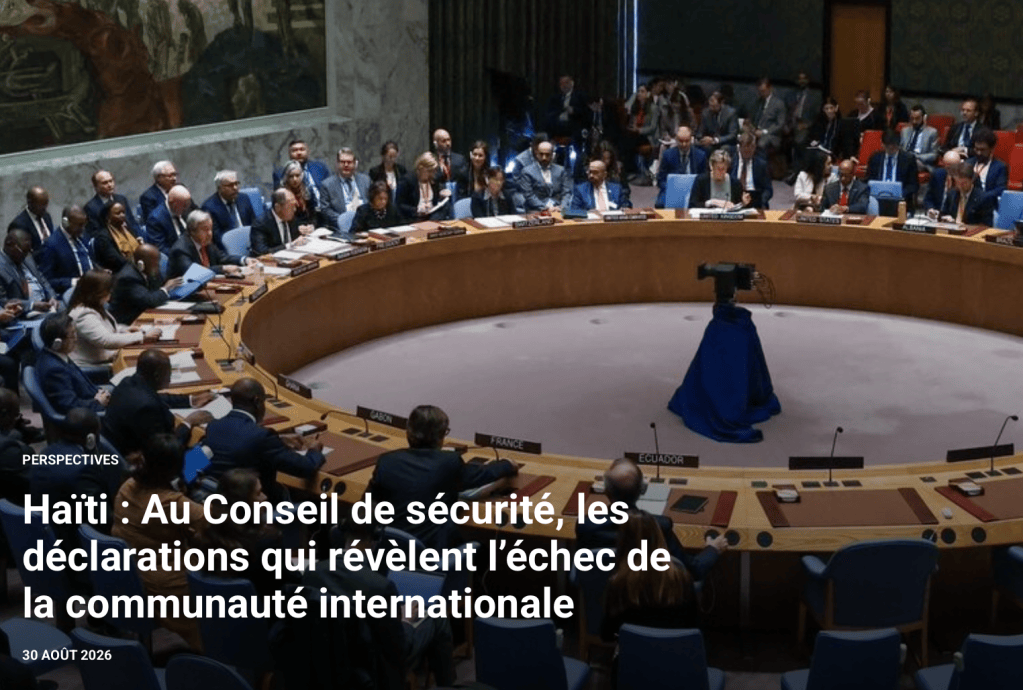
UN Security Council speeches reveal the failure of the international community

The UN Security Council held an emergency meeting about Haiti on Friday, Aug. 28. Like conversations about Gaza, Sudan or Somalia, the meeting only revealed failures.

Gotson Pierre, editor of Haiti’s Alterpresse news service, wrote: 

“Three years after authorization of an international mission intended to support the Haitian National Police action against the gangs, results remain largely insufficient when measured against announced objectives.”

After one failed effort (known as the Multinational Mission to Support Security, MMAS), the UN created the Gang Suppression Force (FRG). 

The intent was to deploy a force of 5,500 international members but, as Dominican foreign affairs minister Roberto Álvarez Gil told a UNSC meeting in July, barely 1,000 were on the ground. On the surface, the problem was logistical – insufficient aircraft to bring police from countries that had promised them (Sri Lanka, Bangladesh, Côte d’Ivoire and others) – but it shows the deeper problem of UN member-state arrears. As you might guess, the United States under Trump is the largest and most reluctant debtor.  And the United States seems to have plenty of aircraft that it uses for deportations all over the planet.
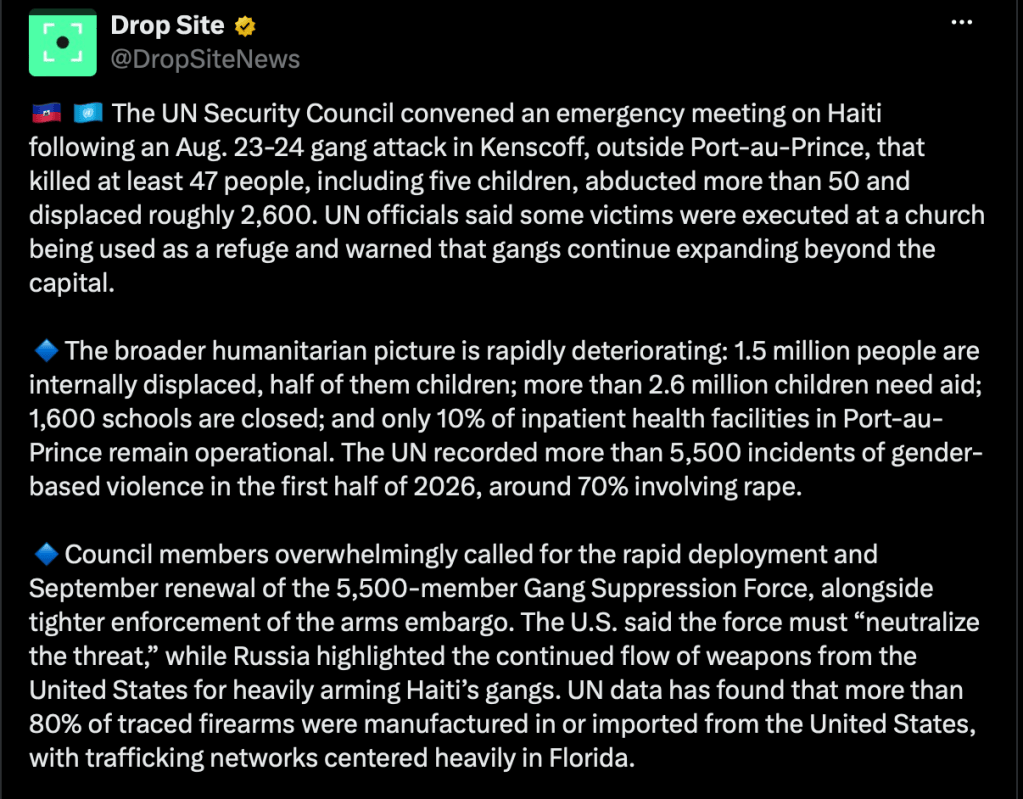
At the Aug. 28 meeting, UNSC members called for rapid deployment of the FRG forces, renewal of the FRG mandate in September, and for tighter enforcement of an arms embargo. 

Two other problems. As noted in the Drop Site report above, the humanitarian situation continues to deteriorate. Meanwhile, Haiti’s illegitimate interim government, headed now only by Prime Minister Alix Didier Fils-Aimé after U.S.-led manoeuvres in January that removed the previous Transitional Presidential Council, is trying to hold general elections for the first time in more than a decade on Dec. 13. It has been registering voters in Port-au-Prince and beyond. 

But, given the history of U.S. interference (and worse) in Haiti over more than a century, my expectation is that such an election will have a low voter turnout and produce a new president who is favourable to U.S. security and business plans, much like those of Michel Martelly (2011-16) and Jovenel Moïse (2017 until his assassination on July 7, 2021). Again, the parties, popular organisations and social movements with different visions for Haiti will be shoved aside.
On the use and misuse of sanctions in a time of empire

by Jim Hodgson

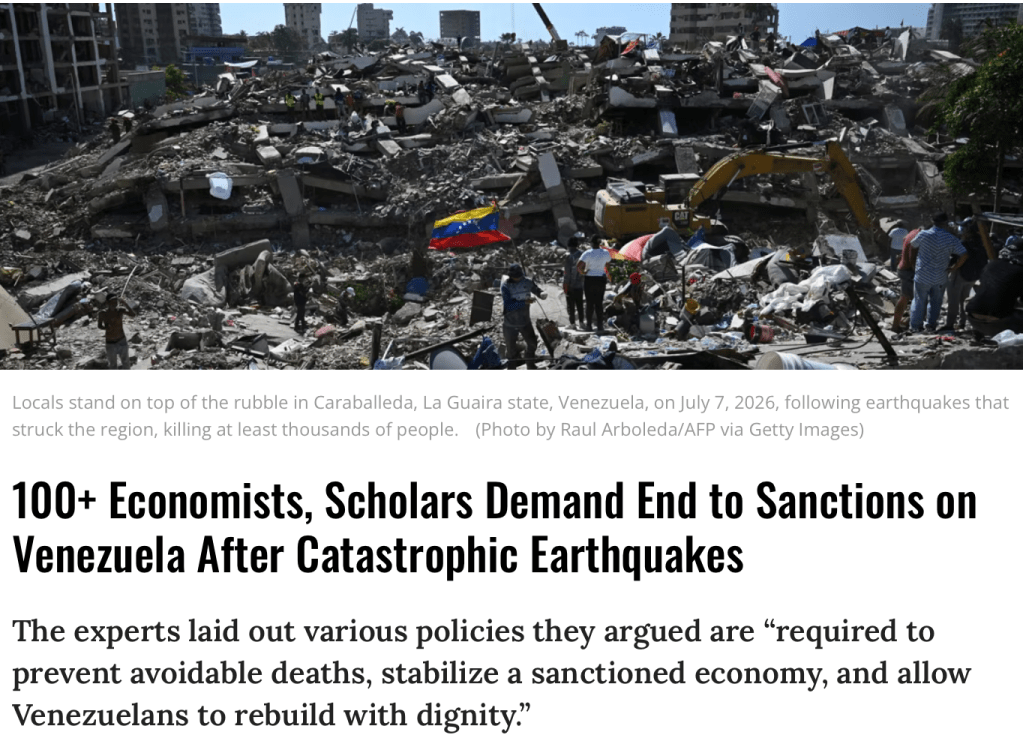
Venezuela’s catastrophic double-tap earthquake on June 24 raises yet again the issues that surround use of sanctions and their humanitarian consequences.

Forgive me for repeating myself, but most sanctions – “unilateral coercive measures” – are almost exclusively applied by rich northern countries against less-wealthy southern countries.

See Common Dreams, July 7, 2026

Venezuela’s drama plays out in the context of historic U.S. refusal to accept the development in this hemisphere of a political and economic model other than the capitalist one. At the end of 1998, Venezuelans chose Hugo Chávez to be their president because he represented a shift away from an oligarchy that used the country’s oil wealth for its own benefit and some allies in an aspiring middle class. In 2004, the United States backed a coup attempt against Chávez: it failed.

Since 2005, U.S. administrations have made annual determination that Venezuela has “failed demonstrably to adhere to its obligations under international narcotics agreements.” The United States began applying sanctions in 2006, saying that Venezuela was not cooperating fully with anti-terrorism efforts, and prohibited all U.S. commercial arms sales and retransfers to Venezuela.

Persistent U.S. action against Venezuela began after the death of Chávez in 2013. His successor, Nicolás Maduro, was perceived as less charismatic (and in the U.S. view, therefore less popular) than Chávez. Oil prices, moreover, had collapsed in 2009, rose again between 2012 and 2014, and collapsed again in 2015. Maduro seemed more vulnerable to external pressure.

Days before Christmas in December 2014, the U.S. Congress voted to give the United States the right to intervene in Venezuela “in defense of democracy and civil society.” Members of congress justified themselves by citing the need to defend “peaceful Venezuelan protesters,” alluding to protests that left 43 people dead. That “defense of civil society” law established the legal framework and paved the way for future sanctions against Venezuela.

These and other measures have been strengthened since 2015. They include a prohibition on use of currencies issued by the Venezuelan government, seizures of accounts and material goods owned by the Venezuelan state and the state-owned oil company and its subsidiaries, and measures against “third parties,” targeting companies that provide services to the Venezuelan state (including transportation of oil). 

Three months later, President Barack Obama cited that law as he issued a presidential decree declaring Venezuela an “unusual and extraordinary threat to the national security and foreign policy of the United States,” and launching what would become a program of more than 1,000 unilateral coercive measures: sanctions.

Assets of Venezuela’s national oil company, PDVSA, including its U.S. subsidiary, CITGO, were eventually blocked or seized, preventing the companies from renegotiating international commitments or attracting new investment. Venezuela went from receiving $39 billion in foreign earnings in 2014 to receiving $743 million in 2020. Measures taken during the first Trump administration led to Venezuela’s effective exclusion from international banking (including SWIFT).

Assets held abroad were confiscated by the United States and handed over to a fake government led by an opposition politician, Juan Guaidó, for whom nobody had voted and yet was backed by Canada and a handful of Latin American countries called the Lima Group.

A variety of situations show limits and possibilities of sanctions. Their use is said to be a “stick in the diplomatic toolkit,”[1] alongside others like dialogue, human rights protection, democracy promotion, mediation, or election observation. For decades after World War II, sanctions were applied by international organizations like the United Nations or the African Union against a member.

After the end of the Cold War in 1991, the UN Security Council used sanctions with mixed success in Yugoslavia and Africa—and also to tragic effect against Iraq in the 1990s. More recently, unilateral sanctions applied by individual states or groups of states against non-members have become more common—and denunciations of their illegality have become louder.

Critics see sanctions as a neocolonial tool available only to powerful states, and one that should be removed from the kit permanently. Indeed, the five permanent members of the UN Security Council are a combination of historic colonial powers and contemporary super-powers that are repeatedly accused of threatening or interfering in the internal affairs of other countries. Moreover, sharp differences among the permanent five have made it more difficult both to impose new multilateral sanctions and to ease existing ones.

Currently, the Venezuelan Anti-Blockade Observatory has documented approximately 930 active sanctions against hundreds of individuals, companies, aircraft, and vessels. A recent article in TeleSUR documents the impact of the sanctions on earthquake recovery efforts.

In a July 7 piece for Just Security, a pair of experts—George Lopez, professor emeritus of peace studies at the University of Notre Dame, and Venezuelan economist and Francisco Rodríguez of the Center for Economic Policy and Research (CEPR)—noted that post-earthquakes, “the United States pledged $300 million to relief agencies, mobilized civilian and military teams to Venezuela that are trained on disaster relief, and issued a limited sanctions waiver for earthquake relief activities.

“But these measures are far from enough,” they stressed, explaining that “the United Nations estimates the losses from the quakes stand at $37 billion,” or 32 per cent of Venezuela’s gross domestic product.

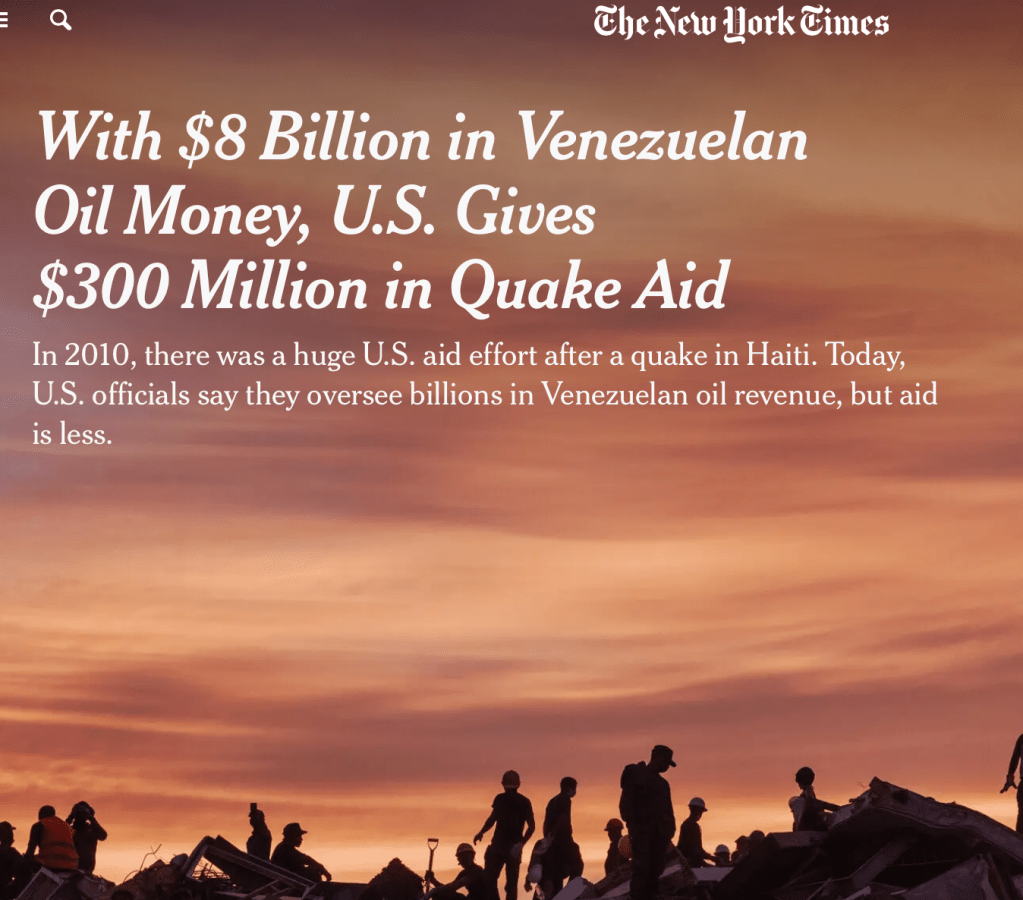
Even The New York Times can see the enormous gap between the U.S. relief offer and the billions of dollars in Venezuelan assets it controls.

Calls to end the sanctions on Venezuela are not new: the damage has been felt for more than a decade. In 2020, more than 40 churches and ecumenical organizations in Latin America and the Caribbean signed a letter calling for an end to U.S. sanctions. “These strategies will not serve any purpose other than to harm those who are already suffering, and who are the most vulnerable to COVID-19. The economic sanctions will also negatively affect the political and social environments needed for a peaceful solution to the crisis in Venezuela.”

That letter followed a statement the previous month from the U.S. National Council of Churches that condemned any possible military intervention in Venezuela and urged elimination of all economic sanctions. It also called on the global ecumenical movement to oppose intervention and sanctions, and to affirm Venezuela’s right to self-determination and sovereignty.

These issues were taken up again by the World Council of Churches and its Commission on International Affairs in a July 16 webinar.

“From the standpoint of international law, interventions such as those perpetrated by the Russian federation in Ukraine and by the U.S. in Venezuela raise serious concerns,” said Peter Prove, director of the commission. “For the WCC, such illegal violations are also theological and ethical violations.” The webinar can be viewed here.


[1] Michael Nesbitt, “Canada’s ‘Unilateral’ Sanctions Regime Under Review: Extraterritoriality, Human Rights, Due Process, and Enforcement in Canada’s Special Economic Measures Act,” (2017), 48-2 Ottawa Law Review 509, CanLIIDocs 119: https://canlii.ca/t/71w.

Venezuela in the wake of quakes, kidnapping and theft of its assets

by Jim Hodgson

I begin with a confession. In the wake of the catastrophic double-tap earthquakes that struck Venezuela on June 24, I have been slow in sharing my thoughts and what I have learned.

My delay is partly due to memories of other disasters, especially my involvement in efforts to rebuild in Haiti after its 2010 earthquake. 

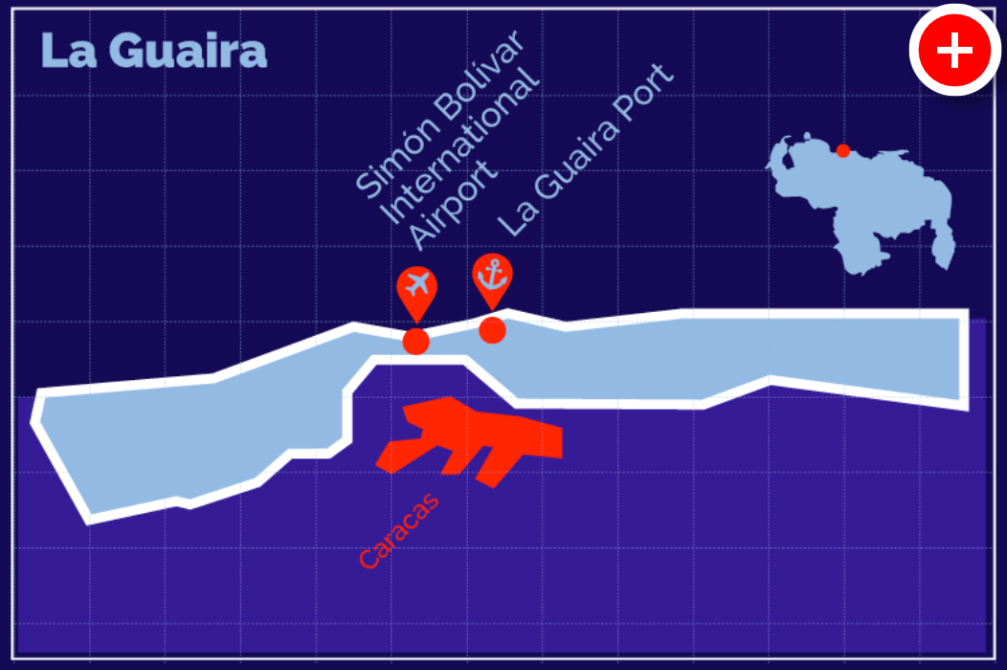
I am also remembering visits in better moments to the area most affected by current calamity: the north coast communities in La Guaira state. It’s the Caribbean Sea, so there are hotels, beaches, pools, yacht clubs and high-rise condominiums, as well as homes for the people who work in the airport, the seaports, and in fishing and service industries.

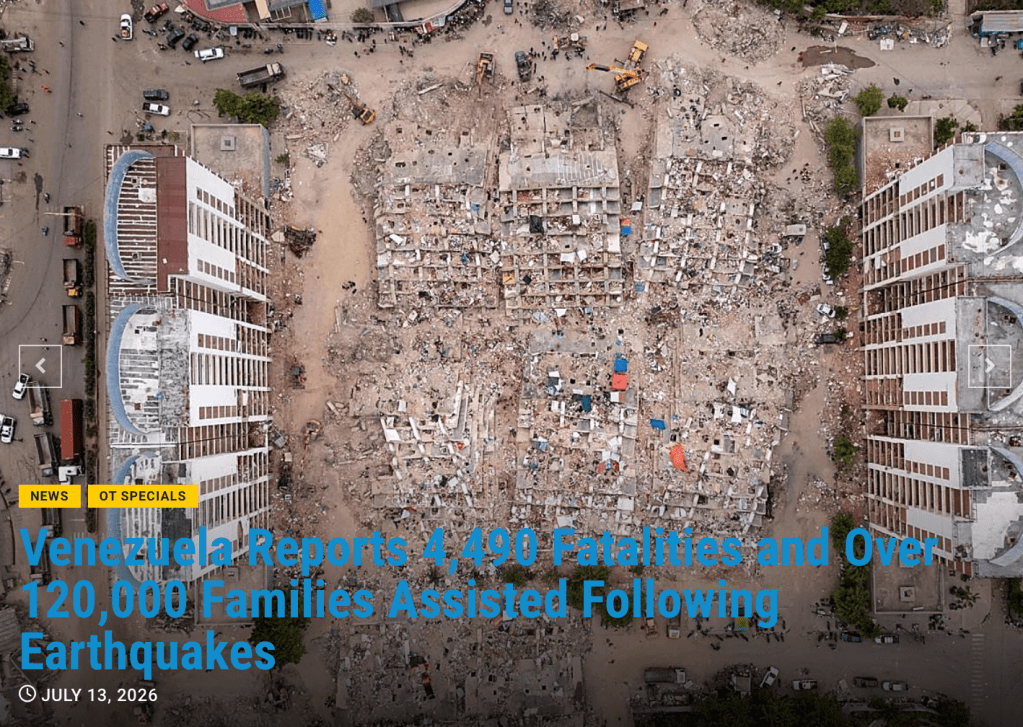
The disaster has slipped from Global North headlines. As of Wednesday, July 15, the official death toll had risen to 4,829 (up from the number shown in the above graphic). The number of reported injuries remained stable at 16,740. (Image: Orinoco Tribune, July 13)

If you travel to Venezuela by air, odds are you arrive in La Guaira at the Simón Bolívar International Airport (often called Maiquetia for a nearby community). Caracas, the capital, is a 25-km drive south and high up into the mountains.

On two of my trips to Venezuela, I observed elections in Caracas and La Guaira. In 2004, an opposition attempt to remove then-President Hugo Chávez proceeded through a revocatory referendum. An election in 2018 (boycotted by part of the opposition) returned President Nicolás Maduro to office. (I wrote about the latter experience in a series of articles for rabble.ca.) 

The day before the 2018 vote, we spent an afternoon visiting communities in La Guaira, including a new social housing project, “Urbanización Hugo Chávez,” located in Catia La Mar just beyond the west end of the airport.

In the wake of the earthquakes, it feels like every building in Guaira has become a point of contention in Venezuela’s polarization. While the government says only five per cent of the damaged buildings are newly built housing, this natural disaster is politicized: something known to happen elsewhere, as in the current wildfire season in Canada. 

But whether you are looking at a pancaked high-rise or a home dislodged from its foundation in a social housing project, people needed to be rescued and survivors still need support.

Economic and social context

To understand what happened in the immediate aftermath of the earthquake, “it’s necessary to place the place the tragedy in its economic and social context,” wrote La Jornada’s Ángel González from Caracas. 

“Venezuela has spent years with a public health system that has not been able to reach optimal conditions after 11 years under U.S. sanctions. That led to a reduction of more than 90 per cent in the budget for public health and education (with 80 per cent of the overall budget allocated to social welfare programs).” Moreover, sanctions prevented the government from buying parts for heavy equipment or new machinery needed for an emergency such as this.

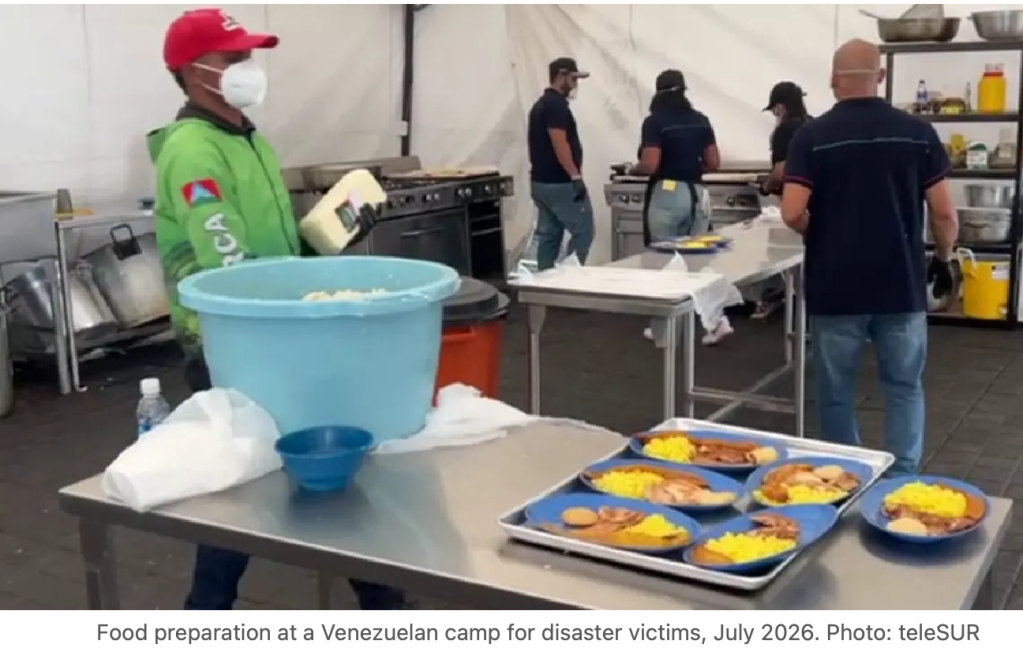
Even so, within a few days, added González, the situation in La Guaira had begun to be addressed with field hospitals set up by the Venezuelan army and international brigades. Two weeks later, temporary shelters with services for more than 22,000 people were in place. About 18,000 people are left without a home.

Acting President Delcy Rodríguez announced July 8 that her government was already working with experts to identify appropriate areas to “build new earthquake-resistant homes and cities.” She added that local and international companies had also been called up “for the rapid and aggressive construction of housing.” That will take time. And money.

And here again, politics enter in. While rescue missions and immediate relief efforts shift to longer-term support and re-building, U.S., Canadian and European sanctions must be eased and Venezuelan assets held abroad must be unblocked.

I have witnessed the humanitarian consequences of sanctions that are misused in cruel attempts to induce regime change in Venezuela, Cuba and other countries, and so have searched almost in vain for news articles that mention sanctions. One exception is an AP News item July 9 that covered the president’s housing announcement. Rodríguez said she had “decided to send a letter, among others, to the King of England” to request the release of 31 metric tons of Venezuelan gold reserves frozen at the Bank of England due to economic sanctions. The gold, valued at USD $1.2 billion in 2019, is now worth about $4.6 billion.

I’ll share more about the use and misuse of sanctions in Venezuela and elsewhere in another post in days ahead.

Meanwhile, you might like to read this op-ed by Mark Weisbrot published in the Los Angeles Times and on the site of the Center for Economic Policy and Research. Sanctions, he writes, “target and punish the civilian population in pursuit of a political goal. Once relatively rare, they have become a ‘tool of first resort, according to the US Treasury — probably because the resulting fatalities are mostly unseen.”

And, to my surprise, there is a relatively good piece in The New York Times about U.S. Secretary of State Marco Rubio acting as Venezuela’s de facto viceroy. I think this link will take you past the paywall to the article.